
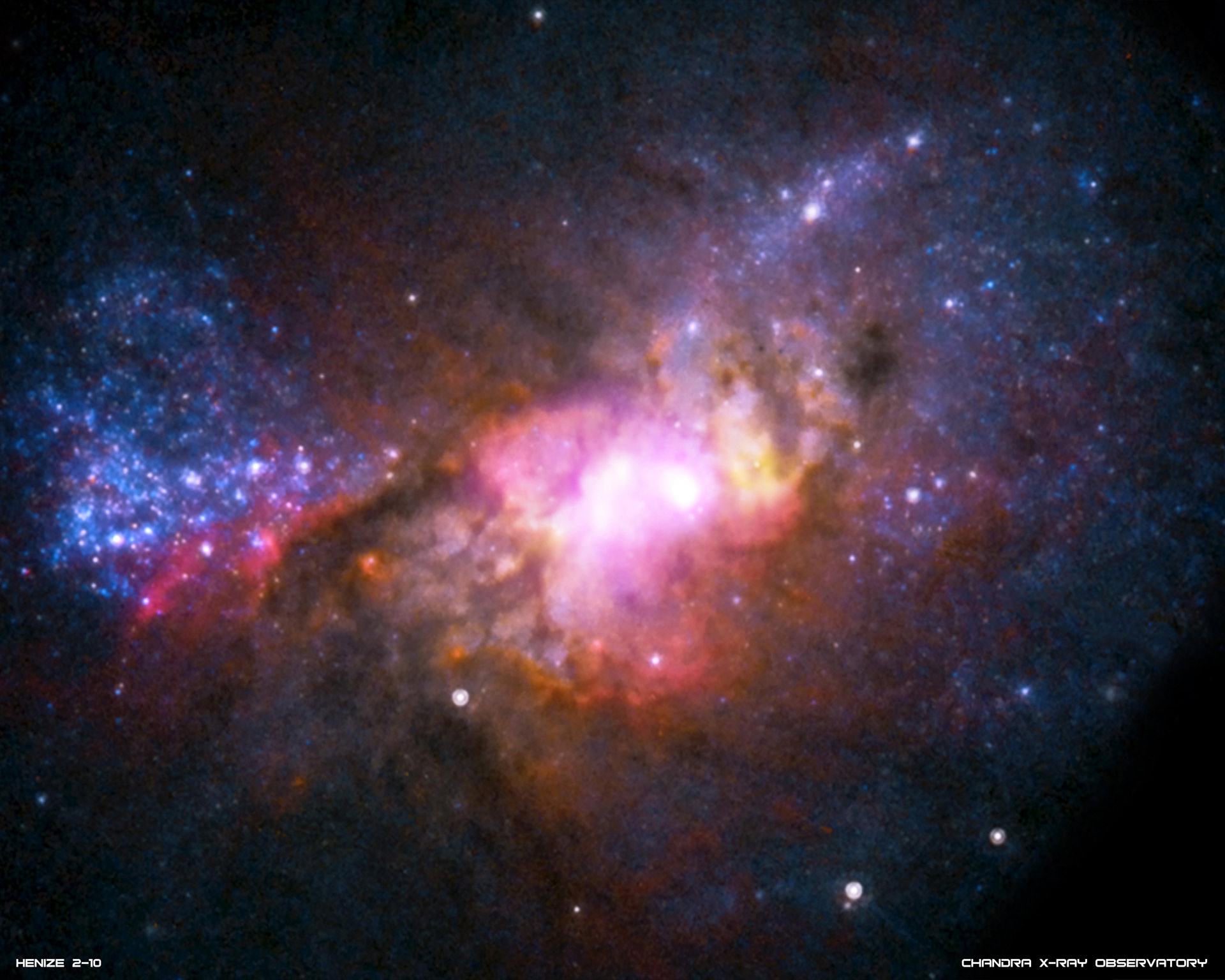
New research shows that a supermassive black hole exists in a place where it isn’t supposed to be, opening a new door to understanding what things were like as the universe evolved and grew in the depths of time.
Supermassive black holes, the mysterious monsters that sit at the center of galaxies—the Milky Way included—were first discovered in the 1960s. They feed on matter and energy that disappear into their inky blackness, never to be seen again.
What are they? Why are they there? Why do they behave so threateningly? What can we learn from them about the evolution of the universe? Scientists such as Dartmouth astrophysicist Ryan Hickox and Thomas Whalen ’14 are seeking answers to these questions.
Hickox, Whalen, and their colleagues have now proven that a supermassive black hole exists in a place where it isn’t supposed to be. In doing so they have opened a new door to understanding what things were like as the universe evolved and grew in the depths of time.
Henize 2-10 is a small, irregular galaxy that is nearby in astronomical terms—30 million light-years, 12 times farther away than our nearest neighboring galaxy, Andromeda.
“Henize is a dwarf starburst galaxy—a small galaxy with regions of very rapid star formation—about 10 percent of the size of our own Milky Way,” says Ryan Hickox, an assistant professor in the Department of Physics and Astronomy. “If you look at it, it’s a blob, but it surprisingly harbors a central black hole.”
The Origin of Black Holes
A big question that scientists pursue is where black holes come from. “When people try to simulate where the galaxies come from, you have to put in these black holes at the beginning, but we don’t really know what the conditions were. These dwarf starburst galaxies are the closest analogs we have, in the universe around us now, to the first galaxies early in the universe,” says Whalen.
Hickox says that there may be similar small galaxies in the known universe, but this is one of the only ones close enough to allow detailed study.
Whalen, Hickox, and a team of other researchers analyzed a series of four X-ray observations of Henize 2-10 using three space telescopes over 13 years, providing conclusive evidence of the existence of a black hole. Their findings appear online and will soon be published in The Astrophysical Journal Letters (AJL).
Suspicions that Henize 2-10 might harbor a black hole arose in 2011 when another team, which included some of their AJL co-authors, first looked at galaxy Henize 2-10 and tried to explain its behavior. The observed dual emissions of X-ray and radio waves, often associated with a black hole, gave credence to the presence of one.
The orbital instruments utilized were Japan’s Advanced Satellite for Cosmology and Astrophysics (1997), the European Space Agency’s XMM-Newton (2004, 2011), and NASA’s Chandra X-ray Observatory in Massachetts (2001).
“The galaxy was bright in 2001 but it has gotten less bright over time,” says Hickox. “This is not consistent with being powered only by star formation processes, so it almost certainly had to have a small supermassive black hole—small compared to the largest supermassive black holes in massive elliptical galaxies, but is still a million times the mass of the sun.”
A characteristic of supermassive black holes is that they do change with time—not a huge amount, explains Hickox, “and that is exactly what Tom Whalen found,” he says. “This variability definitely tells us that the emission is coming from a compact source at the center of this system, consistent with it being a supermassive black hole.”
While supermassive black holes are typically found in the central bulges of galaxies, Henize 2-10 has no bulge. “All the associations that people have made between galaxies and black holes tell us there ought to be no black hole in this system,” says Whalen, but the team has proven otherwise. Whalen is a member of the Chandra X-ray Center team at the Harvard-Smithsonian Center for Astrophysics in Cambridge, Mass.
In their paper, the authors conclude, “Our results confirm that nearby star-forming galaxies can indeed form massive black holes and that by implication so can their primordial counterparts.”
“Studying those to get some sense of what might have happened very early in the universe is very powerful,” says Hickox.
Reference: “Variable Hard X-ray Emission from the Candidate Accreting Black Hole in Dwarf Galaxy Henize 2-10” by Thomas J. Whalen (Dartmouth, CfA), Ryan C. Hickox, Amy E. Reines, Jenny E. Greene, Gregory R. Sivakoff, Kelsey E. Johnson, David M. Alexander and Andy D. Goulding, 5 June 2015, The Astrophysical Journal.
DOI: 10.1088/0004-637X/806/1/37
arXiv: 1504.03331
Never miss a breakthrough: Join the SciTechDaily newsletter.
Follow us on Google and Google News.
1 Comment
Understanding black holes is simple. Black holes are very massive and dense objects, so dense in fact that their gravitational pull is so strong that light can’t escape. The gravitational pull is so strong that the escape velocity is beyond C. How are they made is easier to grasp than trying to figure out how galaxies make them. Actually galaxies don’t make black holes, black holes make galaxies. Do planets make suns? No, suns make planets. Solar systems are formed when planet making material from an exploded star is attracted by another star. That is how all heavenly bodies are formed. All matter in the universe is traveling through space at great speed. When this matter is whizzing by a great gravitational force, it gets pulled toward that mass. Depending on the mass of the matter determines if it goes into orbit, gets pulled in and consumed or merely has it’s course changed. When this large mass has enough matter in orbit around it, voila, a galaxy is born. Gather enough matter and you get huge galaxies. As matter spirals into the center the black hole grows, as it grows it’s gravity increases which causes more orbiting matter to be drawn in. Eventually you may have this extremely large super massive black inside a smaller galaxy.