
Close Menu
    Facebook X (Twitter) Instagram
    SciTechDaily
    • Biology
    • Chemistry
    • Earth
    • Health
    • Physics
    • Science
    • Space
    • Technology
    Facebook X (Twitter) Pinterest YouTube RSS
    SciTechDaily
    Home»Space»Nearby Star Is at Least 13.2 Billion Years Old
    Space

    Nearby Star Is at Least 13.2 Billion Years Old

    By SciTechDailyJanuary 11, 2013No Comments2 Mins Read
    Facebook Twitter Pinterest Telegram LinkedIn WhatsApp Email Reddit
    Share
    Facebook Twitter LinkedIn Pinterest Telegram Email Reddit
    Sun Like Star Space Illustration
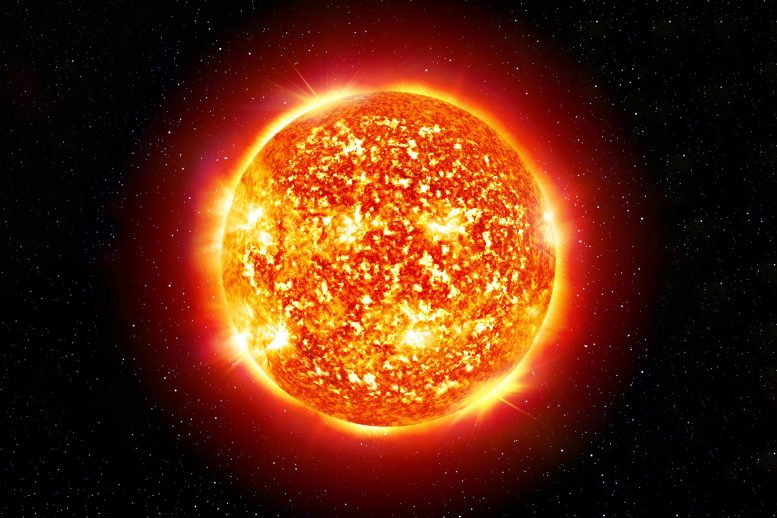
    The oldest known stars (one seen here in artist’s impression) date back at least 13.2 billion years.

    Astronomers have discovered one of the oldest stars in the known universe. They believe it is at least 13.2 billion years old and formed shortly after the Big Bang.

    The astronomers announced their findings at the January 10th meeting of the American Astronomical Society in Long Beach, California. Howard Bond of Pennsylvania State University in University Park states that they believe that this star is the oldest known in the universe with a well-determined age.

    HD 140283 lies only 186 light-years from our Solar System and has been studied for more than a century by astronomers. Researchers have long known that the star consists almost entirely of hydrogen and helium, indicating that it was formed in the early history of the universe. Successive generations of stars have had a chance to forge heavier elements.

    In order to determine the star’s age, the scientists had to accurately determine its distance by using 11 sets of observations recorded between 2003 and 2011 by the Hubble Space Telescope. They were then able to calculate the star’s intrinsic luminosity with good precision. The team exploited the fact that HD 140283 has advanced to a phase where it’s exhausting the hydrogen at its stellar core. Stars at this phase will slowly start dimming in luminosity and that is a highly sensitive indicator of its age. The team calculated that the star is about 13.9 billion years old, +/- 700 million years. Within the error bracket, its age doesn’t conflict with the age of the universe that is 13.77 billion years.

    The first stars coalesced from primordial gas, which didn’t contain any elements heavier than helium. Since HD 140283’s chemical composition contains a low but nonzero abundance of heavy elements, it must have formed after the first stellar generation.

    Reference: Bond, H. E., Nelan, E., VandenBerg, D. A., Schaefer, G. H. & Harmer, D. Abstr. 443.08 221st meeting of the American Astronomical Society, Long Beach, California (2013).

    Never miss a breakthrough: Join the SciTechDaily newsletter.
    Follow us on Google and Google News.

    Astronomy Galaxy Evolution Stellar Evolution
    Share. Facebook Twitter Pinterest LinkedIn Email Reddit

    Related Articles

    ALMA Reveals the Mystery of Missing Massive Galaxies

    Evidence That Local Starbursts Impact the Bulk of the Gas Around Their Host Galaxy

    One of the Most Efficient Star Making Galaxies Ever Observed

    Seeing Galaxy HDF850.1 As it Was 12.5 Billion Years Ago

    Patterns of Light Appear to be From the First Stars and Galaxies

    Galaxies are Hiding More Atomic Hydrogen Gas than Previously Calculated

    Using Infrared Images from Hubble & Spitzer, Scientists Discover 25 Distant Galaxies

    New Model May Rule Out the Presence of Dark Matter

    Researchers find Evidence that Dwarf Galaxy NGC 4449 is Swallowing Smaller Companion

    Leave A Reply Cancel Reply

    • Facebook
    • Twitter
    • Pinterest
    • YouTube

    Don't Miss a Discovery

    Subscribe for the Latest in Science & Tech!

    Trending News

    Scientists Uncover Promising New Strategy To Stop Parkinson’s in Its Tracks

    Experts Reveal the Surprising Cancer Link Behind a Common Vitamin

    This Strange “Golden Orb” Found 2 Miles Deep Stumped Scientists for Years

    Giant “Last Titan” Dinosaur Discovered in Thailand Was Bigger Than 9 Elephants

    This “Longevity Gene” May Protect the Brain From Aging and Dementia

    Common Cleaning Chemical Could Triple Your Risk of a Dangerous Liver Disease

    Scientists Discover Bizarre 100-Million-Year-Old Insect With Giant Claws

    Scientists Discover “Good” Gut Microbes That Could Protect Against Autism and ADHD

    Follow SciTechDaily
    • Facebook
    • Twitter
    • YouTube
    • Pinterest
    • Newsletter
    • RSS
    SciTech News
    • Biology News
    • Chemistry News
    • Earth News
    • Health News
    • Physics News
    • Science News
    • Space News
    • Technology News
    Recent Posts
    • Scientists Warn Many Insects May Not Survive a Warming World
    • Hektoria Glacier Collapse Reveals How Fast Antarctica Can Fall Apart
    • Hidden Earthquake Threat: Oregon’s Fault May Be Closer to the Surface Than Scientists Thought
    • Scientists Use Smartwatch Data To Track the Hidden Health Effects of Air Pollution
    • The Human Body Isn’t Perfect – It Was Improvised by Evolution
    Copyright © 1998 - 2026 SciTechDaily. All Rights Reserved.
    • Science News
    • About
    • Contact
    • Editorial Board
    • Privacy Policy
    • Terms of Use

    Type above and press Enter to search. Press Esc to cancel.