

An Indian Otter found at Hammerschmiede: Neptune’s Vishnu otter arrived 11.4 million years ago from Southeast Asia.
Researchers from the Universities of Tübingen and Zaragoza have discovered a previously unknown species of otter from 11.4-million-year-old strata at the Hammerschmiede fossil site.
The excavation site in the Allgäu region of Germany became world-renowned in 2019 for discoveries of the bipedal ape Danuvius guggenmosi. The new species, published today in the Journal of Vertebrate Palaeontology, was named Vishnuonyx neptuni, meaning Neptune’s Vishnu otter. The Vishnu otter genus was previously known only from Asia and Africa.
The research team is conducting excavations at the Hammerschmiede under the direction of Professor Madelaine Böhme from the Senckenberg Centre for Human Evolution and Palaeoenvironment at the University of Tübingen. It has already recovered more than 130 different species of extinct vertebrates from river deposits attributed to the Ancient Guenz. Many of these species are adapted to life in and around water. However, the detection of a Vishnu otter in Bavaria was unexpected, since representatives of this genus had previously only been known from regions outside Europe.
Dispersal of the Vishnu Otters
One in six species of today’s predatory mammals lives aquatically, either in the oceans, such as seals, or in freshwater, such as otters. The evolutionary history of the 13 otter species that occur today is still comparatively unexplored. Vishnu otters (Vishnuonyx) are mid-sized predators with a weight of ten to 15 kilograms (22 to 33 pounds) that were first discovered in sediments in the foothills of the Himalayas. They lived 14 to 12.5 million years ago in the major rivers of Southern Asia.
Recent finds showed that Vishnu otters reached East Africa about 12 million years ago. The discovery in the now 11.4-million-year-old layers of the Hammerschmiede is the first evidence that they also occurred in Europe – possibly spreading from India throughout the entire Old World. Like all otters, the Vishnu otter depends on water; it cannot travel long distances over land. Its enormous dispersal of more than 6,000 kilometers (3,700 miles) across three continents was made possible by the geographic situation 12 million years ago: newly formed mountain ranges from the Alps in the west to the Iranian Elbrus Mountains in the east separated a large ocean basin from the Tethys Ocean, the forerunner of the Mediterranean and the Indian Ocean.
This created the Paratethys, a vast Eurasian body of water that extended from Vienna to beyond today’s Aral Sea in Kazakhstan. Twelve million years ago, it had only a narrow connection to the Indian Ocean, the so-called Araks Strait in the area of modern-day Armenia. The researchers assume that Neptune’s Vishnu otter followed this connection to the west and reached southern Germany, the Ancient Guenz, and the Hammerschmiede via the emerging delta of the Ancient Danube to the west of what is now the city of Vienna.
The Fish Predator’s Teeth
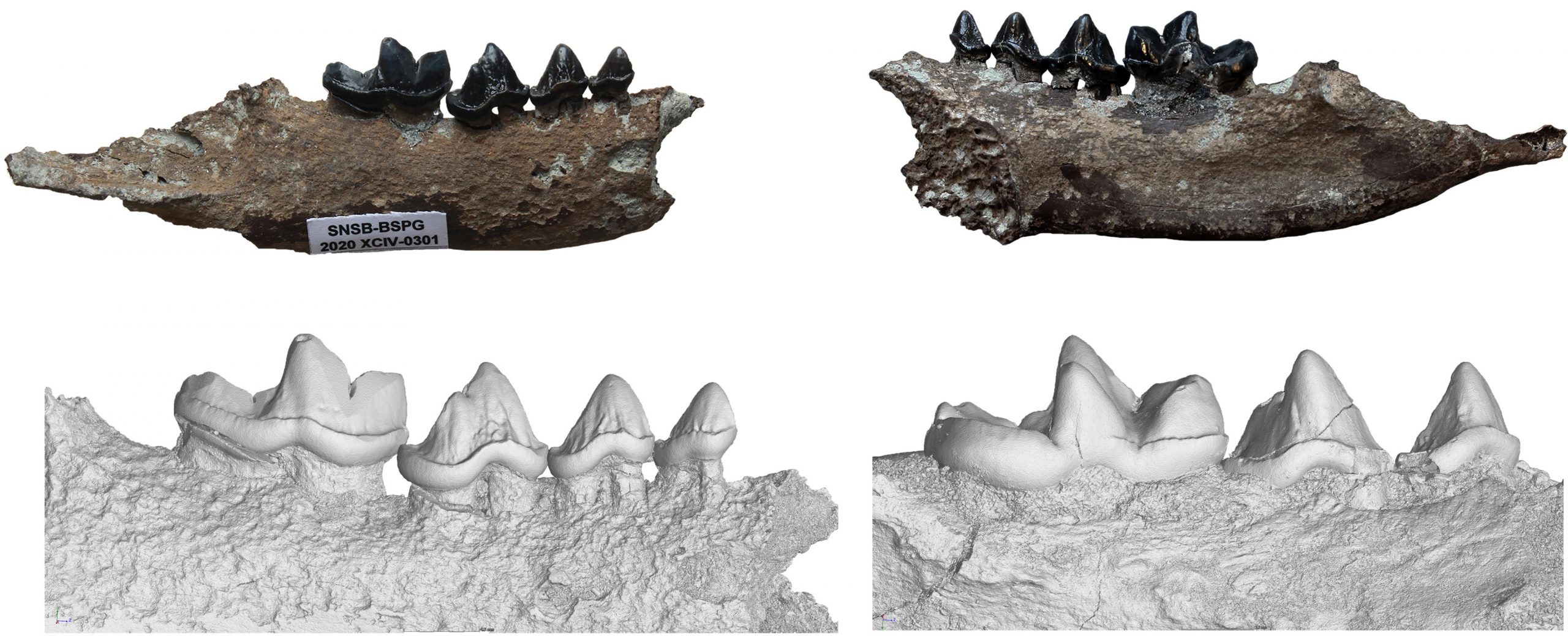
At the recently founded Center for Visualization, Digitization, and Replication in the Department of Geosciences at the University of Tübingen, researchers used computer-tomographic methods to visualize the finest details in the fossils’ tooth structure. This technique allowed the precise observation of very small structures in the otter’s dentition. The pointed cusps, cutting blades, and restricted grinding areas suggest a diet based primarily on fish. Ecologically, Neptune’s Vishnu otter is thus more similar to the Eurasian otter than to the Pacific sea otter or the African and Asian clawless otters – both groups prefer crustaceans or shellfish over fish in their diet.
Reference: “New early Late Miocene species of Vishnuonyx (Carnivora, Lutrinae) from the hominid locality of Hammerschmiede, Bavaria, Germany” by Nikolaos Kargopoulos, Alberto Valenciano, Panagiotis Kampouridis, Thomas Lechner and Madelaine Böhme, 16 September 2021, Journal of Vertebrate Paleontology.
DOI: 10.1080/02724634.2021.1948858
Never miss a breakthrough: Join the SciTechDaily newsletter.
Follow us on Google and Google News.