
Close Menu
    Facebook X (Twitter) Instagram
    SciTechDaily
    • Biology
    • Chemistry
    • Earth
    • Health
    • Physics
    • Science
    • Space
    • Technology
    Facebook X (Twitter) Pinterest YouTube RSS
    SciTechDaily
    Home»Chemistry»New Algorithm Reveals the Secret Chemistry Behind Cheaper, Cleaner Propylene
    Chemistry

    New Algorithm Reveals the Secret Chemistry Behind Cheaper, Cleaner Propylene

    By Luke Auburn, University of RochesterNovember 30, 20251 Comment3 Mins Read
    Facebook Twitter Pinterest Telegram LinkedIn WhatsApp Email Reddit
    Share
    Facebook Twitter LinkedIn Pinterest Telegram Email Reddit
    From Propylene to Products Siddharth Deshpande and Snehitha Srirangam
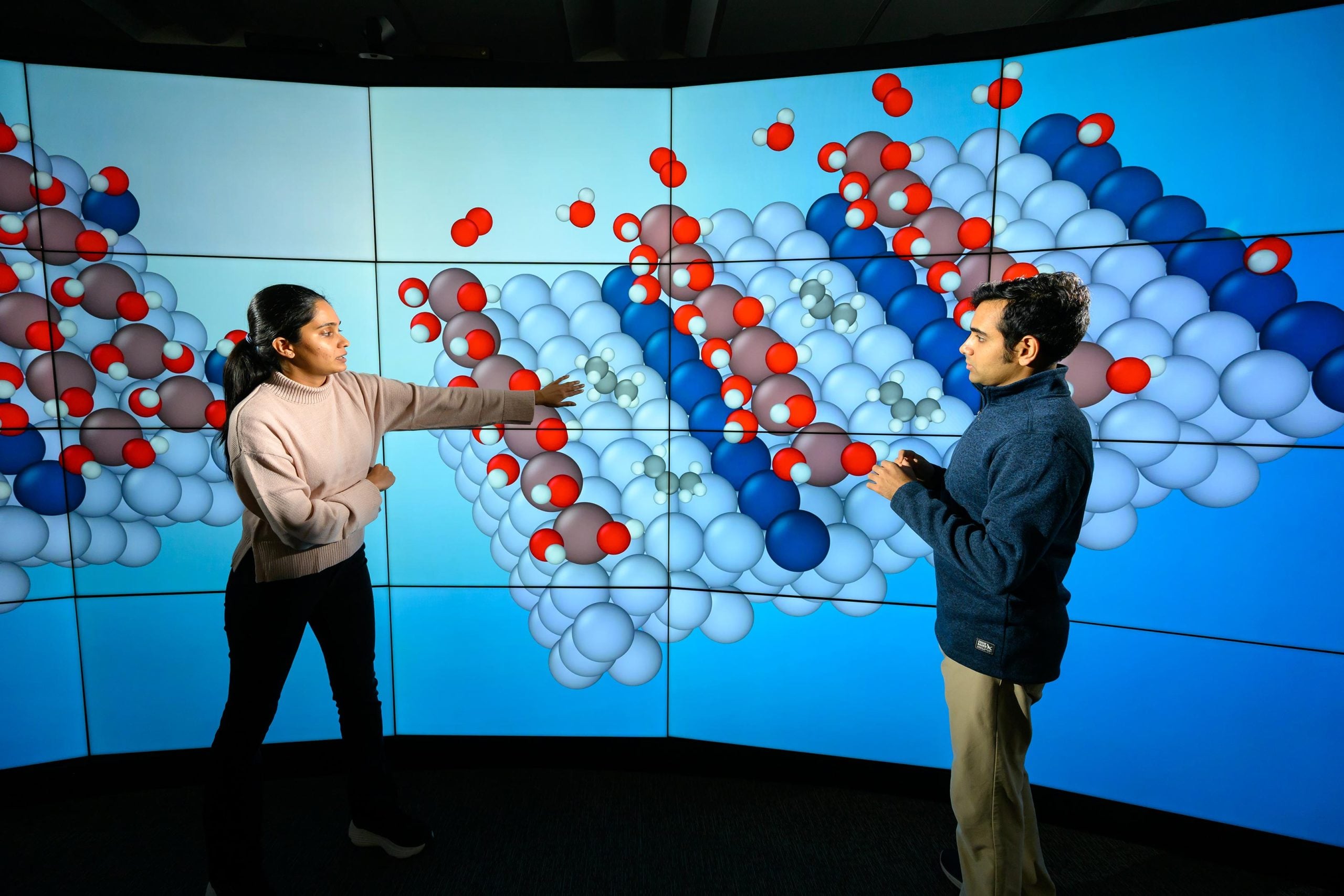
    Assistant Professor Siddharth Deshpande and PhD student Snehitha Srirangam use data visualizations to reveal what happens on an atomic level when catalysts convert shale gas into polypropylene. The new algorithms they developed could lead to more efficient ways to create everyday products. Credit: University of Rochester photo / J. Adam Fenster

    Scientists have mapped the atomic interactions that make nanoscale catalysts so effective at converting propane into propylene.

    The discovery highlights a stabilizing oxide pattern that could guide improved industrial production methods.

    Propane’s Transformation Into Propylene

    Many everyday goods, including plastic squeeze bottles and outdoor furniture, depend on a chemical process that converts propane into propylene. A 2021 report in Science showed that chemists could use tandem nanoscale catalysts to merge several stages of this conversion into a single reaction—a method that raises efficiency and reduces costs for manufacturers. However, the precise atomic activity behind this combined process was still unknown, which made it difficult to extend the method to other major industrial reactions.

    Algorithms Uncover Atomic-Level Details

    Scientists at the University of Rochester created algorithms that highlight the atomic-scale features guiding the reaction when nanoscale catalysts convert propane into propylene. Their findings, published in the Journal of the American Chemical Society, describe the complex interplay of materials that shift between multiple states during the reaction.

    “There are so many different possibilities of what’s happening at the catalytic active sites, so we need an algorithmic approach to very easily yet logically screen through the large amount of possibilities that exist and focus on the most important ones,” says Siddharth Deshpande, an assistant professor in the Department of Chemical and Sustainability Engineering. “We refined our algorithms and used them to do a very detailed analysis of the metallic phase and oxide phase driving this very complex reaction.”

    Oxide Behavior and Catalyst Stability

    During their investigation, Deshpande and chemical engineering PhD student Snehitha Srirangam uncovered unexpected patterns. They observed that the oxide in the reaction tended to form around defective metal sites in a highly selective way, a feature that played a crucial role in keeping the catalyst stable.

    Even though the oxide can appear in several chemical compositions, it consistently remained positioned around those defective metal sites.

    Expanding the Approach to Other Industrial Reactions

    Deshpande says this deeper understanding, along with the team’s algorithmic tools, can help scientists examine the atomic structures of other important reactions, including methanol synthesis that supports products ranging from paints to fuel cells. He believes that over time, this knowledge could guide companies toward more efficient strategies for producing propylene and other industrial chemicals so they can move away from the trial-and-error methods commonly used today.

    “Our approach is very general and can open the doors to understand many of these processes that have remained an enigma for decades,” says Deshpande. “We know these processes work, and we produce tons of these chemicals, but we have much to learn about why exactly they’re working.”

    Reference: “Site-Selective Oxide Rearrangement in a Tandem Metal–Metal Oxide Catalyst Improves Selectivity in Oxidative Dehydrogenation of Propane” by Snehitha Srirangam and Siddharth Deshpande, 28 October 2025, Journal of the American Chemical Society.
    DOI: 10.1021/jacs.5c13571

    Never miss a breakthrough: Join the SciTechDaily newsletter.
    Follow us on Google and Google News.

    Catalysts Chemical Engineering Nanotechnology University of Rochester
    Share. Facebook Twitter Pinterest LinkedIn Email Reddit

    Related Articles

    Scientists Found a Platinum Alternative Hiding in Plain Sight

    “Swiss Army Knife” Nanoparticle Catalyst Can Make Natural Gas Burn Cleaner

    Researchers Discover Nanoscale Catalyst to Efficiently Convert CO2 Into Ethylene

    New Nanoparticle Catalysts Improve Reactivity with Much Less Platinum

    Another Step Toward Lower Cost Alkaline Fuel Cells

    Cobalt-Graphene Catalyst Performs Nearly As Well as Platinum

    Scientists Examine Platinum-Based Catalyst Design

    Zeolite Catalyst Creates P-Xylene From Biomass

    Gold Improves the Performance of Nanoparticle Fuel-Cell Reactions

    1 Comment

    1. rob on December 1, 2025 6:41 am

      We need more plastic rubbish like we need a hole in out bowel.

      Reply
    Leave A Reply Cancel Reply

    • Facebook
    • Twitter
    • Pinterest
    • YouTube

    Don't Miss a Discovery

    Subscribe for the Latest in Science & Tech!

    Trending News

    Scientists Discover 132-Million-Year-Old Dinosaur Tracks on South Africa’s Coast

    Scientists Uncover the Secret Ingredient Behind the Spark That May Have Started Life on Earth

    Physicists Observe Matter in Two Places at Once in Mind-Bending Quantum Experiment

    Stanford Scientists Discover Hidden Brain Circuit That Fuels Chronic Pain

    New Study Reveals Why Ozempic Works Better for Some People Than Others

    Climate Change Is Altering a Key Greenhouse Gas in a Way Scientists Didn’t Expect

    New Study Suggests Gravitational Waves May Have Created Dark Matter

    Scientists Discover Why the Brain Gets Stuck in Schizophrenia

    Follow SciTechDaily
    • Facebook
    • Twitter
    • YouTube
    • Pinterest
    • Newsletter
    • RSS
    SciTech News
    • Biology News
    • Chemistry News
    • Earth News
    • Health News
    • Physics News
    • Science News
    • Space News
    • Technology News
    Recent Posts
    • 320 Light-Years Away, a Planet Confirms a Fundamental Cosmic Assumption
    • Astronomers Solve Decades-Long Mystery About Saturn’s Spin – “Something Strange Was Happening”
    • Scientists Uncover Strange New State of Matter Inside Uranus and Neptune
    • The Crown Jewel of Dentistry? Breakthrough Tech Could Transform Tooth Repair
    • The Surprising Non-Medical Factor That Determines Cancer Survival
    Copyright © 1998 - 2026 SciTechDaily. All Rights Reserved.
    • Science News
    • About
    • Contact
    • Editorial Board
    • Privacy Policy
    • Terms of Use

    Type above and press Enter to search. Press Esc to cancel.