
Close Menu
    Facebook X (Twitter) Instagram
    SciTechDaily
    • Biology
    • Chemistry
    • Earth
    • Health
    • Physics
    • Science
    • Space
    • Technology
    Facebook X (Twitter) Pinterest YouTube RSS
    SciTechDaily
    Home»Space»New ALMA Image of LL Pegasi and Its Companion
    Space

    New ALMA Image of LL Pegasi and Its Companion

    By SciTechDailyMarch 6, 20172 Comments2 Mins Read
    Facebook Twitter Pinterest Telegram LinkedIn WhatsApp Email Reddit
    Share
    Facebook Twitter LinkedIn Pinterest Telegram Email Reddit
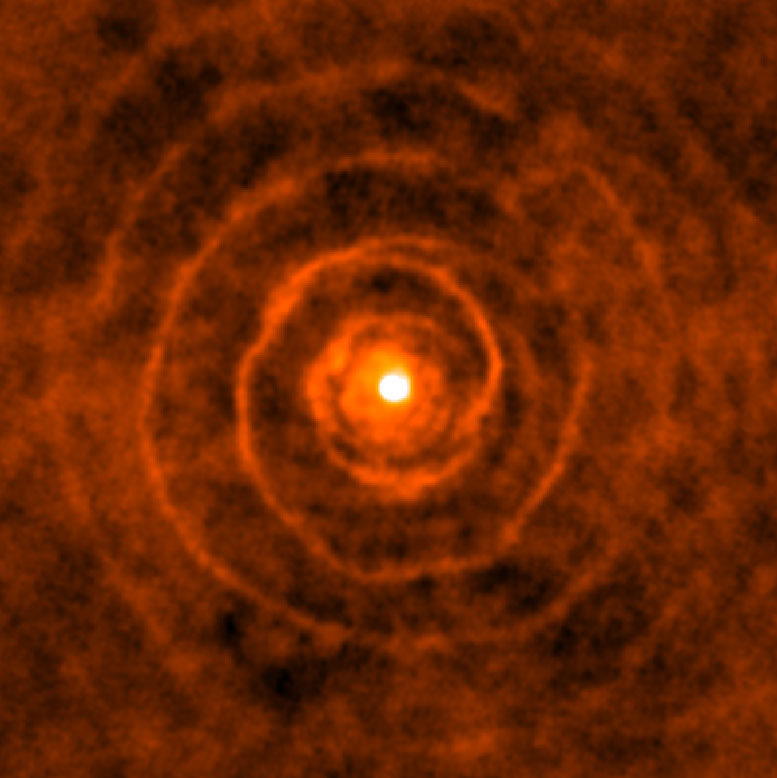
    ALMA Views LL Pegasi and Its Companion
    The binary star system of LL Pegasi and its companion. Credit: ALMA (ESO/NAOJ/NRAO)/H. Kim et al.

    This ALMA image of the week shows the binary star system of LL Pegasi and its companion.

    Although it looks like the pattern of a shell on the beach, this intriguing spiral is in fact astronomical in nature. The Atacama Large Millimeter/submillimeter Array (ALMA) captured this remarkable image of a binary star system, where two stars — LL Pegasi and its companion — are locked in a stellar waltz, orbiting around their common center of gravity. The old star LL Pegasi is continuously losing gaseous material as it evolves into a planetary nebula, and the distinct spiral shape is the imprint made by the stars orbiting in this gas.

    The spiral spans light-years and winds around with extraordinary regularity. Based on the expansion rate of the spiraling gas, astronomers estimate that a new “layer” appears every 800 years — approximately the same time it takes for the two stars to complete one orbit around each other.
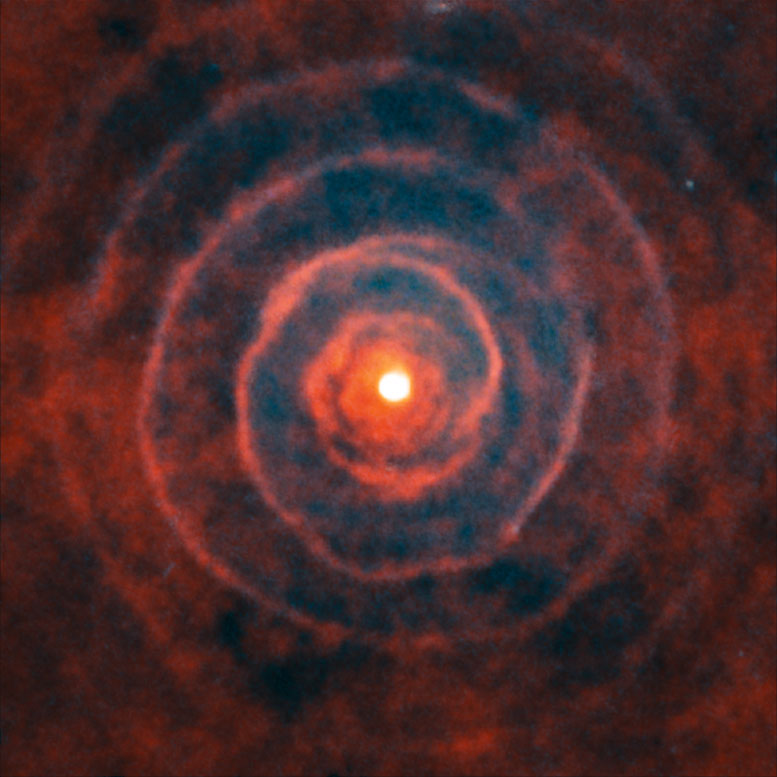
    ALMA and Hubble Observe LL Pegasi
    This image is a composite of images made with the NASA/ESA Hubble Space Telescope and the Atacama Large Millimeter/submillimeter Array (ALMA), both observing the binary star system LL Pegasi. The old star LL Pegasi is continuously losing gaseous material as it evolves into a planetary nebula, and the distinct spiral shape is the imprint made by the stars orbiting in this gas. Credit: ALMA (ESO/NAOJ/NRAO)/H. Kim et al.

    LL Pegasi was first highlighted about 10 years ago when the NASA/ESA Hubble Space Telescope obtained a picture of the almost-perfect spiral structure. This was the first time a spiral pattern had been found in the material surrounding an old star. Now, ALMA’s observations, of which this image only shows one “cross-section”, have added an extra dimension to reveal the exquisitely-ordered 3D geometry of the spiral pattern. A full view of the 3D video can be seen in this video.


    This video shows the observed structure surrounding the binary star system LL Pegasi, as seen by the Atacama Large Millimeter/submillimeter Array (ALMA). ALMA’s observations were able to reveal the exquisitely-ordered 3D geometry of the spiral pattern (seen to the left). The observations match almost perfectly with the predicted theoretical model (to the right).

    Never miss a breakthrough: Join the SciTechDaily newsletter.
    Follow us on Google and Google News.

    ALMA Astronomy Hubble Space Telescope
    Share. Facebook Twitter Pinterest LinkedIn Email Reddit

    Related Articles

    Webb Telescope Exposes the Turbulent Secrets of HH 30

    Running on Empty: Astronomers Solve 12-Billion-Year-Old Mystery of Stalled Galaxies

    Astronomers Catch Wind Rushing Out of Galaxy for the First Time [Video]

    Observations of Massive Galaxies in the Early Universe Reveal Rare Dark-Matter Haloes

    Most Distant Galaxy Ever Observed by ALMA Sheds Light on the First Stars

    ESO Image of the Week – Dawn of a New Era for Supernova 1987A

    3D Model Lets Astronomers Explore Supernova 1987a Like Never Before

    Astronomers Explore the Hubble Ultra Deep Field

    Astronomers Observe Trio of Young Galaxies Merging Near ‘Cosmic Dawn’

    2 Comments

    1. Valeriy on March 6, 2017 2:14 pm

      Star formation is one of the least comprehended phenomenon in astrophysics. Is there a general theory of star formation? No, there is not. There is a number of models based on computer simulations which include supersonic hydrodynamics with non-ideal MHD turbulence influenced by gravity. They include the line and continuum radiative processes of the energy transfer; a number of chemical processes with dissociation, recombination and ionization, with uncertain nomenclature of atoms and molecules, unknown magnetic fields and formation and destruction of dust particles. In addition there is macrophysics that is an environment in the molecular clouds, clumps and cores; inclusion in the multiple systems, collisions among stellar systems; jets and outflows; radiation pressure.

      Reply
    2. Madanagopal.V.C. on March 13, 2017 3:12 am

      Most stars in this universe is binary and tertiary in formation. Even our own Solar system can be considered to be the result of tertiary stars or more in formation if we can conclude that our giants like Jupiter , Saturn and Uranus as failed stars. Thank You.

      Reply
    Leave A Reply Cancel Reply

    • Facebook
    • Twitter
    • Pinterest
    • YouTube

    Don't Miss a Discovery

    Subscribe for the Latest in Science & Tech!

    Trending News

    Bone-Strengthening Discovery Could Reverse Osteoporosis

    Scientists Uncover Hidden Trigger Behind Stem Cell Aging

    Scientists Find Way to Reverse Fatty Liver Disease Without Changing Diet

    Could Humans Regrow Limbs? New Study Reveals Promising Genetic Pathway

    Scientists Reveal Eating Fruits and Vegetables May Increase Your Risk of Lung Cancer

    Scientists Reverse Brain Aging With Simple Nasal Spray

    Scientists Uncover Potential Brain Risks of Popular Fish Oil Supplements

    Scientists Discover a Surprising Way To Make Bread Healthier and More Nutritious

    Follow SciTechDaily
    • Facebook
    • Twitter
    • YouTube
    • Pinterest
    • Newsletter
    • RSS
    SciTech News
    • Biology News
    • Chemistry News
    • Earth News
    • Health News
    • Physics News
    • Science News
    • Space News
    • Technology News
    Recent Posts
    • Scientists Discover Massive Magma Reservoir Beneath Tuscany
    • Scientists Create “Neurobots” – Living Machines With Their Own Nervous Systems
    • Europe’s Most Active Volcano Just Got Stranger – Here’s Why Scientists Are Rethinking It
    • Why Are Giant Ants Letting Tiny Ants Crawl All Over Them?
    • Revolutionary Technique Sends Healthy Mitochondria Exactly Where They’re Needed
    Copyright © 1998 - 2026 SciTechDaily. All Rights Reserved.
    • Science News
    • About
    • Contact
    • Editorial Board
    • Privacy Policy
    • Terms of Use

    Type above and press Enter to search. Press Esc to cancel.