
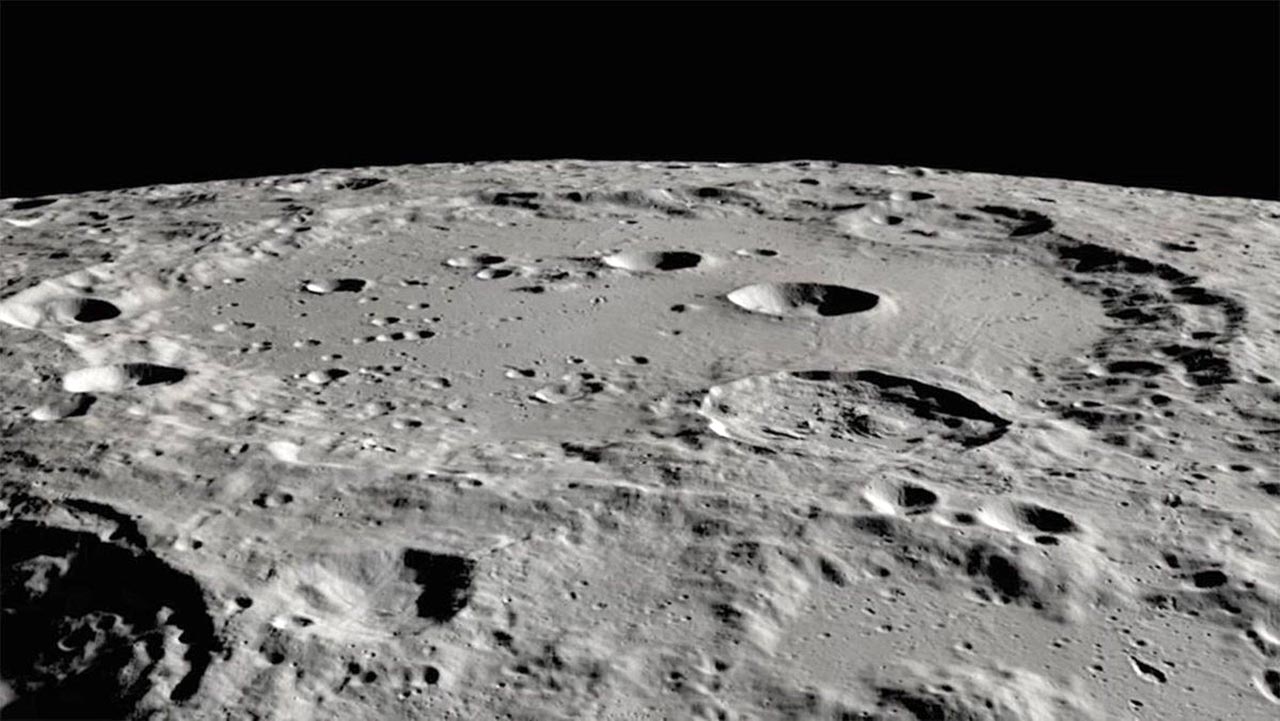
Scientists studying Apollo lunar mission samples uncovered evidence of a dual heritage for lunar water, tracing back to Earth’s formation and later cometary impacts.
Using advanced isotope techniques, they challenged prevailing theories about solar wind origins, setting the stage for sustainable lunar exploration and redefining how water resources can support human habitation.
Analyzing Lunar Water: Groundbreaking Techniques
A research team from Vrije Universiteit Brussel (VUB)analyzed water from nine samples collected during the Apollo lunar missions, employing a high-precision triple oxygen isotope technique. Developed by Dr. Morgan Nunn Martinez at the University of California, San Diego, this method separates water into different binding phases — loosely bound, tightly bound, and trapped within minerals — through stepwise heating at 50°C, 150°C, and 1,000°C.
A Dual Heritage for Lunar Water
The results reveal compelling evidence that lunar water has a dual origin: part of it comes from Earth-like material formed during the planet’s early history, while the rest was delivered by cometary impacts.
“This is a major step forward in unraveling where lunar water comes from,” explained Dr. Maxwell Thiemens of the AMGC research group of the VUB. “Our data suggest that the Moon inherited water tracing back to Earth’s formation, followed by later contributions from comets, delivering the water reservoirs we see today.”
Three Key Findings on Lunar Water Origins
Three key results are central to the report. An early Earth signature: The oxygen isotopic composition closely matches enstatite chondrites, a meteorite type believed to be the building blocks of the Earth. There are also clear signs of cometary contribution: A significant portion of lunar water shows isotopic similarities to comets. A reduced importance of solar wind: the study challenges the prevalent theory that the majority of lunar water was produced in situ via solar interactions with lunar silicates, presenting instead a complex mixing of sources.
Implications for Lunar Bases and Space Exploration
This discovery is timely as nations and private enterprises intensify their efforts to establish permanent lunar bases. Understanding the water’s origins and distribution could have significant implications for sustaining human presence on the Moon.
“The data not only enhance our understanding of the Moon’s past but also pave the way for future space exploration and resource utilization. These findings should redefine how we think about water as a resource for long-term lunar habitation.” Thiemens concludes.
This research has the potential to shape lunar and planetary science for decades to come, offering a deeper connection between Earth’s water-rich environment and the Moon’s arid surface. With Artemis missions on the horizon, this pioneering study provides a crucial foundation for future exploration and resource planning.
Reference: “Triple oxygen isotopes of lunar water unveil indigenous and cometary heritage” by Maxwell M. Thiemens, Morgan H. Nunn Martinez and Mark H. Thiemens, 16 December 2024, Proceedings of the National Academy of Sciences.
DOI: 10.1073/pnas.2321069121
Never miss a breakthrough: Join the SciTechDaily newsletter.
Follow us on Google and Google News.