

Close Menu
    Facebook X (Twitter) Instagram
    SciTechDaily
    • Biology
    • Chemistry
    • Earth
    • Health
    • Physics
    • Science
    • Space
    • Technology
    Facebook X (Twitter) Pinterest YouTube RSS
    SciTechDaily
    Home»Biology»New Antibiotic in Discovered in Tropical Forest – May Leaded to a “Plant Probiotic”
    Biology

    New Antibiotic in Discovered in Tropical Forest – May Leaded to a “Plant Probiotic”

    By Rutgers UniversityOctober 8, 2019No Comments3 Mins Read
    Facebook Twitter Pinterest Telegram LinkedIn WhatsApp Email Reddit
    Share
    Facebook Twitter LinkedIn Pinterest Telegram Email Reddit

    Tropical Forest

    Findings may lead to ‘plant probiotic’ and new antibiotics.

    Scientists from Rutgers University and around the world have discovered an antibiotic produced by a soil bacterium from a Mexican tropical forest that may help lead to a “plant probiotic,” more robust plants and other antibiotics.

    Probiotics, which provide friendlier bacteria and health benefits for humans, can also be beneficial to plants, keeping them healthy and more robust. The new antibiotic, known as phazolicin, prevents harmful bacteria from getting into the root systems of bean plants, according to a Rutgers co-authored study published today (October 8, 2019) in the journal Nature Communications.

    “We hope to show the bacterium can be used as a ‘plant probiotic’ because phazolicin will prevent other, potentially harmful bacteria from growing in the root system of agriculturally important plants,” said senior author Konstantin Severinov, a principal investigator at the Waksman Institute of Microbiology and a professor of molecular biology and biochemistry in the School of Arts and Sciences at Rutgers University-New Brunswick. “Antibiotic resistance is a huge problem in both medicine and agriculture, and continuing searches for new antibiotics are very important as they may provide leads for future anti-bacterial agents.”
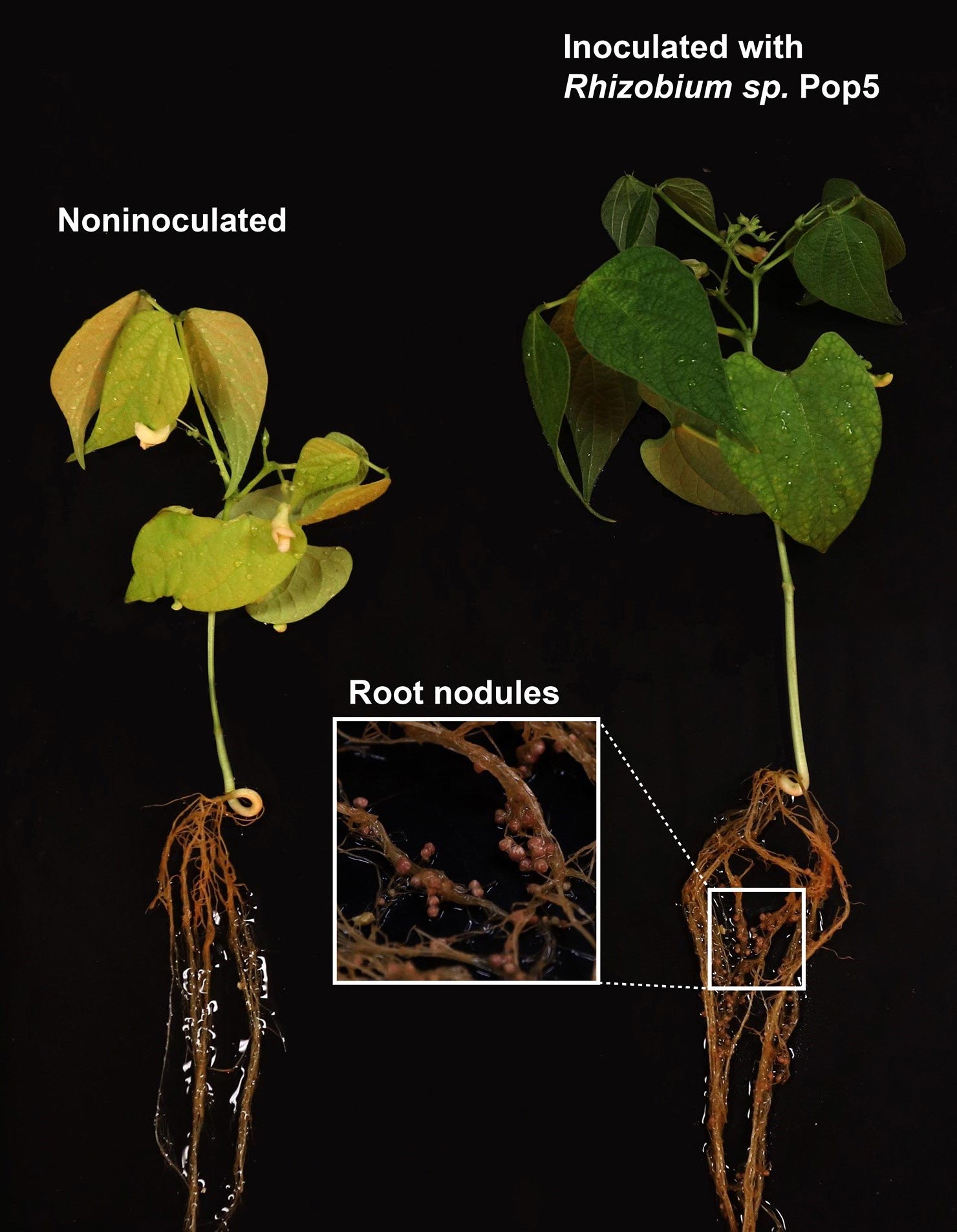
    Phazolicin
    The bacterium that produces the antibiotic phazolicin forms nodules on bean plant roots, resulting in a more robust plant (right) than on the left. Credit: Dmitrii Y. Travin

    The bacterium that produces phazolicin, is an unidentified species of Rhizobium. It was found in a tropical forest in Los Tuxtlas, Mexico, in the soil and roots of wild beans called Phaseolus vulgaris, hence the antibiotic’s name: phazolicin. Like other Rhizobia, the phazolicin-producing microbe forms nodules on bean plant roots and provides plants with nitrogen, making them grow more robustly than others. Unlike other Rhizobia, it also defends plants from harmful bacteria sensitive to phazolicin. The phenomenon could eventually be exploited in beans, peas, chickpeas, lentils, peanuts, soybeans, and other legumes.

    Using computer and bioinformatic analysis, the scientists predicted the existence of phazolicin and then confirmed its existence in the lab. They revealed the atomic structure of the antibiotic and showed it is bound to and targets the ribosome, a protein manufacturing factory in bacterial cells. The scientists discovered that by introducing mutations in ribosomes, they can modify and control sensitivity, or susceptibility, to the antibiotic. 

    Scientists from the Skolkovo Institute of Science and Technology in Russia; Russian Academy of Science; University of California, Berkeley; Lomonosov Moscow State University in Russia; the University of Illinois at Chicago; and University Paris-Sud and University Paris-Saclay in France contributed to the study.

    Reference: “Structure of ribosome-bound azole-modified peptide phazolicin rationalizes its species-specific mode of bacterial translation inhibition” by Dmitrii Y. Travin, Zoe L. Watson, Mikhail Metelev, Fred R. Ward, Ilya A. Osterman, Irina M. Khven, Nelli F. Khabibullina, Marina Serebryakova, Peter Mergaert, Yury S. Polikanov, Jamie H. D. Cate and Konstantin Severinov, 8 October 2019, Nature Communications.
    DOI: 10.1038/s41467-019-12589-5

    Never miss a breakthrough: Join the SciTechDaily newsletter.
    Follow us on Google and Google News.

    Antibiotics Bacteria Plant Science Rutgers University University of Illinois at Chicago
    Share. Facebook Twitter Pinterest LinkedIn Email Reddit

    Related Articles

    Fruit Fly Compound Could Lead to New Antibiotics

    Plant Protein Kills Bacterial Cells – New Model for Antibacterial Mechanism Could Result in New Antibiotics

    ‘Poison Arrows’ Launched by Warring Bacteria Could Lead to New Antibiotics

    Shark Skin Microbiome Protects Wounds From Infection

    Evolution of Antibiotic Resistance Altered by Bacterial Lifestyle

    MetaCherchant Software Reveals New Causes of Antibiotic Resistance

    Stimulating Resolution Programs Limit Consequences of Infection

    Understanding Antibiotics and Their Role in Killing Bacteria

    Antibiotic-Free Meat Might Still Be Contaminated with Drug Resistant Bacteria

    Leave A Reply Cancel Reply

    • Facebook
    • Twitter
    • Pinterest
    • YouTube

    Don't Miss a Discovery

    Subscribe for the Latest in Science & Tech!

    Trending News

    Millions of People Have Osteopenia Without Realizing It – Here’s What You Need To Know

    Researchers Discover Boosting a Single Protein Helps the Brain Fight Alzheimer’s

    World-First Study Reveals Human Hearts Can Regenerate After a Heart Attack

    Why Your Dreams Feel So Real Sometimes and So Strange Other Times

    This Simple Home Device May Boost Brain Power in Adults Over 40

    Enormous Prehistoric Insects Puzzle Scientists

    Scientists Develop Bioengineered Chewing Gum That Could Help Fight Oral Cancer

    After 37 Years, the World’s Longest-Running Soil Warming Experiment Uncovers a Startling Climate Secret

    Follow SciTechDaily
    • Facebook
    • Twitter
    • YouTube
    • Pinterest
    • Newsletter
    • RSS
    SciTech News
    • Biology News
    • Chemistry News
    • Earth News
    • Health News
    • Physics News
    • Science News
    • Space News
    • Technology News
    Recent Posts
    • After 100 Years, Scientists Uncover Hidden Rule Governing Cosmic Rays
    • The Milky Way Has a Hidden Edge and Scientists Finally Mapped It
    • Scientists Stunned by New Organic Molecules Found on Mars
    • Scientists Discover Evolution’s 120-Million-Year-Old “Cheat Sheet”
    • This New “Sound Laser” Could Measure Gravity With Stunning Precision
    Copyright © 1998 - 2026 SciTechDaily. All Rights Reserved.
    • Science News
    • About
    • Contact
    • Editorial Board
    • Privacy Policy
    • Terms of Use

    Type above and press Enter to search. Press Esc to cancel.