
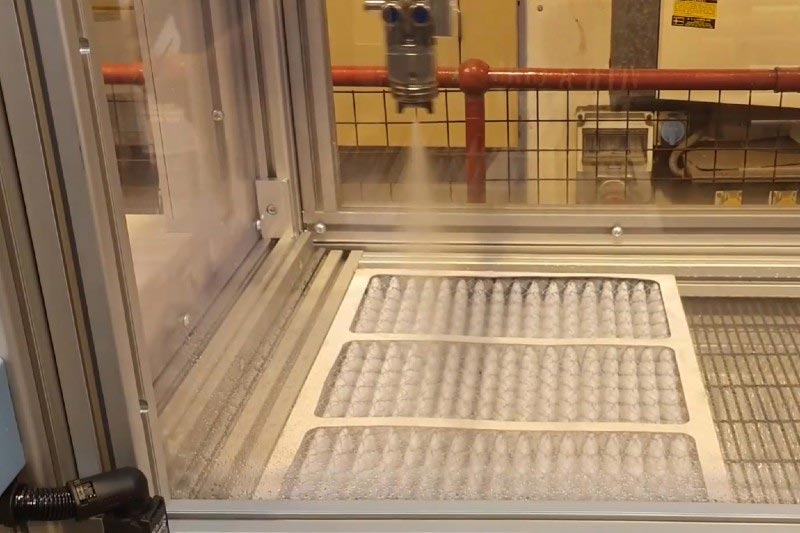
Researchers at the University of Birmingham working in partnership with firms NitroPep Ltd and Pullman AC have developed new antimicrobial technology for air filters which can in seconds kill bacteria, fungi, and viruses including SARS-CoV-2 — providing a potential solution to prevent the spread of airborne infections.
In a study, published on March 9, 2022, in the journal Scientific Reports, the antimicrobial treatment for air filters — coated with a chemical biocide called chlorhexidine digluconate (CHDG) — were rigorously tested and compared to commonly used standard ‘control’ filters in the laboratory, in industrial air condensing units, and in a trial on-board trains operating on the UK’s railways.
In the laboratory, cells of the Wuhan strain of SARS-CoV-2 – the virus that causes COVID-19 — were added to the surface of both the treated and control filters and measured at intervals over a period of more than an hour. The results showed that, while much of the virus remained on the surface of the control filter for an hour, all SARS-CoV-2 cells were killed within 60 seconds on the treated filter. Similar results were seen in experiments testing bacteria and fungi that commonly cause illness in humans – including E. coli, S. aureus, and C. albicans – proving the novel technology to be both highly effective anti-fungal and anti-bacterial air filter treatments.
Meanwhile, in order to determine how effective the filters are in a real-world setting, both the control and treated filters were installed in heating, ventilation, and air conditioning systems on train carriages. The filters were installed for three months in matched pairs across carriages on the same train-line, before being removed and shipped for analysis with researchers counting colonies of bacteria remaining on them. The trial found no pathogens survived on the treated filter, even after three months on board the train.
Further tests also found the treated filters are durable, and are able to maintain their structure and filtration function over the lifetime of their use.
Addressing the Need for Pathogen-Controlled Ventilation
Dr. Felicity de Cogan, Royal Academy of Engineering Industry Fellow at the University of Birmingham, said: “The COVID-19 pandemic has brought to the forefront of public consciousness the real need for new ways to control the spread of airborne respiratory pathogens. In crowded spaces, from offices to large indoor venues, shopping malls, and on public transport, there is an incredibly high potential for transmission of COVID-19 and other viruses such as flu. Most ventilation systems recycle air through the system, and the filters currently being used in these systems are not normally designed to prevent the spread of pathogens, only to block air particles. This means filters can actually act as a potential reservoir for harmful pathogens. We are excited that we have been able to develop a filter treatment which can kill bacteria, fungi, and viruses – including SARS-CoV-2 — in seconds. This addresses a global unmet need and could help clean the air in enclosed spaces, helping to prevent the spread of respiratory disease.”
Dr. de Cogan said that, while there have been other novel filters to ‘purify air’ – from high-efficiency particulate air filters used in aerospace cabins, to UV light, and silver nanoparticles added to filter mesh — these have fallen short as they either lack energy efficiency or speed in effectiveness and are not ideal for the majority of existing heating, ventilation and air conditioning systems which would require significant infrastructure upgrades to use them.
Dr. de Cogan adds: “In comparison, the technology we have developed can be applied to existing filters and can be used in existing heating, ventilation, and air conditioning systems with no need for the cost or hassle of any modifications. This level of compatibility with existing systems removes many of the barriers encountered when new technologies are brought onto the market.”
NitroPep Ltd is now further developing the filters to deliver them as a product on the market. The new technology is the latest stage of Dr de Cogan’s ongoing research creating patented antimicrobial technologies, which has included the development of a coating for surfaces called NitroPep that is also effective against SARS-CoV-2.
The latest study comes after previous research carried out globally has found that the risk of developing COVID-19 increases with greater public transport use,[1] while other former studies have shown higher rates of flu-like illnesses in people traveling on London’s underground,[2] as well as a 6-fold increase in respiratory infection in people using a tram or bus.[3]
Reference: “Efficacy of antimicrobial and anti-viral coated air filters to prevent the spread of airborne pathogens” by Rowan Watson, Morwenna Oldfield, Jack A. Bryant, Lily Riordan, Harriet J. Hill, Julie A. Watts, Morgan R. Alexander, Michael J. Cox, Zania Stamataki, David J. Scurr and Felicity de Cogan, 9 March 2022, Scientific Reports.
DOI: 10.1038/s41598-022-06579-9
Notes
- Shen; Li ; Dong et al (2020). ‘Community Outbreak Investigation of SARS-CoV-2 Transmission Among Bus Riders in Eastern China‘ JAMA Internal Medicine
- Gosce et al (2018). ‘Analysing the link between public transport use and airborne transmission: mobility and contagion in the London underground‘. Environmental Health.
- Van Tam et al (2011). ‘Is public transport a risk factor for acute respiratory infection?‘. BMC Infectious Diseases.
The new research, published in Scientific Reports, was funded by the Wellcome Trust, Medical Research Council, Engineering and Physical Sciences Research Council, the Medical Research Foundation, and Engineering X Pandemic Preparedness, run by the Royal Academy of Engineering. It was carried out in collaboration with NitroPep Ltd, Pullman AC Ltd, and the University of Nottingham.
Never miss a breakthrough: Join the SciTechDaily newsletter.
Follow us on Google and Google News.