
Scientists have determined a new way to protect the hair follicle from chemotherapy in an effort to prevent hair loss as a result of cancer treatments.
Researchers based at The University of Manchester have discovered a new strategy for how to protect hair follicles from chemotherapy, which could lead to new treatments that prevent chemotherapy-induced hair loss — arguably one of the most psychologically distressing side effects of modern cancer therapy.
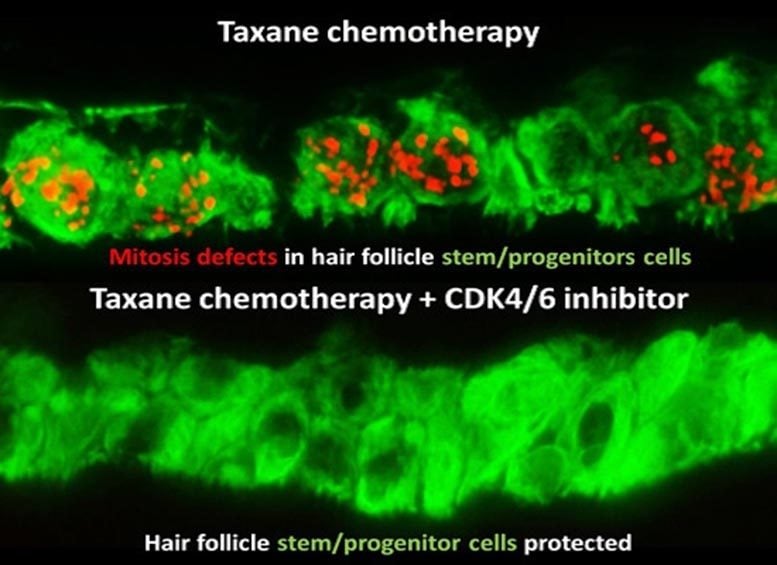
The study from the laboratory of Professor Ralf Paus of the Center for Dermatology Research describes how damage in the hair follicle caused by taxanes, cancer drugs that can cause permanent hair loss, can be prevented.
To do this, scientists have exploited the properties of a newer class of drugs called CDK4/6 inhibitors, which blocks cell division and are already medically approved as so-called “targeted” cancer therapies.
Dr. Talveen Purba, lead author on the study explains: “Although at first this seems counterintuitive, we found that CDK4/6 inhibitors can be used temporarily to halt cell division without promoting additional toxic effects in the hair follicle. When we bathed organ-cultured human scalp hair follicles in CDK4/6 inhibitors, the hair follicles were much less susceptible to the damaging effects of taxanes”
Taxanes are very important anti-cancer drugs commonly used to treat, for example, patients with breast or lung carcinoma and particularly cause anxieties among breast cancer patients for the very distressing and sometimes long-lasting hair loss taxanes can induce. (Thousands of patients in the US are currently suing pharmaceutical company Sanofi over a lack of warning of the risk of permanent hair loss after treatment with the taxane drug Taxotere.)
Dr. Purba emphasizes: “A pivotal part of our study was to first get to grips with how exactly hair follicles responded to taxane chemotherapy, and we found that the specialized dividing cells at the base of the hair follicle that are critical for producing hair itself, and the stem cells from which they arise, are most vulnerable to taxanes. Therefore, we must protect these cells most from undesired chemotherapy effects – but so that the cancer does not profit from it.”
The team hopes that their work will support the development of externally applicable medicines that will slow or briefly suspend cell division in the scalp hair follicles of patients undergoing chemotherapy to mitigate against chemotherapy-induced hair damage. This could complement and enhance the efficacy of existing preventive approaches i.e. scalp cooling devices.
The researchers underscore that more work is desperately needed in this lamentably underfunded field of cancer medicine, where patients have waited for so long to see real breakthroughs in pharmacological hair loss prevention.
Dr. Purba said: “Despite the fact that taxanes have been used in the clinic for decades, and have long been known to cause hair loss, we’re only now scratching the surface of how they damage the human hair follicle.”
He added: “We also don’t really know why some patients show greater hair loss than others even though they get the same drug and drug dose, and why it is that certain chemotherapy regimens and drug combinations have much worse outcomes than others”
“We need time to further develop approaches like this to not only prevent hair loss, but promote hair follicle regeneration in patients who have already lost their hair due to chemotherapy.”
Reference: “CDK4/6 inhibition mitigates stem cell damage in a novel model for taxane‐induced alopecia” by Talveen S Purba, Kayumba Ng’andu, Lars Brunken, Eleanor Smart, Ellen Mitchell, Nashat Hassan, Aaron O’Brien, Charlotte Mellor, Jennifer Jackson, Asim Shahmalak and Ralf Paus, 12 September 2019, EMBO Molecular Medicine.
DOI: 10.15252/emmm.201911031
Never miss a breakthrough: Join the SciTechDaily newsletter.
Follow us on Google and Google News.