
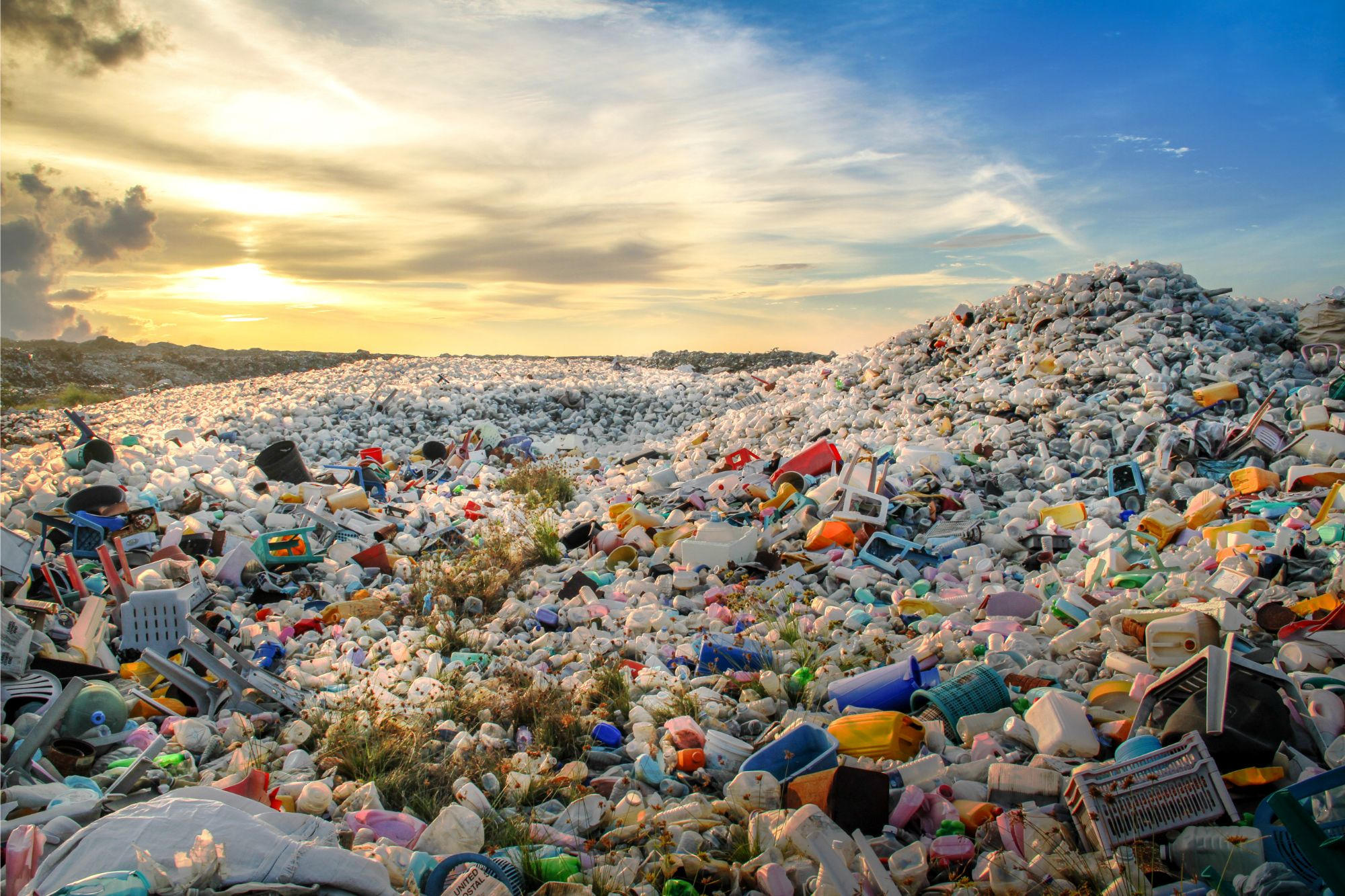
A new catalyst may enable mixed plastic recycling
The future of plastic recycling could soon become far simpler and more efficient.
Researchers at Northwestern University have developed a new plastic upcycling method that greatly reduces — and may even eliminate — the need to pre-sort mixed plastic waste.
At the heart of the process is a low-cost nickel-based catalyst that selectively targets polyolefin plastics, including polyethylenes and polypropylenes, which make up nearly two-thirds of global single-use plastic consumption. This means the catalyst could be applied to large volumes of unsorted polyolefin waste.
When activated, the catalyst converts these low-value solid plastics into liquid oils and waxes that can be repurposed into higher-value products such as fuels, lubricants, and candles. The catalyst can be reused multiple times and, notably, is also capable of breaking down plastics contaminated with polyvinyl chloride (PVC), a toxic material long considered to make plastics “unrecyclable.”
Key challenges and breakthrough potential
The study was recently published in the journal Nature Chemistry.
“One of the biggest hurdles in plastic recycling has always been the necessity of meticulously sorting plastic waste by type,” said Northwestern’s Tobin Marks, the study’s senior author. “Our new catalyst could bypass this costly and labor-intensive step for common polyolefin plastics, making recycling more efficient, practical, and economically viable than current strategies.”
“When people think of plastic, they likely are thinking about polyolefins,” said Northwestern’s Yosi Kratish, a co-corresponding author on the paper. “Basically, almost everything in your refrigerator is polyolefin-based — squeeze bottles for condiments and salad dressings, milk jugs, plastic wrap, trash bags, disposable utensils, juice cartons and much more. These plastics have a very short lifetime, so they are mostly single-use. If we don’t have an efficient way to recycle them, then they end up in landfills and in the environment, where they linger for decades before degrading into harmful microplastics.”
A world-renowned catalysis expert, Marks is the Vladimir N. Ipatieff Professor of Catalytic Chemistry at Northwestern’s Weinberg College of Arts and Sciences and a professor of chemical and biological engineering at Northwestern’s McCormick School of Engineering. He is also a faculty affiliate at the Paula M. Trienens Institute for Sustainability and Energy. Kratish is a research assistant professor in Marks’ group, and an affiliated faculty member at the Trienens Institute. Qingheng Lai, a research associate in Marks’ group, is the study’s first author. Marks, Kratish and Lai co-led the study with Jeffrey Miller, a professor of chemical engineering at Purdue University; Michael Wasielewski, Clare Hamilton Hall Professor of Chemistry at Weinberg; and Takeshi Kobayashi a research scientist at Ames National Laboratory.
The polyolefin predicament
From yogurt cups and snack wrappers to shampoo bottles and medical masks, polyolefin plastics are part of everyday life. They are the most widely used plastics in the world, produced in enormous quantities. By some estimates, more than 220 million tons of polyolefin products are manufactured globally each year. Yet, according to a 2023 report in the journal Nature, recycling rates for these plastics remain troublingly low, falling between less than 1% and 10% worldwide.
This poor recycling record is largely due to the durability of polyolefins. Their structure is made up of small molecules connected by carbon-carbon bonds, which are notoriously strong and difficult to break apart.
“When we design catalysts, we target weak spots,” Kratish said. “But polyolefins don’t have any weak links. Every bond is incredibly strong and chemically unreactive.”
Problems with current processes
Currently, only a few, less-than-ideal processes exist that can recycle polyolefin. It can be shredded into flakes, which are then melted and downcycled to form low-quality plastic pellets. But because different types of plastics have different properties and melting points, the process requires workers to scrupulously separate various types of plastics. Even small amounts of other plastics, food residue, or non-plastic materials can compromise an entire batch. And those compromised batches go straight into the landfill.
Another option involves heating plastics to incredibly high temperatures, reaching 400 to 700 degrees Celsius. Although this process degrades polyolefin plastics into a useful mixture of gases and liquids, it’s extremely energy-intensive.
“Everything can be burned, of course,” Kratish said. “If you apply enough energy, you can convert anything to carbon dioxide and water. But we wanted to find an elegant way to add the minimum amount of energy to derive the maximum value product.”
Precision engineering
To uncover that elegant solution, Marks, Kratish, and their team looked to hydrogenolysis, a process that uses hydrogen gas and a catalyst to break down polyolefin plastics into smaller, useful hydrocarbons. While hydrogenolysis approaches already exist, they typically require extremely high temperatures and expensive catalysts made from noble metals like platinum and palladium.
“The polyolefin production scale is huge, but the global noble metal reserves are very limited,” Lai said. “We cannot use the entire metal supply for chemistry. And, even if we did, there still would not be enough to address the plastic problem. That’s why we’re interested in Earth-abundant metals.”
For its polyolefin recycling catalyst, the Northwestern team pinpointed cationic nickel, which is synthesized from an abundant, inexpensive, and commercially available nickel compound. While other nickel nanoparticle-based catalysts have multiple reaction sites, the team designed a single-site molecular catalyst.
The single-site design enables the catalyst to act like a highly specialized scalpel — preferentially cutting carbon-carbon bonds — rather than a less controlled blunt instrument that indiscriminately breaks down the plastic’s entire structure. As a result, the catalyst allows for the selective breakdown of branched polyolefins (such as isotactic polypropylene) when they are mixed with unbranched polyolefins — effectively separating them chemically.
“Compared to other nickel-based catalysts, our process uses a single-site catalyst that operates at a temperature 100 degrees lower and at half the hydrogen gas pressure,” Kratish said. “We also use 10 times less catalyst loading, and our activity is 10 times greater. So, we are winning across all categories.”
Accelerated by contamination
With its single, precisely defined, and isolated active site, the nickel-based catalyst possesses unprecedented activity and stability. The catalyst is so thermally and chemically stable, in fact, that it maintains control even when exposed to contaminants like PVC. Used in pipes, flooring, and medical devices, PVC is visually similar to other types of plastics but significantly less stable upon heating. Upon decomposition, PVC releases hydrogen chloride gas, a highly corrosive byproduct that typically deactivates catalysts and disrupts the recycling process.
Amazingly, not only did Northwestern’s catalyst withstand PVC contamination, PVC actually accelerated its activity. Even when the total weight of the waste mixture is made up of 25% PVC, the scientists found their catalyst still worked with improved performance. This unexpected result suggests the team’s method might overcome one of the biggest hurdles in mixed plastic recycling — breaking down waste currently deemed “unrecyclable” due to PVC contamination. The catalyst also can be regenerated over multiple cycles through a simple treatment with inexpensive alkylaluminium.
“Adding PVC to a recycling mixture has always been forbidden,” Kratish said. “But apparently, it makes our process even better. That is crazy. It’s definitely not something anybody expected.”
Reference: “Stable single-site organonickel catalyst preferentially hydrogenolyses branched polyolefin C–C bonds” by Qingheng Lai, Xinrui Zhang, Shan Jiang, Matthew D. Krzyaniak, Selim Alayoglu, Amol Agarwal, Yukun Liu, Wilson C. Edenfield, Takeshi Kobayashi, Yuyang Wang, Vinayak Dravid, Michael R. Wasielewski, Jeffery T. Miller, Yosi Kratish and Tobin J. Marks, 2 September 2025, Nature Chemistry.
DOI: 10.1038/s41557-025-01892-y
Supported by the U.S. Department of Energy (award number DE-SC0024448) and The Dow Chemical Company.
Never miss a breakthrough: Join the SciTechDaily newsletter.
Follow us on Google and Google News.
5 Comments
Hope the scientists are successful in their attempts to recycle and break down the plastics,it would be great if it’s successful
Wow, I hope this is commercially viable asap.
If I had a nickel for every time scientists promised they found a way to recycle better, faster and more…
…I’d have a nice bunch of nickels.
This is a fantastic step towards managing plastic waste. My question is, if this catalyst is commercialized and used to the fullest, how much nickel will be needed?
considering the dencities and boyencee of plaatic, using a chloride and salt properties you could essentially make pyrex or glass or different plastic possibilities….fusion of Ameren or arma