
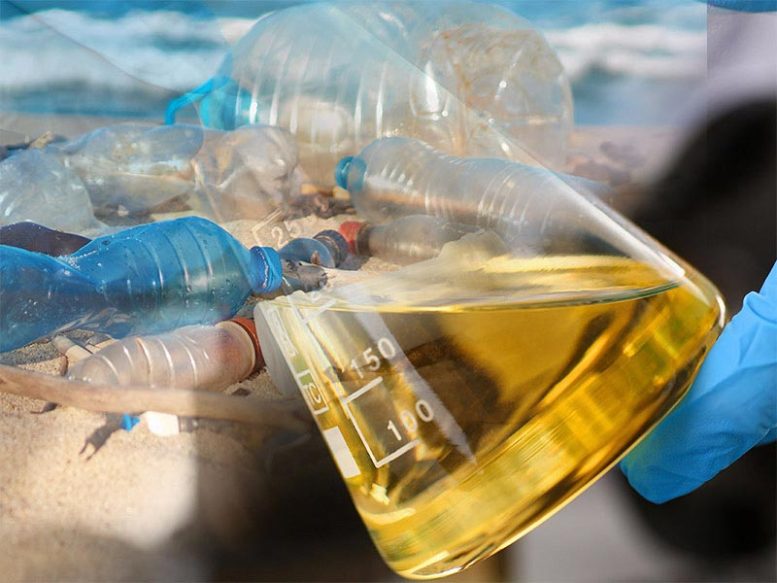
New technology could divert problem plastics from landfills and convert them into fuel sources.
A plastics recycling innovation that does more with less simultaneously increases conversion to useful products while using less of the precious metal ruthenium. It will be presented today (August 22, 2022) at the American Chemical Society fall meeting in Chicago.
“The key discovery we report is the very low metal load,” said Pacific Northwest National Laboratory (PNNL) chemist Janos Szanyi, who led the research team. “This makes the catalyst much cheaper.”
The new technique more efficiently converts plastics to valuable commodity chemicals—a process termed “upcycling.” Moreover, it produces much less methane, an undesirable greenhouse gas, as a byproduct, compared with other reported methods.
“It was very interesting to us that there had been nothing previously published showing this result,” said postdoctoral research scientist Linxiao Chen, who presented the research at ACS. “This research shows the opportunity to develop effective, selective, and versatile catalysts for plastic upcycling.”
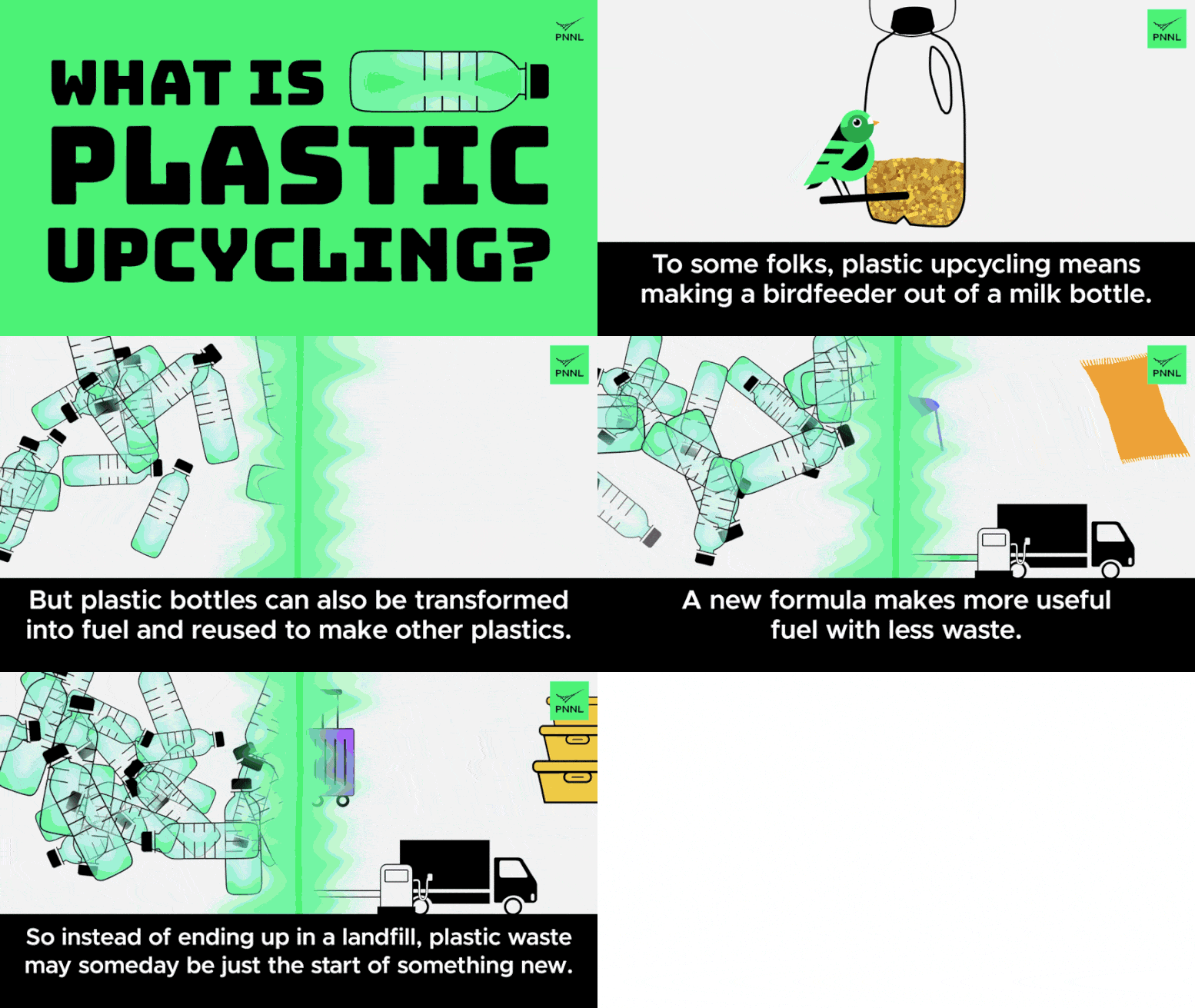
Less Metal Is More in Plastic Upcycling
Petroleum-based plastic waste represents an untapped source of carbon-based chemicals that can serve as the starting material for useful durable materials and fuels. Despite ample supplies in recycling bins, very little plastic is actually recycled currently, mainly for economic and practical reasons. However, PNNL researchers are trying to change the dynamic by applying their expertise in efficiently breaking chemical bonds.
It’s well known that adding hydrogen—a reaction known as hydrogenolysis—to difficult-to-recycle plastics like polypropylene and polyethylene presents a promising strategy to convert plastic waste into value-added small hydrocarbons. But this process requires efficient and selective catalysts to make it economically feasible.
That’s where this recent PNNL-led research excelled.
The team of scientists found that reducing the amount of the precious metal ruthenium actually improved the polymer upcycling efficiency and selectivity. In a study recently published in the journal ACS Catalysis, they showed that the improvement in efficiency happened when the low ratio of metal to support structure caused the structure to shift from an orderly array of particles to disordered rafts of atoms.
Trapped Atoms
A track record of PNNL expertise in single-atom catalysts helped the team understand why less is more. The researchers observed the transition to disorder on the molecular level and then used established theory to show that single atoms are actually more effective catalysts in this experimental work.
The work builds on research in atom trapping and single-atom catalysts by Yong Wang, a professor of chemical engineering at Washington State University, Pullman, and a PNNL Laboratory fellow.
“There has been a lot of effort from a material perspective to try to understand how single atoms or very small clusters can make effective catalysts,” said Gutiérrez.
At ACS, Chen also described new work that explores the role of the support material in improving the efficiency of the system.
“We have investigated cheaper and more easily available support materials to replace cerium oxide,” said Chen. “We found that a chemically modified titanium oxide may enable a more effective and selective pathway for polypropylene upcycling.”
Learning How To Tolerate Chlorine
To make the method practical for use with mixed plastic recycling streams, the researchers are now exploring how the presence of chlorine affects the efficiency of the chemical conversion.
“We are looking into more demanding extraction conditions,” said chemist Oliver Y. Gutiérrez, an expert in industrial applications for catalysis. “When you don’t have a clean plastic source, in an industrial upcycling process, you have chlorine from polyvinylchloride and other sources. Chlorine can contaminate the plastic upcycling reaction. We want to understand what effect chlorine has on our system.”
Now, that fundamental understanding may help convert waste plastic that would usually end up as pollution in the environment into useful products.
Reference: “Disordered, Sub-Nanometer Ru Structures on CeO2 are Highly Efficient and Selective Catalysts in Polymer Upcycling by Hydrogenolysis” by Linxiao Chen, Laura C. Meyer, Libor Kovarik, Debora Meira, Xavier I. Pereira-Hernandez, Honghong Shi, Konstantin Khivantsev, Oliver Y. Gutiérrez and János Szanyi, 5 April 2022, ACS Catalysis.
DOI: 10.1021/acscatal.2c00684
The research was supported by the Department of Energy, Office of Science. This research also used resources from the Advanced Photon Source, an Office of Science user facility operated for DOE by Argonne National Laboratory.
Never miss a breakthrough: Join the SciTechDaily newsletter.
Follow us on Google and Google News.
1 Comment
Just keep collecting all kinds of trash in landfills is extremely bad idea for many reasons!
Best solution would be just burning all trash to produce electricity (& recycling remaining raw materials) and/or using all trash to produce biodiesel/biofuel for all big/heavy land/sea/air vehicles!