
Synthesizing an alternative fuel for muscle could lead to medical advances.
A chemist and kinesiologist got on a bus, but this isn’t the set-up to a joke. Instead, kinesiologist and lead author Ned Debold and chemist Dhandapani Venkataraman, “DV,” began talking on their bus commute to the University of Massachusetts Amherst and discovered their mutual interest in how energy is converted from one form to another – for Debold, in muscle tissue and for DV, in solar cells.
Debold told the chemist how researchers have been seeking an alternative energy source to replace the body’s usual one, a molecule called adenosine triphosphate (ATP). Such a source could control muscle activity, and might lead to new muscle spasm-calming treatments in cerebral palsy, for example, or activate or enhance skeletal muscle function in MS, ALS, and chronic heart failure.
All are highly debilitating because the body has no way to fix them, says muscle physiologist Debold. It doesn’t have good mechanisms to control – either inhibit or boost – myosin function, the molecular motor that drives movement.
As DV notes, the usual approach to seeking a new compound is to systematically test each one among millions until one seems worth follow-up – the classic “needle in a haystack” approach. He says, “At one point I suggested to Ned, ‘Why don’t we build the needle ourselves instead?’ That started us on this interesting project that put together people who would otherwise never work together.”
The two soon saw that they would need someone to model interactions between the molecules DV was making and the myosin molecules Debold was using to test them. They invited computational chemist Jianhan Chen.
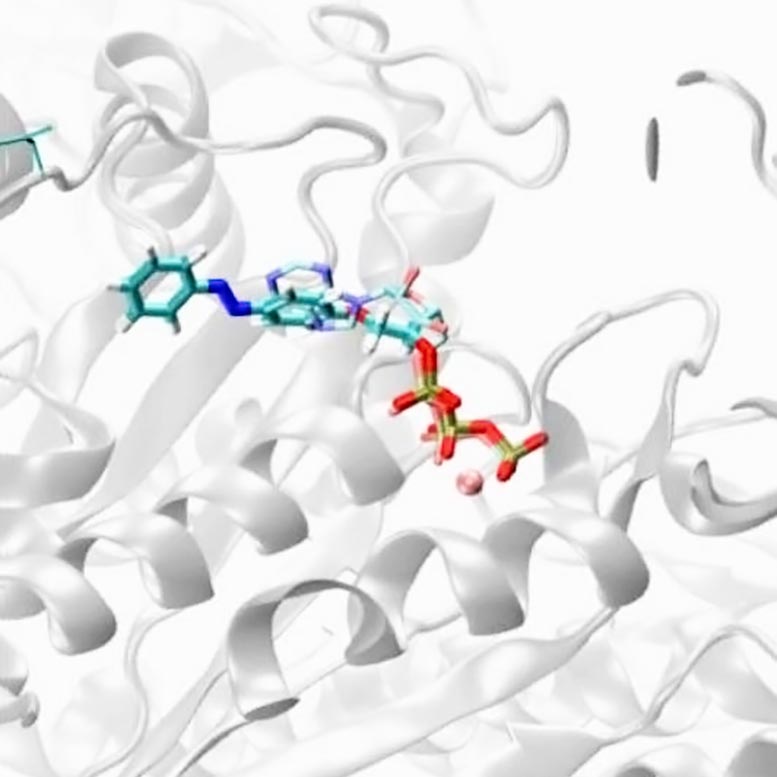
Chen explains, “We did computer modeling because experimentally it is difficult to know how myosin might be using the molecules DV was synthesizing. We can use computer simulation to provide a detailed picture at the molecular level to understand why these compounds might have certain effects. This can provide insight into not only how myosin interacts with the current set of compounds, but also it can provide a roadmap for DV to use to design new compounds that are even more effective at altering myosin function.”
This month, the researchers report in the Biophysical Journal that they have made a series of synthetic compounds to serve as alternative energy sources for the muscle protein myosin, and that myosin can use this new energy source to generate force and velocity. Mike Woodward from the Debold lab is the first author of their paper and Xiaorong Liu from the Chen lab performed the computer simulation.
By using different isomers – molecules with atoms in different arrangements – they were able to “effectively modulate, and even inhibit, the activity of myosin,” suggesting that changing the isomer may offer a simple yet powerful approach to control molecular motor function. With three isomers of the new ATP substitute, they show that myosin’s force- and motion-generating capacity can be dramatically altered. “By correlating our experimental results with computation, we show that each isomer exerts intrinsic control by affecting distinct steps in myosin’s mechano-chemical cycle.”
DV recalls, “My lab had never made such types of compounds before, we had to learn a new chemistry; my student Eric Ostrander worked on the synthesis.” The new chemistry involves sticking three phosphate groups onto a light-sensitive molecule, azobenzene, making what the researchers now call Azobenzene triphosphate, he adds.
The next stage for the trio will be to map the process at various points in myosin’s biochemical cycle, Debold says. “In the muscle research field, we still don’t fully understand how myosin converts energy gain from the food we eat into mechanical work. It’s a question that lies at the heart of understanding how muscles contract. By feeding myosin carefully designed alternative energy sources, we can understand how this complex molecular motor works. And along the way we are likely to reveal novel targets and approaches to address a host of muscle-related diseases.”
Reference: “Positional Isomers of a Non-Nucleoside Substrate Differentially Affect Myosin Function” by Mike Woodward, Eric Ostrander, Seung P. Jeong, Xiarong Liu, Brent Scott, Matt Unger, Jianhan Chen, Dhandapani Venkataraman and Edward P. Debold, 29 June 2020, Biophysical Journal.
DOI: 10.1016/j.bpj.2020.06.024
Never miss a breakthrough: Join the SciTechDaily newsletter.
Follow us on Google and Google News.