
Close Menu
    Facebook X (Twitter) Instagram
    SciTechDaily
    • Biology
    • Chemistry
    • Earth
    • Health
    • Physics
    • Science
    • Space
    • Technology
    Facebook X (Twitter) Pinterest YouTube RSS
    SciTechDaily
    Home»Space»New Chronology of the Saturn Planetary System
    Space

    New Chronology of the Saturn Planetary System

    By Planetary Science InstituteNovember 8, 2020No Comments3 Mins Read
    Facebook Twitter Pinterest Telegram LinkedIn WhatsApp Email Reddit
    Share
    Facebook Twitter LinkedIn Pinterest Telegram Email Reddit
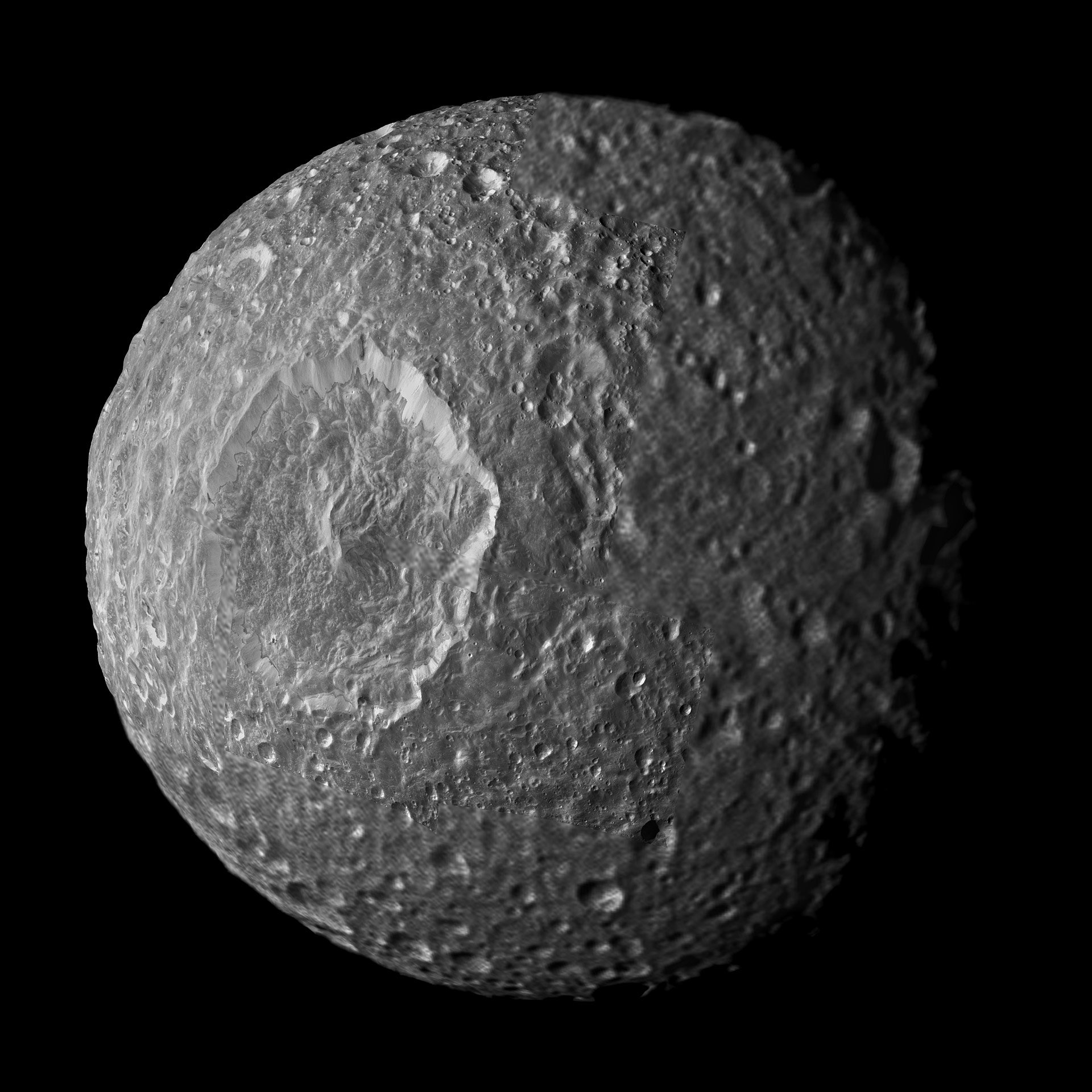
    Saturn's Moon Mimas
    This mosaic of Saturn’s moon Mimas showing its cratered surface was created from images taken by NASA’s Cassini spacecraft. Credit: NASA/JPL-Caltech/Space Science Institute

    A new chronology for the moons of Saturn has been developed by Planetary Science Institute Associate Research Scientist Samuel W. Bell. 

    “Most studies dating surfaces on the Moon or Mars rely on counting how many impact craters have formed and knowing the cratering rate, but on the moons of Saturn, we do not know the cratering rate,” said Bell, author of “Relative Crater Scaling Between the Major Moons of Saturn: Implications for Planetocentric Cratering and the Surface Age of Titan” appearing in the Journal of Geophysical Research: Planets. “Previous chronologies of the Saturn system have assumed that the craters on the moons of Saturn virtually all came from objects orbiting the Sun.” 

    “If the impacts came solely from Sun-orbiting objects, the relative cratering rate would be much, much higher the closer the moons are to Saturn. However, the crater densities of the oldest surfaces of Mimas, Tethys, Dione, Rhea, and Iapetus are all relatively similar,” Bell said. “It would be too much of a coincidence for the ages of the oldest surfaces on each moon to vary by the exact amounts necessary to produce broadly similar crater densities.  As a result, it seems much likelier that the impactors actually come from objects orbiting Saturn itself, moonlets that would be too small to detect with current technology. 

    “There are many important implications of this new chronology,” Bell said. “For instance, under the assumption that all the impactors orbit the Sun, the possibility that any of the moons are younger than 4 billion years old is ruled out. However, with impactors orbiting Saturn itself, the moons could be younger, as has been suggested from astrometric observations of tidal orbital evolution. 

    “The assumption of impactors orbiting the Sun results in the conclusion that the surface of Titan is probably at least 4 billion years old, even though Titan shows clear evidence of active weathering,” Bell said. “With the new chronology, Titan could be quite young, which is much more consistent with observations of lakes, riverbeds, dunes, and mountains. 

    “With the new chronology, we can much more accurately quantify what we do and don’t know about the ages of the moons and the features on them,” Bell said. “The grand scale history of the Saturn system still hides many mysteries, but it is beginning to come into focus.”

    Reference: “Relative Crater Scaling Between the Major Moons of Saturn: Implications for Planetocentric Cratering and the Surface Age of Titan” by Samuel W. Bell, 26 May 2020, Journal of Geophysical Research: Planets.
    DOI: 10.1029/2020JE006392

    Bell’s research was done while he was working at Brown University’s Center for Computation and Visualization and the Planetary Science Institute.

    Never miss a breakthrough: Join the SciTechDaily newsletter.
    Follow us on Google and Google News.

    Moons Planetary Science Institute Saturn
    Share. Facebook Twitter Pinterest LinkedIn Email Reddit

    Related Articles

    Secrets of Saturn’s Largest Moon Titan Revealed by Impact Craters

    NASA Discovers “Very Weird” Molecule in Titan’s Atmosphere

    Stunning New View of Saturn’s Moon Enceladus [Explore Interactively]

    Infrared Eyes on Enceladus: Hints of Fresh Ice in Northern Hemisphere of Saturn’s Moon

    NASA’s Surprising Discovery: Saturn’s Planet-Sized Moon Titan Drifting Away 100X Faster Than Thought

    Secrets of Titan’s Atmosphere Revealed – Galactic Cosmic Rays Affect Saturn’s Largest Moon

    Inner Complexity of Saturn’s Moon Enceladus Revealed – Hints at Habitable Conditions

    First Global Geologic Map of Titan (Saturn’s Largest Moon) Completed

    20 New Moons Discovered Orbiting Saturn – You Can Help Name Them [Video]

    Leave A Reply Cancel Reply

    • Facebook
    • Twitter
    • Pinterest
    • YouTube

    Don't Miss a Discovery

    Subscribe for the Latest in Science & Tech!

    Trending News

    The Universe Is Expanding Too Fast and Scientists Can’t Explain Why

    “Like Liquid Metal”: Scientists Create Strange Shape-Shifting Material

    Early Warning Signals of Esophageal Cancer May Be Hiding in Plain Sight

    Common Blood Pressure Drug Shows Surprising Power Against Deadly Antibiotic-Resistant Superbug

    Scientists Uncover Dangerous Connection Between Serotonin and Heart Valve Disease

    Scientists Discover a “Protector” Protein That Could Help Reverse Hair Loss

    Bone-Strengthening Discovery Could Reverse Osteoporosis

    Scientists Uncover Hidden Trigger Behind Stem Cell Aging

    Follow SciTechDaily
    • Facebook
    • Twitter
    • YouTube
    • Pinterest
    • Newsletter
    • RSS
    SciTech News
    • Biology News
    • Chemistry News
    • Earth News
    • Health News
    • Physics News
    • Science News
    • Space News
    • Technology News
    Recent Posts
    • A Common Diabetes Drug May Hold the Key to Stopping HIV From Coming Back
    • Ancient “Syphilis-Like” Disease in Vietnam Challenges Key Scientific Assumptions
    • Drinking Alcohol To Cope in Your 20s Could Damage Your Brain for Life
    • Scientists Crack Alfalfa’s Chromosome Mystery After Decades of Debate
    • Ancient Ant-Plant Alliance Collapses As Predatory Wasps Move In
    Copyright © 1998 - 2026 SciTechDaily. All Rights Reserved.
    • Science News
    • About
    • Contact
    • Editorial Board
    • Privacy Policy
    • Terms of Use

    Type above and press Enter to search. Press Esc to cancel.