
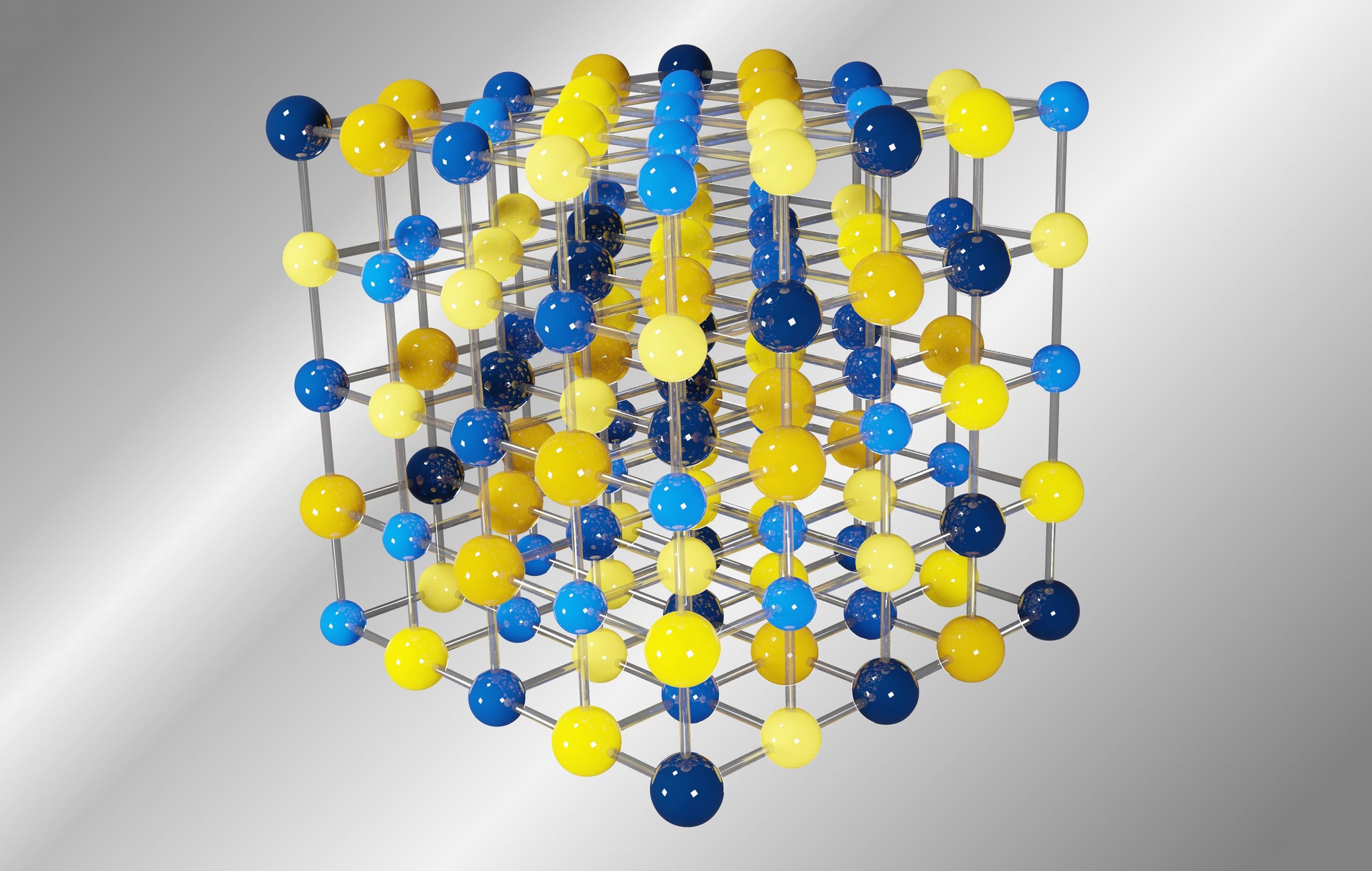
Semiconductors are important materials in numerous functional applications such as digital and analog electronics, solar cells, LEDs, and lasers. Semiconducting alloys are particularly useful for these applications since their properties can be engineered by tuning the mixing ratio or the alloy ingredients. However, the synthesis of multicomponent semiconductor alloys has been a big challenge due to thermodynamic phase segregation of the alloy into separate phases.
Recently, University of Michigan researchers Emmanouil (Manos) Kioupakis and Pierre F. P. Poudeu, both in the Materials Science and Engineering Department, utilized entropy to stabilize a new class of semiconducting materials, based on GeSnPbSSeTe high-entropy chalcogenide alloys,[1] a discovery that paves the way for wider adoption of entropy-stabilized semiconductors in functional applications. Their article, “Semiconducting high-entropy chalcogenide alloys with ambi-ionic entropy stabilization and ambipolar doping” was recently published in the journal Chemistry of Materials.
Entropy, a thermodynamic quantity that quantifies the degree of disorder in a material, has been exploited to synthesize a vast array of novel materials by mixing each component in an equimolar fashion, from high-entropy metallic alloys to entropy-stabilized ceramics. Despite having a large enthalpy of mixing, these materials can surprisingly crystalize in a single crystal structure, enabled by the large configurational entropy in the lattice. Kioupakis and Poudeu hypothesized that this principle of entropy stabilization can be applied to overcome the synthesis challenges of semiconducting alloys that prefer to segregation into thermodynamically more stable compounds. They tested their hypothesis on a 6-component II-VI chalcogenide alloy derived from the PbTe structure by mixing Ge, Sn, and Pb on the cation site, and S, Se, and Te on the anion site.
Using high throughput first-principles calculations, Kioupakis uncovered the complex interplay between the enthalpy and entropy in GeSnPbSSeTe high-entropy chalcogenide alloys. He found that the large configurational entropy from both anion and cation sublattices stabilizes the alloys into single-phase rocksalt solid solutions at the growth temperature. Despite being metastable at room temperature, these solid solutions can be preserved by fast cooling under ambient conditions.
Poudeu later verified the theory predictions by synthesizing the equimolar composition (Ge1/3Sn1/3Pb1/3S1/3Se1/3Te1/3) by a two-step solid-state reaction followed by fast quenching in liquid nitrogen. The synthesized power showed well-defined XRD patterns corresponding to a pure rocksalt structure. Furthermore, they observed reversible phase transition between single-phase solid solution and multiple-phase segregation from DSC analysis and temperature-dependent XRD, which is a key feature of entropy stabilization.
What makes high-entropy chalcogenide intriguing is their functional properties. Previously discovered high-entropy materials are either conducting metals or insulating ceramics, with a clear dearth in the semiconducting regime. Kioupakis and Poudeu found that. the equimolar GeSnPbSSeTe is an ambipolarly dopable semiconductor, with evidence from a calculated band gap of 0.86 eV and sign reversal of the measured Seebeck coefficient upon p-type doping with Na acceptors and n-type doping with Bi donors. The alloy also exhibits an ultralow thermal conductivity that is nearly independent of temperature. These fascinating functional properties make GeSnPbSSeTe a promising new material to be deployed in electronic, optoelectronic, photovoltaic, and thermoelectric devices.
Entropy stabilization is a general and powerful method to realize a vast array of materials compositions. The discovery of entropy stabilization in semiconducting chalcogenide alloys by the team at UM is only the tip of the iceberg that can pave the way for novel functional applications of entropy-stabilized materials.
Reference: “Semiconducting High-Entropy Chalcogenide Alloys with Ambi-ionic Entropy Stabilization and Ambipolar Doping” by Zihao Deng, Alan Olvera, Joseph Casamento, Juan S. Lopez, Logan Williams, Ruiming Lu, Guangsha Shi, Pierre F. P. Poudeu and Emmanouil Kioupakis, 26 May 2020, Chemistry of Materials.
DOI: 10.1021/acs.chemmater.0c01555
Related conference presentation: Zihao Deng, Alan Olvera, Joseph Casamento, Juan Lopez, Logan Williams, Ruiming Lu, Guangsha Shi, Pierre F. P. Poudeu, and Emmanouil Kioupakis. Computational prediction and experimental discovery of semiconducting high-entropy chalcogenide alloys, MRS Fall Meeting 2019, EL04.01.05
This study was supported by the National Science Foundation through Grant No. DMR-1561008 (first-principles calculations, synthesis, and characterization) and the Department of Energy, Office of Basic Energy Sciences under Award # DE-SC-00018941 (electronic and thermal transport measurements). The DFT calculations used resources of the National Energy Research Scientific Computing (NERSC) Center, a DOE Office of Science User Facility supported under Contract No. DE-AC02-05CH11231.
Never miss a breakthrough: Join the SciTechDaily newsletter.
Follow us on Google and Google News.