
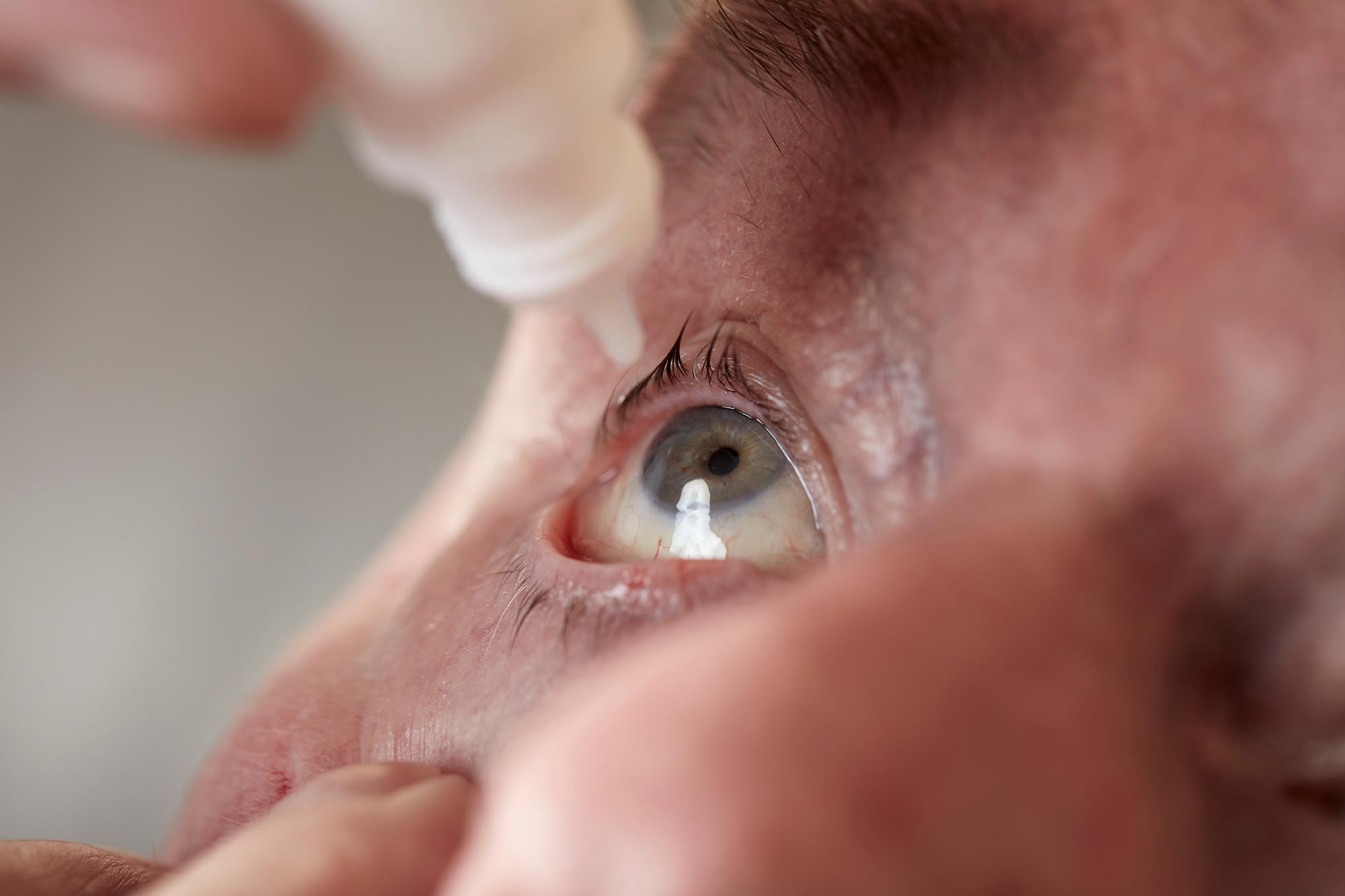
Imagine tossing aside your reading glasses and regaining crisp, youthful vision with just a few drops a day.
New research suggests that specially formulated eye drops can significantly improve near vision in people with presbyopia — age-related difficulty focusing on close objects. Patients reported sharper sight within an hour, sustained improvements for up to two years, and only mild, temporary side effects.
Eye Drops That Sharpen Sight Without Glasses
Almost everyone experiences presbyopia as they get older, which makes it harder to focus on nearby objects and read small print. For many, the solution is reading glasses, but new research suggests that relief could be as simple as applying special eye drops two or three times each day.
At the 43rd Congress of the European Society of Cataract and Refractive Surgeons (ESCRS),[1] researchers presented the results of a retrospective study involving 766 patients. Most participants were able to read two, three, or even more additional lines on the Jaeger chart, a tool used to measure near vision, after using the specially designed drops. This improvement lasted for as long as two years.
An Innovative Alternative to Glasses and Surgery
Dr. Giovanna Benozzi, director of the Center for Advanced Research for Presbyopia, in Buenos Aires, Argentina, said: “We conducted this research due to the significant unmet medical need in presbyopia management. Current solutions, such as reading glasses or surgical interventions, have limitations, including inconvenience, social discomfort, and potential risks or complications. There is a group of presbyopia patients who have limited options besides spectacles, and who are not candidates for surgery; these are our primary focus of interest. We sought to provide robust clinical evidence supporting an innovative pharmacological solution to offer patients a non-invasive, convenient, and effective alternative.”
The drops were originally developed by Dr. Benozzi’s father, the late Dr. Jorge Benozzi, at the same center. They combine two active ingredients: pilocarpine, which constricts the pupils and activates the ciliary muscle that adjusts the eye’s focus for objects at different distances, and diclofenac, a non-steroidal anti-inflammatory drug (NSAID) that reduces inflammation and helps ease the discomfort often caused by pilocarpine.
Testing Pilocarpine Formulations Across Hundreds of Patients
Patients administered the eye drops twice a day, usually on waking and again approximately six hours later, with an optional third dose if symptoms recurred or additional visual comfort was needed. The group of patients (373 women and 393 men, with an average age of 55) was divided into three groups to receive one of three eye drop formulations. Each formulation had a fixed dose of diclofenac, but concentrations of pilocarpine were 1%, 2% and 3%.
The researchers assessed the improvement in how well patients could read the Jaeger chart without reading glasses (uncorrected near visual acuity) one hour after the first administration of the drops, and they followed up the patients for two years.
Rapid and Lasting Vision Improvements Observed
Dr. Benozzi told the Congress: “Our most significant result showed rapid and sustained improvements in near vision for all three concentrations. One hour after having the first drops, patients had an average improvement of 3.45 Jaeger lines. The treatment also improved focus at all distances.
“Impressively, 99% of 148 patients in the 1% pilocarpine group reached optimal near vision and were able to read two or more extra lines. Approximately 83% of all patients maintained good functional near vision at 12 months. Importantly, no significant adverse events like increased intraocular pressure or retinal detachment were observed.”
Impressive Outcomes Across All Dosage Groups
In the 2% group, 69% of 248 patients were able to read three or more extra lines on the Jaeger chart, and in the 3% group, 84% of 370 patients could read three or more extra lines.
The improvement in the patients’ vision was sustained for up to two years, with a median duration of 434 days. Adverse side effects were mild, with the most common being temporary dim vision, which occurred in 32% of cases, irritation when the drops were instilled (3.7%) and headache (3.8%). No patients discontinued the treatment.
Common adverse side effects of pilocarpine can also include eye redness, watery eyes, blurred vision, dim or dark vision, sensitivity to light or problems changing focus between objects, seeing flashes of light or “floaters” in vision, and, in rare cases, detached retinas.
Tailoring Treatment Based on Presbyopia Severity
Dr. Benozzi continued: “Nearly all patients experienced positive improvements in near visual acuity, although the magnitude of the improvement depended on the status of their vision before treatment at baseline. Our study revealed that optimal pilocarpine concentrations could be individualised depending on the baseline severity of presbyopia as assessed by the initial Jaeger scores. Patients with less severe presbyopia responded best to 1% concentrations, while those with more advanced presbyopia required higher 2% or 3% concentrations to achieve significant visual improvement.”
She concluded: “These results suggest this combination therapy offers a safe, effective, and well-tolerated alternative to traditional presbyopia management. It significantly reduces dependence on reading glasses, providing a convenient, non-invasive option for patients, although these eye drops may not eliminate the need for glasses in all individuals.
“Importantly, this treatment is not intended to replace surgical interventions, but rather to serve as a valuable solution for patients who need safe, effective, and personalised alternatives and seek freedom from the inconvenience of eyewear. Eye care professionals now have an evidence-based pharmacological option that expands the spectrum of presbyopia care beyond glasses and surgery.”
Long-Term Research and Next Steps in Presbyopia Care
Besides the group of patients in this study, Dr. Benozzi has other patients who have received the treatment for more than ten years. Dr. Benozzi plans further research to measure improvements in patients’ quality of life, and to explore the underlying physiological mechanisms of the eye drops.
Strengths of the study include the large number of patients included and the long follow-up time. It is the first systematic evaluation comparing three different pilocarpine concentrations in combination with diclofenac. A limitation is that it is a retrospective, single-centre study, which could limit the generalisability of the findings and introduce selection bias.
ESCRS President-Elect, Professor Burkhard Dick, chair of the ophthalmology department at the University Eye Hospital Bochum, Germany, was not involved in the research. He commented, “While surgery for age-related near vision loss has advanced, some patients are not candidates. The single-centre retrospective study by Dr. Benozzi suggests that eye drops containing pilocarpine and diclofenac may improve near vision for up to two years, but the limited design means the results may not apply to everyone. Long-term pilocarpine use can sometimes cause side effects such as reduced night vision, dimmer vision in low light, eye strain, irritation and, in rare cases, retinal detachment, while prolonged topical NSAID use may pose corneal risks. Broader, long-term, multi-centre studies are needed to confirm safety and effectiveness before this treatment can be widely recommended.”
Reference:
- Abstract number: ESCRS25-FP-3944, ‘Dose-dependent efficacy and safety of pilocarpine-diclofenac eye drops for presbyopia: a real-world single-center study” by Giovanna Benozzi et al.
Meeting: 43rd Congress of the European Society of Cataract and Refractive Surgeons
Never miss a breakthrough: Join the SciTechDaily newsletter.
Follow us on Google and Google News.
4 Comments
As a now eighty-one year old lay American male professionally diagnosed with mild cataracts and AMD (so-called “Age Related Macular Degeneration”) years ago, I find that like my own professionally diagnosed/self-labeled “Allergy” Related Macular Degeneration/AMD, my self-diagnosed presbyopia is diet/allergy related and can change from day to day, even meal to meal. There are at least two problems regarding those in the US. First, mainstream US medicine still fails to recognize Dr. Arthur F. Coca’s (by 1935; my) kind of food allergies as true allergies (https://www.foodallergy.org/fare-blog/why-we-need-stop-referring-ige-mediated-allergies-true-food-allergies). Second, mainstream medicine still fails to factor-in toxic US FDA approved chronic-inflammation causing/contributing-to food additives (e.g., common allergen soy, cooking oil preservative TBHQ and artificially cultured “free” (can cross the blood-brain barrier) MSG, minimally. While the new eye drops may be an excellent treatment modality, I believe prevention would be vastly superior to perpetual treatments, in the long-run.
Well said. But I’d love to have access to this modality!
I’d rather stick with reading glasses than have to routinely go to an eye doctor to keep getting the prescription eye drops. Now if they were OTC, that would be a different story.
It is not completely clear if the study participants’ eyesight improved after a single dose and lasted for 2 years…or if they continued using the eye drops for two years on a daily basis. And if they stopped, I assume the presbyopia returned?
I was confused by that too as the story also says some people used it for 10 years. I would love to put down the reading glasses, especially since, as I get older, my distance vision is slowly deteriorating and I hate progressive lenses.