
Close Menu
    Facebook X (Twitter) Instagram
    SciTechDaily
    • Biology
    • Chemistry
    • Earth
    • Health
    • Physics
    • Science
    • Space
    • Technology
    Facebook X (Twitter) Pinterest YouTube RSS
    SciTechDaily
    Home»Space»New GAIA Data Reveal Relics of Merger Events in the Milky Way
    Space

    New GAIA Data Reveal Relics of Merger Events in the Milky Way

    By Rene Fransen, University of GroningenJune 12, 2018No Comments4 Mins Read
    Facebook Twitter Pinterest Telegram LinkedIn WhatsApp Email Reddit
    Share
    Facebook Twitter LinkedIn Pinterest Telegram Email Reddit
    Analysis of Halo Star Movement
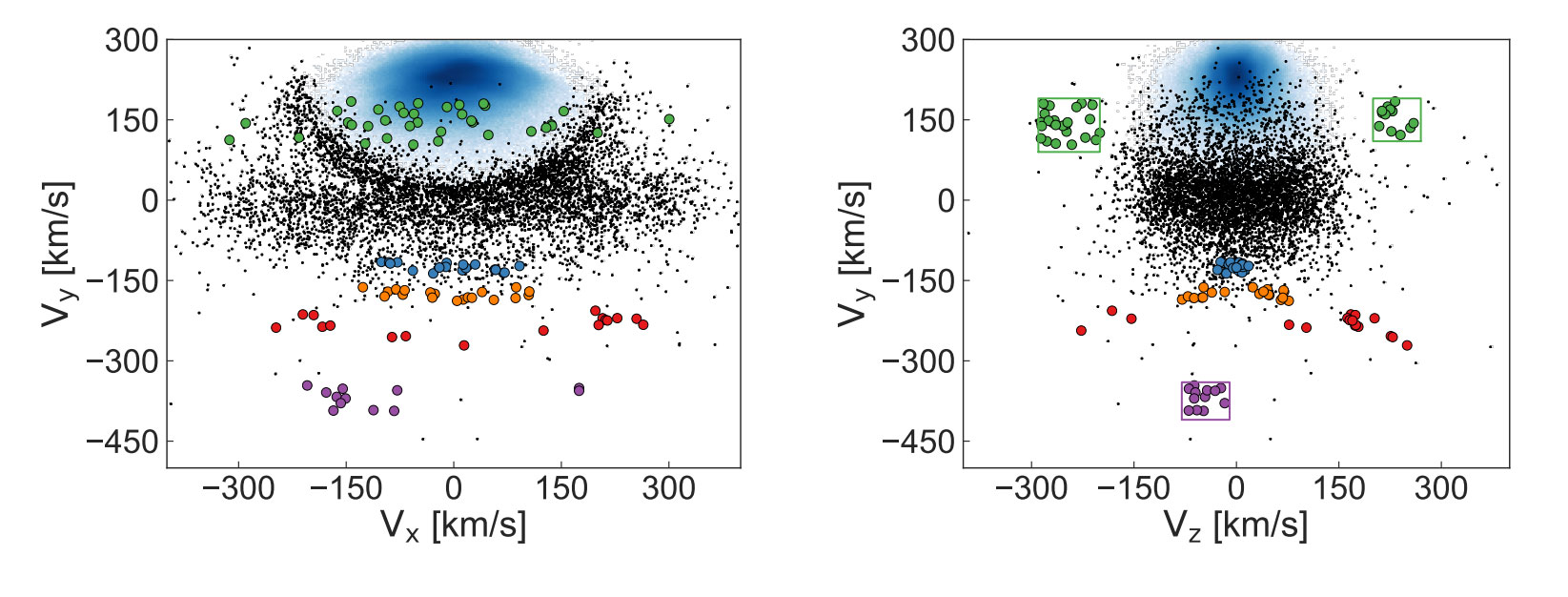
    Velocity distribution of halo stars (black dots and colored circles) selected according to the Toomre diagram shown in Fig. 1. The blue density maps show the velocity distributions of all stars within 1 kpc from the Sun and reveal the contribution of the disk(s). The left panel exposes particularly clearly the effect of our kinematic selection criterion. The colored stars mark the location of tight clumps that are easy to discern because of their large velocities. Koppelman et al.

    University of Groningen astronomers have discovered relics of merger events in the Milky Way halo. Five small groups of stars appear to represent mergers with smaller galaxies, while a big ‘blob’ comprising hundreds of stars appears to be the remnant of a large merger event. These results were published in The Astrophysical Journal Letters on 12 June.

    The study is based on the recent Gaia Data Release 2. This provided the astronomical community with accurate information on the position and movement of millions of stars, mostly in the Milky Way. Ph.D. student Helmer Koppelman is part of the research group of Professor of Dynamics, Structure, and Formation of the Milky Way Amina Helmi, who has been involved in the Gaia mission almost from its inception. He started analyzing the data right after the release and published a preprint of the article just eight days later. This has now been officially published.

    Halo

    ‘Our aim is to study how the Milky Way has evolved’, says Koppelman. The idea is that smaller galaxies merge to form larger ones. ‘One of the questions is whether a lot of small galaxies merge or a few large ones.’ As most stars in the Milky Way’s halo – the spherical cloud of stars surrounding the main disk and bulge of our galaxy – are thought to be remnants of merger events, Koppelman and his colleagues focused on halo stars in the Gaia data.

    ‘We collected information from stars within 3,000 light-years of the Sun, as the accuracy of the position and movement is highest for stars that are near us,’ Koppelman explains. The first step was to filter out the stars from the Milky Way disk. ‘These stars move around the center of the disk, so are easily identified.’ What remained were about 6,000 halo stars.

    Blob

    By calculating their trajectory, Koppelman was able to identify stars with a shared origin. ‘We discovered five small clusters which we believe are remnants of five merger events.’ However, many of the remaining stars also appeared to have a shared history. ‘These stars form a huge “blob” with a retrograde movement compared to the disk. This suggests they are the result of a merger with a large galaxy. In fact, we believe that this merger event must have remodeled the disk in our Milky Way.’ A more detailed study of the nature of this merger is now underway. ‘At this point in time, we can say that our Milky Way was shaped by a massive merger event and some smaller mergers.’

    Koppelman also looked for stars belonging to the ‘Helmi stream’, which is named after his Ph.D. supervisor who identified it back in 1999 as the remnant of a merger event. ‘Up to now, fewer than twenty stars belonging to the Helmi stream had been identified. The Gaia data has added over a hundred new stars.’ Further analysis should clarify the nature of the galaxy that produced this stream. ‘We will also be looking at stars beyond 3,000 light-years to discover more members of the different streams we identified. Together with simulations of galaxy evolution, this should give us exciting new insights into the evolution of the Milky Way.’

    Reference: “One large blob and many streams frosting the nearby stellar halo in Gaia DR2” by Helmer H. Koppelman, Amina Helmi and Jovan Veljanoski, 12 June 2018, The Astrophysical Journal Letters.
    DOI: 10.3847/2041/aac882

    Never miss a breakthrough: Join the SciTechDaily newsletter.
    Follow us on Google and Google News.

    Astronomy Astrophysics ESA Gaia Spacecraft University of Groningen
    Share. Facebook Twitter Pinterest LinkedIn Email Reddit

    Related Articles

    Astronomers Map the Movement of White Dwarfs of the Milky Way

    Gaia Spacecraft Discovers Parts of the Milky Way Are Much Older Than Thought

    Gaia Space Mission Discovers Mysterious Fossil Spiral Arms in Milky Way

    Astronomers Discover a “Break” in One of the Milky Way’s Spiral Arms

    Dark Matter: Is It “Real Stuff” or Gravity Misunderstood?

    Supermassive Black Holes Like to Eat, but Have a Variety of Table Manners

    Tantalizing Evidence: Is the Nearest Star Cluster to the Sun Being Destroyed?

    Unexpected Discovery: Hubble Space Telescope Uncovers Concentration of Small Black Holes

    Astronomers Discover Evidence for Substance on Liquid-Gas Boundary on Exoplanet WASP-31b

    Leave A Reply Cancel Reply

    • Facebook
    • Twitter
    • Pinterest
    • YouTube

    Don't Miss a Discovery

    Subscribe for the Latest in Science & Tech!

    Trending News

    Scientists Discover Mysterious Creature Living in the Great Salt Lake – and It Exists Nowhere Else on Earth

    It’s Alive? Surprising Discovery Changes What We Know About Fog

    A Tiny Bright-Blue Octopus Found in the Galápagos Is Completely New to Science

    Scientists Discover Surprising Anti-Aging Power Hidden in Aged Garlic

    Why More People in Their 30s Are Suddenly Getting Colon Cancer

    Scientists Discover Sperm Seem To Bypass a Fundamental Law of Physics

    Archaeologists Discover Mysterious Artificial Island Older Than Stonehenge in Scotland

    Massive Study Warns Marijuana Use in Teens Is Linked to Serious Mental Illness

    Follow SciTechDaily
    • Facebook
    • Twitter
    • YouTube
    • Pinterest
    • Newsletter
    • RSS
    SciTech News
    • Biology News
    • Chemistry News
    • Earth News
    • Health News
    • Physics News
    • Science News
    • Space News
    • Technology News
    Recent Posts
    • Largest Known Wild Chimpanzee Community Breaks Apart After Decades of Unity
    • Scientists Turn Mice Transparent to Uncover Obesity’s Secret Effects on Nerves
    • Scientists Discover a Hidden Cause of Cellular Aging That Can Be Reversed
    • World’s Most-Used Weedkiller Found To Disrupt Honeybee Brains
    • New Crocodile Cousin Discovered After 210 Million Years Hidden in Stone
    Copyright © 1998 - 2026 SciTechDaily. All Rights Reserved.
    • Science News
    • About
    • Contact
    • Editorial Board
    • Privacy Policy
    • Terms of Use

    Type above and press Enter to search. Press Esc to cancel.