
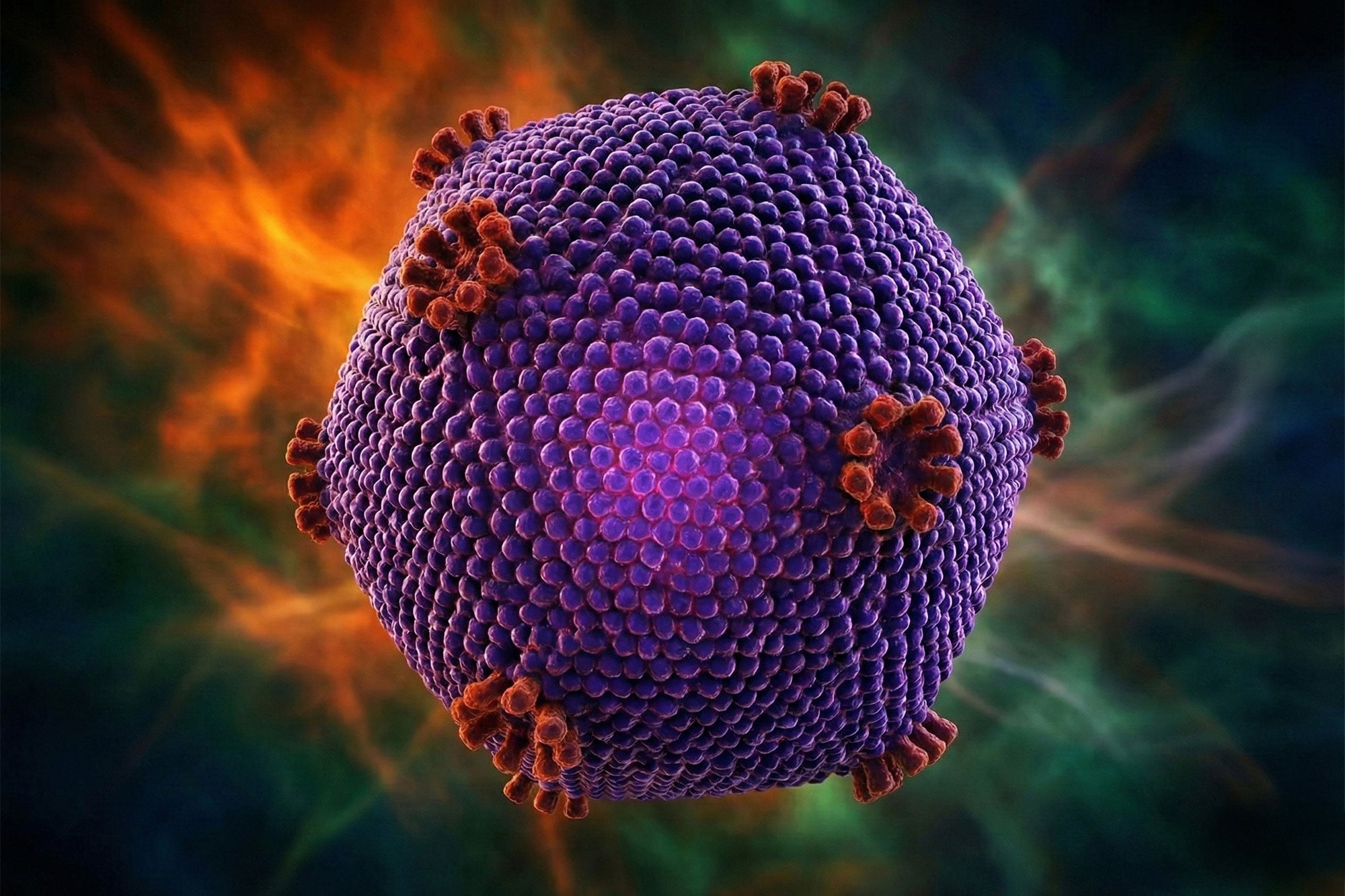
Ushikuvirus is a newly identified giant virus that infects amoebas, adding to a growing group of oversized viruses that scientists believe may have played an important role in the emergence of complex cellular life.
The story of how life began on Earth looks even more bizarre when viruses enter the picture. Many researchers suspect viruses have been present since the earliest cells emerged, yet they do not operate like other living things.
Because they consist only of genetic material, viruses cannot make proteins on their own, even though proteins are necessary for the basic chemistry that powers cells and supports life independently.
This unusual biology has fueled decades of debate about where viruses came from, how they changed over time, and where they belong on the traditional tree of life. Professor Masaharu Takemura of the Graduate School of Science, Tokyo University of Science (TUS), Japan, has been a key figure in this work.
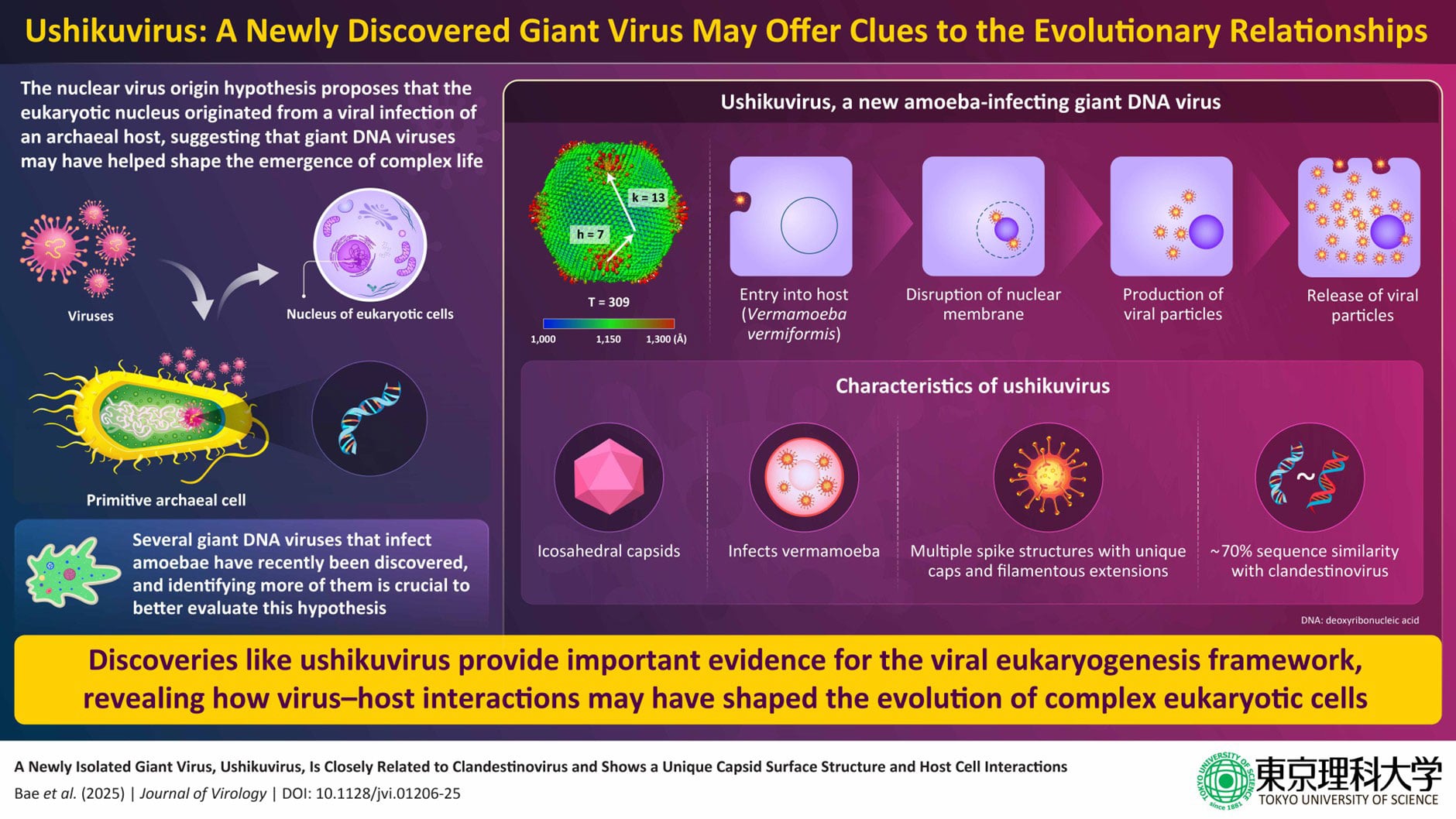
In 2001, he and Dr. Philip Bell of the Department of Biological Sciences, Macquarie University, Sydney, independently introduced the cell nuclear virus origin theory, also known as viral eukaryogenesis (term coined by Dr. Bell). The hypothesis proposes that the nucleus of eukaryotic cells (cells whose nucleus is bound by a membrane) began as a large DNA virus, such as a poxvirus, that infected an archaeal ancestor (single-celled microorganisms).
Rather than destroying its host, the virus is thought to have persisted inside the cytoplasm for long periods, gradually capturing important genes from the host until it evolved into the structure we now identify as the eukaryotic nucleus. If correct, the idea would place viruses among the drivers of life’s earliest major transitions.
Giant Viruses and Viral Factories
Support for this line of thinking has grown with the discovery of giant DNA viruses in 2003. When these viruses infect cells, they create dedicated compartments known as virus factories within the host. In some cases, those compartments are wrapped in a membrane and act as sites for DNA replication, a setup that resembles a nucleus and suggests a possible evolutionary relationship between viruses and the rise of complex cells.
More recently, scientists have continued to uncover additional DNA viruses, including the family Mamonoviridae, which infect acanthamoeba (a type of amoeba, which is a single-celled microorganism). Researchers have also described a closely related virus called clandestinovirus, which infects vermamoeba (another type of amoeba from a different family).
Ushikuvirus: A New Giant Virus
In a joint study published in the Journal of Virology, Prof. Takemura and collaborators from the National Institute of Natural Sciences (NINS), Japan, report another giant DNA virus that infects amoeba. The newly identified virus was named ushikuvirus after Lake Ushiku in the Ibaraki Prefecture of Japan, where it was isolated. The finding adds further weight to the nuclear virus origin hypothesis.
The research team included Mr. Jiwan Bae and Mrs. Narumi Hantori, Master’s degree students at the Graduate School of Science, TUS, as well as Dr. Raymond Burton-Smith and Professor Kazuyoshi Murata from NINS.
“Giant viruses can be said to be a treasure trove whose world has yet to be fully understood. One of the future possibilities of this research is to provide humanity with a new view that connects the world of living organisms with the world of viruses,” says Prof. Takemura.
Giant viruses are ubiquitously present in the environment. However, their isolation remains a challenge. These viruses are highly diverse and the discovery of ushikuvirus is extremely valuable. The newly discovered ushikuvirus infects vermamoeba, like clandestinovirus, and is morphologically similar to members of the Mamonoviridae family, particularly Medusavirus, a genus characterized by its icosahedral shape and numerous short spikes on the capsid surface.
However, ushikuvirus also shows distinct features: it induces a specific cytopathic effect that causes its vermamoeba hosts to grow into unusually large cells, and it possesses multiple spike structures with unique caps on the capsid surface, some with filamentous extensions, not seen in medusaviruses.
Insights Into Viral Replication and Evolution
Additionally, unlike medusaviruses and clandestinovirus, which replicate within the intact host nucleus, ushikuvirus disrupts the nuclear membrane to produce viral particles. This suggests a phylogenetic link between Mamonoviridae family that utilizes intact nucleus as viral factory and giant viruses like pandoravirus that disrupt the nuclear membrane for replication. Researchers believe that these variations between viruses may have evolved as adaptations to their hosts.
By comparing these structural and functional differences, researchers are beginning to piece together how giant viruses have diversified over time and how their interactions with host cells may have shaped the evolution of complex eukaryotic life.
“The discovery of a new Mamonoviridae-related virus, ‘ushikuvirus,’ which has a different host, is expected to increase knowledge and stimulate discussion regarding the evolution and phylogeny of the Mamonoviridae family. As a result, it is believed that we will be able to get closer to the mysteries of the evolution of eukaryotic organisms and the mysteries of giant viruses,” says Prof. Takemura.
The discovery of these amoeba-infecting viruses could have practical implications for healthcare. Because certain Acanthamoeba species can cause diseases such as amoebic encephalitis, understanding how giant viruses infect and destroy amoebae may one day help scientists develop new strategies to prevent or treat such infections.
Reference: “A newly isolated giant virus, ushikuvirus, is closely related to clandestinovirus and shows a unique capsid surface structure and host cell interactions” by Jiwan Bae, Narumi Hatori, Raymond N. Burton-Smith, Kazuyoshi Murata and Masaharu Takemura, 24 November 2025, Journal of Virology.
DOI: 10.1128/jvi.01206-25
This research was supported by JSPS/KAKENHI grant number 20H03078 and Joint Research of the Exploratory Research Center on Life and Living Systems (ExCELLS) (ExCELLS program No, 22EXC601-4).
Never miss a breakthrough: Join the SciTechDaily newsletter.
Follow us on Google and Google News.