
Close Menu
    Facebook X (Twitter) Instagram
    SciTechDaily
    • Biology
    • Chemistry
    • Earth
    • Health
    • Physics
    • Science
    • Space
    • Technology
    Facebook X (Twitter) Pinterest YouTube RSS
    SciTechDaily
    Home»Space»New Images and 3D Model of Comet 67P
    Space

    New Images and 3D Model of Comet 67P

    By Dr. Tony Phillips, Science@NASAJuly 25, 20141 Comment3 Mins Read
    Facebook Twitter Pinterest Telegram LinkedIn WhatsApp Email Reddit
    Share
    Facebook Twitter LinkedIn Pinterest Telegram Email Reddit
    New Views of the Rosetta Comet
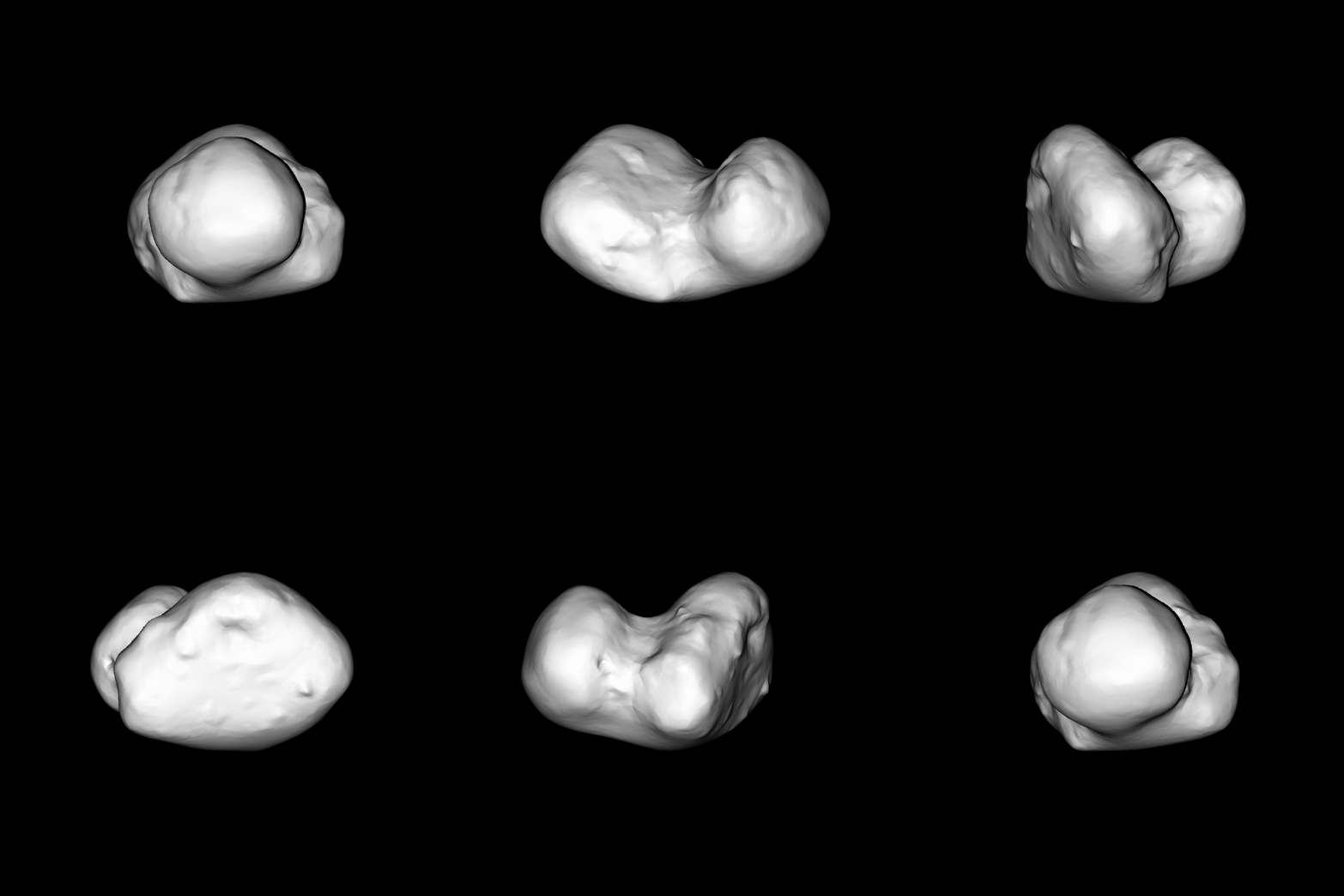
    Images of comet 67P/Churyumov-Gerasimenko taken on July 14, 2014, by the OSIRIS imaging system aboard the European Space Agency’s Rosetta spacecraft have allowed scientists to create this three-dimensional shape model of the nucleus. Credit: ESA/Rosetta/MPS for OSIRIS Team/MPS/UPD/LAM/IAA/SSO/INTA/UPM

    New images from ESA’s Rosetta spacecraft reveal surface structures of comet 67P/Churyumov-Gerasimenko, allowing scientists to create a 3D shape model of the nucleus.

    As the European Space Agency’s Rosetta probe approaches Comet 67P/Churyumov-Gerasimenko (67P) for an August rendezvous, the comet’s core is coming into sharper focus. Today, ESA released a new set of images and a striking 3D model of 67P’s nucleus.

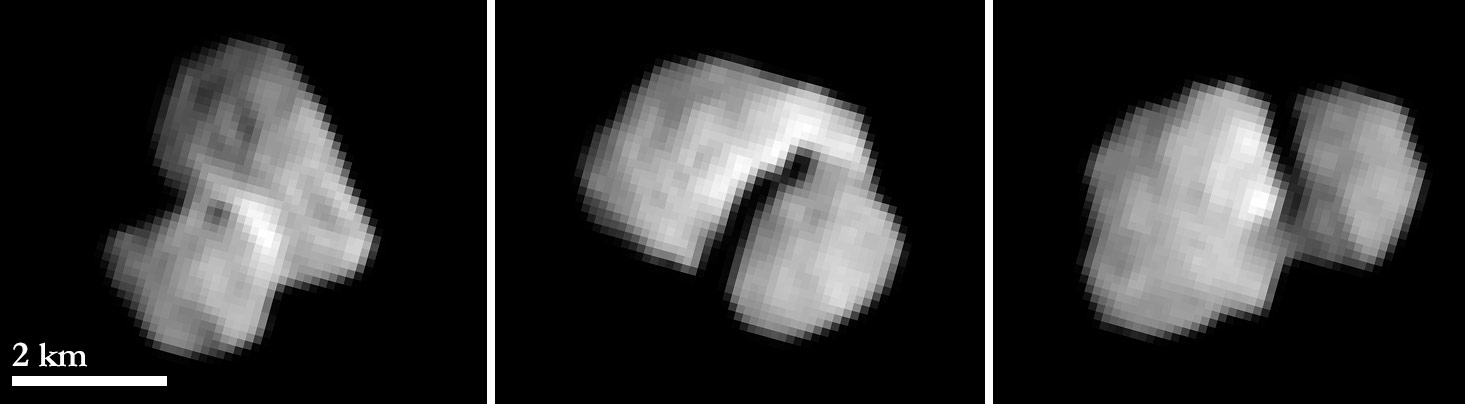
    The resolution of the latest images taken by the spacecraft’s OSIRIS imaging system on July 20th is 330 feet (100 meters) per pixel. At that resolution, 67P appears to consist of two parts: a smaller head connected to a larger body. The connecting region, the neck, is proving to be especially intriguing.

    “The only thing we know for sure at this point is that this neck region appears brighter compared to the head and body of the nucleus,” says OSIRIS Principal Investigator Holger Sierks from the Max Planck Institute for Solar System Research in Germany. This collar-like appearance could be caused by differences in material or grain size, or could be a topographical effect–no one knows.
    Surface Impressions of Rosetta Comet
    Comet 67P/Churyumov-Gerasimenko was imaged by the European Space Agency’s Rosetta spacecraft on July 20, 2014, from a distance of approximately 3,400 miles (5,500 kilometers). These three images were taken two hours apart. Credit: ESA/Rosetta/MPS for OSIRIS Team/MPS/UPD/LAM/IAA/SSO/INTA/UPM

    The appearance of 67P reminds mission scientists of comet 103P/Hartley, which was visited in a flyby by NASA’s EPOXI mission in 2010. While Hartley’s ends show a rather rough surface, its middle is much smoother. Scientists believe this waist to be a “gravitational low.” Because it contains the body’s center of mass, material kicked up by, say, meteoroid impacts, that cannot leave the comet’s gravitational field is most likely to be re-deposited there.

    Whether this also holds true for 67P’s neck region is still unclear. Another explanation for the high reflectivity could be a different surface composition. In the coming weeks, the OSIRIS team hopes to analyze the spectral data of this region obtained with the help of the imaging system’s filters. These can select several wavelength regions from the reflected light, allowing scientists to identify the fingerprints of certain materials and compositional features.

    Rosetta will be the first mission in history to rendezvous with a comet, escort it as it orbits the sun, and deploy a lander to its surface. ESA says the next high-resolution OSIRIS image will be published on July 31st. Stay tuned!

    Never miss a breakthrough: Join the SciTechDaily newsletter.
    Follow us on Google and Google News.

    Astronomy Astrophysics Comet NASA
    Share. Facebook Twitter Pinterest LinkedIn Email Reddit

    Related Articles

    Cosmic Chameleons: Mysterious “Dark Comets” May Hold Clues to Life’s Origins on Earth

    Webb Telescope Captures Mysterious Gas Jets From Speeding Object in the Outer Solar System

    Astronomers Discover “One of a Kind” Glow Surrounding Comet – Ultraviolet Atomic Emissions

    Dozens of ‘Comet Crumbs’ Detected by LISA Pathfinder [Video]

    Research Shows a Significant Increase in the Amount of Water “Pouring” Out of Comet 67P

    NASA Preparing for Comet Siding Spring’s “Close” Flyby of Mars

    Astronomers Reveal the True Identity of Mysterious Centaurs

    Comet ISON’s Journey Toward the Sun

    NASA’s Swift Helps Astronomers Get a Closer Look at Comet ISON

    1 Comment

    1. windows clock on July 7, 2019 10:49 pm

      Thank you for this valuable information. if you are looking for a online help from managing your device time and date setting when it comes to read my suggest web tutorial and know all about things in this issue.

      Reply
    Leave A Reply Cancel Reply

    • Facebook
    • Twitter
    • Pinterest
    • YouTube

    Don't Miss a Discovery

    Subscribe for the Latest in Science & Tech!

    Trending News

    Scientists Say This Natural Hormone Reverses Obesity by Targeting the Brain

    35-Million-Year-Old Mystery: Strange Arachnid Discovered Preserved in Amber

    Is AI Really Just a Tool? It Could Be Altering How You See Reality

    JWST Reveals a “Forbidden” Planet With a Baffling Composition

    The Protein “Sabotaging” Aging Muscle Recovery Could Be Key to Surviving Aging

    This Diet–Gut Interaction Could Transform Fat Into a Calorie-Burning Machine

    Scientists Discover Hidden Virus Linked to Colorectal Cancer

    Scientists Discover 132-Million-Year-Old Dinosaur Tracks on South Africa’s Coast

    Follow SciTechDaily
    • Facebook
    • Twitter
    • YouTube
    • Pinterest
    • Newsletter
    • RSS
    SciTech News
    • Biology News
    • Chemistry News
    • Earth News
    • Health News
    • Physics News
    • Science News
    • Space News
    • Technology News
    Recent Posts
    • Scientists Uncover Hidden Superconductivity in Material Once Thought Only Magnetic
    • Scientists Baffled by Bizarre “Living Fossil” From 275 Million Years Ago
    • 500 Million Years Ago, Life Changed Forever: Scientists Reveal the DNA Changes That Helped Animals Move Onto Land
    • Surprise RNA Discovery Challenges Long-Held Beliefs About How Genes Work
    • Your IQ at 23 Could Predict Your Wealth at 27, Study Finds
    Copyright © 1998 - 2026 SciTechDaily. All Rights Reserved.
    • Science News
    • About
    • Contact
    • Editorial Board
    • Privacy Policy
    • Terms of Use

    Type above and press Enter to search. Press Esc to cancel.