
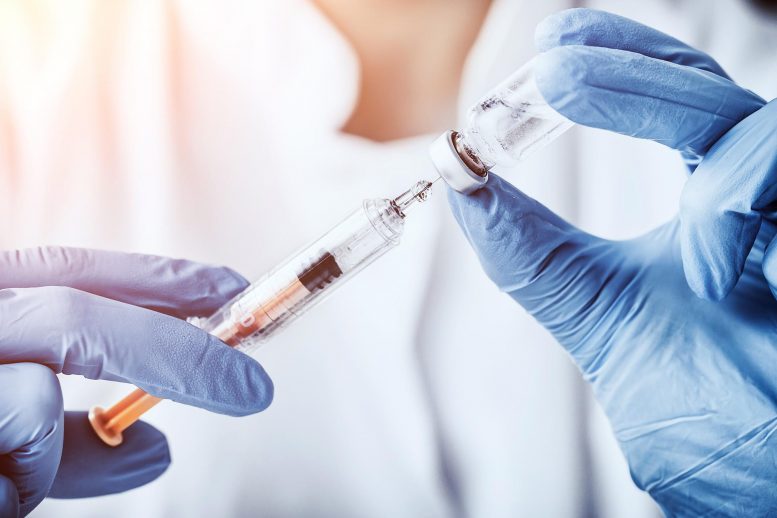
Flu season comes around like clockwork every year, and sooner or later everyone gets infected. The annual flu shot is a key part of public health efforts to control the flu, but the vaccine’s effectiveness is notoriously poor, falling somewhere from 40% to 60% in a typical year.
A growing body of evidence suggests that a history of exposure to influenza virus might be undermining the effectiveness of the annual flu vaccine. Partial immunity developed during prior flu seasons — either through natural infection or vaccination — might interfere with the body’s response to a new vaccine, such that vaccination mainly boosts the recognition of prior influenza strains but does little to create the ability to fight new strains.
Now, a team led by researchers at Washington University School of Medicine in St. Louis has developed an approach to assess whether a vaccine activates the kind of immune cells needed for long-lasting immunity against new influenza strains. Using this technique, the researchers showed that the flu vaccine is capable of eliciting antibodies that protect against a broad range of flu viruses, at least in some people. The findings, published August 31 in the journal Nature, could aid efforts to design an improved flu vaccine that provides protection not only against old influenza viruses but also new ones.
“Every year, about half of the U.S. adult population gets vaccinated against influenza,” said senior author Ali Ellebedy, Ph.D., an assistant professor of pathology and immunology at Washington University. “It’s necessary for public health, but it’s also incredibly expensive and inefficient. What we need is a one-and-done influenza shot, but we are not there yet. Anything that helps us understand how immunity develops in the context of prior exposures would be important as we try to make a better vaccine.”
The key to long-lasting immunity lies in lymph nodes, minuscule organs of the immune system positioned throughout the body. Easy to miss in healthy people, lymph nodes become swollen and tender during an infection as immune cells busily interact and multiply within them.
The first time a person is exposed to a virus – either by infection or vaccination – immune cells capture the virus and bring it to the nearest lymph node. There, the virus is presented to so-called naïve B cells, causing them to mature and start producing antibodies to fight the infection. Once the virus is successfully routed, most of the immune cells that take part in the battle die off, but a few continue circulating in the blood as long-lived memory B cells.
The second time a person is exposed to a virus, memory B cells quickly reactivate and start producing antibodies again, bypassing naive B cells. This rapid response quickly builds protection for people who have been reinfected with the exact same strain of virus, but it’s not ideal for people who have received a vaccine designed to build immunity against a slightly different strain, as in the annual flu vaccine.
“If our influenza vaccine targets memory cells, those cells will respond to the parts of the virus that haven’t changed from previous influenza strains,” Ellebedy said. “Our goal is to get our immune system up to date with the new strains of influenza, which means we want to focus the immune response on the parts of the virus that are different this year.”
To get decades-long immunity against the new strains, the flu strains from the vaccine need to be taken to the lymph nodes, where they can be used to train a new set of naïve B cells and induce long-lived memory B cells specifically tailored to recognize the unique features of the vaccine strains.
To find out what happens inside lymph nodes after influenza vaccination, Ellebedy enlisted the help of co-authors Rachel Presti, MD, Ph.D., an associate professor of medicine, and Sharlene Teefey, MD, a professor of radiology at Washington University. Presti led a team at the Infectious Disease Clinical Research Unit that coordinated the sampling of blood and lymph nodes from healthy volunteers before and after vaccination. Guided by ultrasound imaging, Teefey carefully extracted so-called germinal centers that hold immune cells from underarm lymph nodes of eight healthy, young volunteers vaccinated with the 2018-19 quadrivalent influenza vaccine. That vaccine was designed to protect against four different strains of influenza virus. The immune cells were extracted at one, two, four, and nine weeks after vaccination.
Ellebedy and colleagues - including co-senior authors Steven Kleinstein, Ph.D., a professor of pathology at Yale University School of Medicine, and Andrew Ward, Ph.D., a professor of integrative structural and computational biology at Scripps Research Institute, as well as co-first-authors Jackson Turner, Ph.D., a postdoctoral researcher who works with Ellebedy, Julian Zhou, a graduate student in Kleinstein’s lab, and Julianna Han, Ph.D., a postdoctoral scholar who works with Ward – analyzed the immune cells in the germinal centers to find the ones that had been activated by vaccination.
In three volunteers, both memory B cells and naïve B cells in the lymph nodes responded to the vaccine strains, indicating that the vaccine had initiated the process of inducing long-lasting immunity against the new strains.
“Our study shows that the influenza vaccine can engage both kinds of cells in the germinal centers, but we still don’t know how often that happens,” Ellebedy said. “But given that influenza vaccine effectiveness hovers around 50%, it probably doesn’t happen as often as we would like. That brings up the importance of promoting strategies to boost the germinal centers as a step toward a universal influenza vaccine.”
Reference: “Human germinal centres engage memory and naive B cells after influenza vaccination” by Jackson S. Turner, Julian Q. Zhou, Julianna Han, Aaron J. Schmitz, Amena A. Rizk, Wafaa B. Alsoussi, Tingting Lei, Mostafa Amor, Katherine M. McIntire, Philip Meade, Shirin Strohmeier, Rafael I. Brent, Sara T. Richey, Alem Haile, Yuhe R. Yang, Michael K. Klebert, Teresa Suessen, Sharlene Teefey, Rachel M. Presti, Florian Krammer, Steven H. Kleinstein, Andrew B. Ward and Ali H. Ellebedy, 31 August 2020, Nature.
DOI: 10.1038/s41586-020-2711-0
Never miss a breakthrough: Join the SciTechDaily newsletter.
Follow us on Google and Google News.