
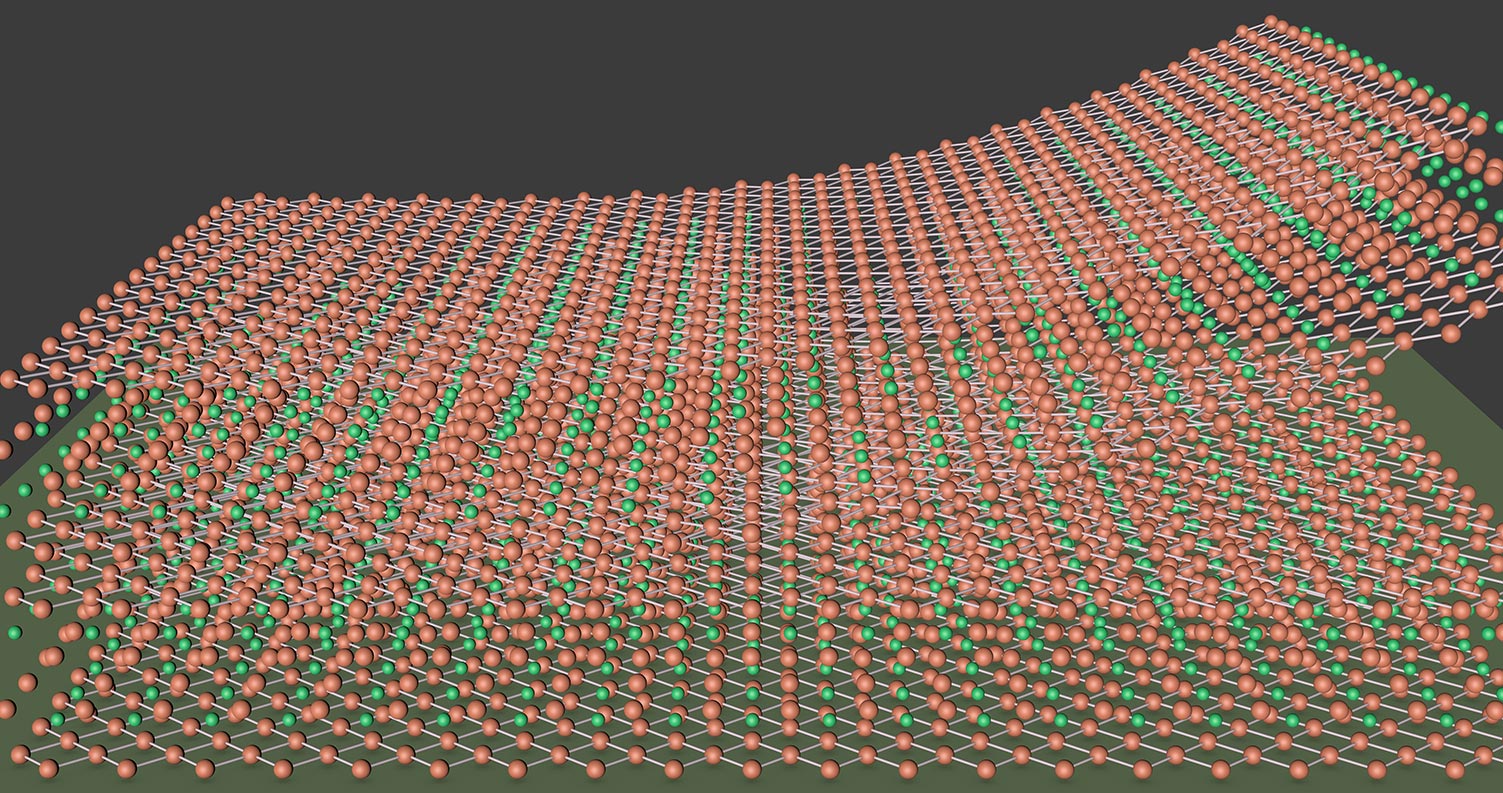
New material has highest electron mobility among known layered magnetic materials. Properties make it a promising candidate for new areas like magnetic twistronic devices and spintronics, as well as advances in data storage and device design.
All the elements are there to begin with, so to speak; it’s just a matter of figuring out what they are capable of – alone or together. For Leslie Schoop’s lab, one recent such investigation has uncovered a layered compound with a trio of properties not previously known to exist in one material.
With an international interdisciplinary team, Schoop, assistant professor of chemistry, and Postdoctoral Research Associate Shiming Lei, published a paper last week in Science Advances reporting that the van der Waals material gadolinium telluride (GdTe3) displays the highest electronic mobility among all known layered magnetic materials. In addition, it has magnetic order, and can easily be exfoliated.
Combined, these properties make it a promising candidate for new areas like magnetic twistronic devices and spintronics, as well as advances in data storage and device design.
The Schoop team initially uncovered these unique characteristics in early 2018 shortly after beginning the project. Their first success was in demonstrating that GdTe3 is easily exfoliable down to ultrathin flakes below 10nm. Subsequently, the team spent two years refining the purity of the material crystals to a state that only served to amplify the results. The lab has already shipped a number of samples to researchers eager to explore how the compound fits into a category previously occupied only by black phosphorous and graphite. High mobility is rare in layered materials.
The properties detailed in the study, described as quantum oscillations or “wiggles” that can be measured, are so pronounced that they were observed without the special probes and equipment generally found in national laboratories.
“Usually, if you see these oscillations, it depends partly on the quality of your sample. We really sat down and made the best crystals possible. Over the course of two years we improved the quality, so that these oscillations became more and more dramatic,” said Schoop. “But the first samples already showed them, even though with the first crystals we grew we didn’t know exactly what we were doing,” said Schoop, laughing.
“It was very exciting for us. We saw these results of highly mobile electrons in this material that we didn’t expect. Of course we were hoping for good results. But I didn’t anticipate it to be as dramatic,” Schoop added.
Lei characterized the news as a “breakthrough” largely because of the high mobility. “Adding this material into the zoo of 2D van der Waals materials is like adding a newly discovered ingredient for cooking, which allows for new flavors and dishes,” he said.
“So first, you get these materials out. The next thing is identifying the potential: what is the function of the device you can make from it? What is the performance we can further improve as a next generation of materials along this line?”
A rare-earth tritelluride, GdTe3 has a carrier mobility beyond 60,000 cm2V-1s-1. This means that if a field of one volt per cm is applied to the material, the electrons move with a net speed of 60,000 cm per second. To compare, mobilities in other magnetic materials are often found to be only a few hundred cm2V-1s-1 .
“High mobility is important because this means that electrons inside the materials are able to travel at high speeds with minimal scattering, thus reducing the heat dissipation of any electronic devices built from it,” said Lei.
Van der Waals materials – in which the layers are bound by a weak force – are the parent compounds of 2D materials. Researchers are studying them for next-generation device fabrication and also for use in twistronics, first described in the science community only a few years ago. With twistronics, the layers of 2D materials are misaligned or twisted as they lay atop one another. The judicious misalignment of the crystal lattice can change electrical, optical, and mechanical properties in ways that may yield new opportunities for applications.
In addition, it was discovered some 15 years ago that van der Waals materials could be exfoliated down to the thinnest layer by using something as commonplace as scotch tape. This revelation excited many new developments in physics. Finally, 2D materials were only recently revealed to exhibit magnetic order, in which the spins of electrons are aligned to each other. All “thin” devices — hard drives, for example – are based on materials ordering magnetically in different ways that produce different efficiencies.
“We have found this material where the electrons shoot through as on a highway – perfect, very easily, fast,” said Schoop. “Having this magnetic order in addition and the potential to go to two dimensions is just something that was uniquely new for this material.”
The results of the study are a strong showing for Schoop’s young lab, established just over two years ago. They are the product of a collaboration with the Princeton Center for Complex Materials, an NSF-funded Materials Research Science and Engineering Center, and co-authors Nai Phuan Ong, Sanfeng Wu, and Ali Yazdani, all faculty with Princeton’s Department of Physics.
To fully understand the electronic and magnetic properties of GdTe3, the team also collaborated with Boston College for exfoliation tests, and Argonne National Laboratory and the Max Planck Institute for Solid State Research to understand the electronic structure of the material using synchroton radiation.
From a broader perspective, what satisfied Schoop most about the study was the “chemical intuition” that led the team to begin the investigation with GdTe3 in the first place. They suspected there would be promising results. But the fact that GdTe3 yielded them so quickly and emphatically is a sign, said Schoop, that chemistry has significant contributions to make to the field of solid state physics.
“We’re a group in the chemistry department and we figured out that this material should be of interest for highly mobile electrons based on chemical principles,” said Schoop. “We were thinking about how the atoms were arranged in these crystals and how they should be bonded to each other, and not based on physical means, which is often understanding the energy of electrons based on Hamiltonians.
“But we took a very different approach, much more related to drawing pictures, like chemists do, related to orbitals and things like that,” she said. “And we were successful with this approach. It’s just such a unique and different approach in thinking about exciting materials.”
Reference: “High mobility in a van der Waals layered antiferromagnetic metal” by Shiming Lei, Jingjing Lin, Yanyu Jia, Mason Gray, Andreas Topp, Gelareh Farahi, Sebastian Klemenz, Tong Gao, Fanny Rodolakis, Jessica L. McChesney, Christian R. Ast, Ali Yazdani, Kenneth S. Burch, Sanfeng Wu, Nai Phuan Ong and Leslie M. Schoop, 7 February 2020, Science Advances,
DOI: 10.1126/sciadv.aay6407
The paper, S. Lei, J. Lin, Y. Jia, M. Gray, A. Topp, G. Farahi, S. Klemenz, T. Gao, F. Rodolakis, J. L. McChesney, C.R. Ast, A. Yazdani, K. S. Burch, S. Wu, N.P. Ong, and L.M. Schoop appeared in an online issue of Science Advances on February 7, 2020, (Lei et. al., Sci. Adv. 6, eaay6407 2020). This research was supported by the NSF through the Princeton Center for Complex Materials (Award # NSF DMR 1420541). L.M.S. was supported by a Beckman Young Investigator award from the Arnold and Mabel Beckman Foundation. L.M.S. and S.L. were additionally supported by a MURI grant on Topological Insulators from the Army Research Office (grant number ARO W911NF-12-1-0461).
Never miss a breakthrough: Join the SciTechDaily newsletter.
Follow us on Google and Google News.