
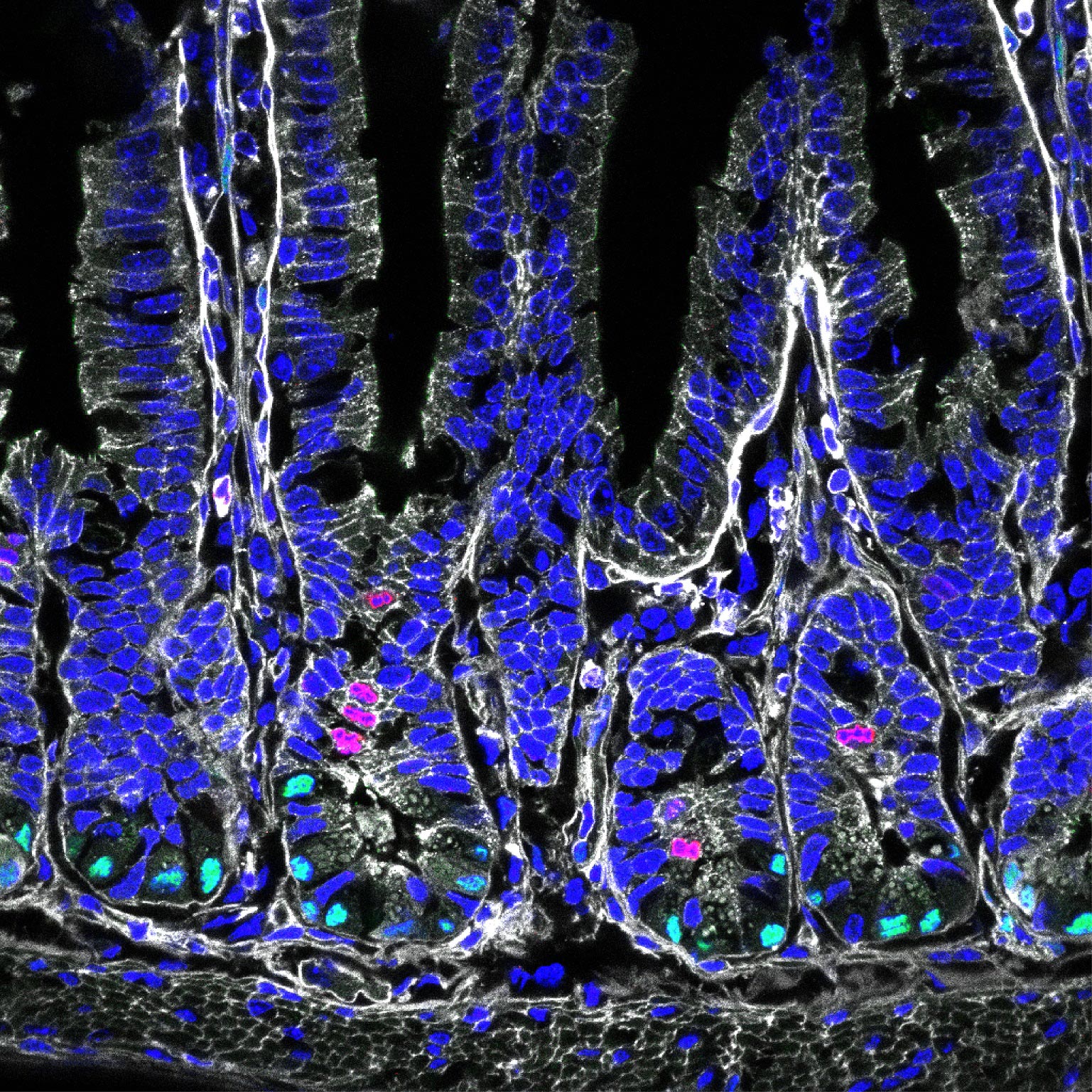
The intestine is essential for maintaining our energy balance and is a master at reacting quickly to changes in nutrition and nutrient balance. It manages to do this with the help of intestinal cells that among other things are specialized in the absorption of food components or the secretion of hormones. In adult humans, the intestinal cells regenerate every five to seven days. The ability to constantly renew and develop all types of intestinal cells from intestinal stem cells is crucial for the natural adaptability of the digestive system. However, a long-term diet high in sugar and fat disrupts this adaptation and can contribute to the development of obesity, type 2 diabetes, and gastrointestinal cancer.
The molecular mechanisms behind this maladaptation are part of the research field of Heiko Lickert and his group at Helmholtz Munich and the Technical University of Munich. The scientists assume that intestinal stem cells play a special role in maladaptation. Using a mouse model, the researchers investigated the effects of a high-sugar and high-fat diet and compared it with a control group.
From High-Calorie Diet to Increased Risk of Gastrointestinal Cancer
“The first thing we noticed was that the small intestine increases greatly in size on the high-calorie diet,” says study leader Anika Böttcher. “Together with Fabian Theis’ team of computational biologists at Helmholtz Munich, we then profiled 27,000 intestinal cells from control diet and high fat/high sugar diet-fed mice. Using new machine learning techniques, we thus found that intestinal stem cells divide and differentiate significantly faster in the mice on an unhealthy diet.” The researchers hypothesize that this is due to an upregulation of the relevant signaling pathways, which is associated with an acceleration of tumor growth in many cancers. “This could be an important link: Diet influences metabolic signaling, which leads to excessive growth of intestinal stem cells and ultimately to an increased risk of gastrointestinal cancer,” says Böttcher.
With the help of this high-resolution technique, the researchers have also been able to study rare cell types in the intestine, for example, hormone-secreting cells. Among their findings, they were able to show that an unhealthy diet leads to a reduction in serotonin-producing cells in the intestine. This can result in intestinal inertia (typical of diabetes mellitus) or increased appetite. Furthermore, the study showed that the absorbing cells adapt to the high-fat diet, and their functionality increases, thus directly promoting weight gain.
Important Basic Research for Non-Invasive Therapies
These and other findings from the study lead to a new understanding of disease mechanisms associated with a high-calorie diet. “What we have found out is of crucial importance for developing alternative non-invasive therapies,” says study leader Heiko Lickert, in summarizing the results. To date, there is no pharmacological approach to prevent, stop or reverse obesity and diabetes. Only bariatric surgery causes permanent weight loss and can even lead to remission of diabetes. However, these surgeries are invasive, non-reversible and costly to the healthcare system. Novel non-invasive therapies could happen, for example, at the hormonal level through targeted regulation of serotonin levels. The research group will examine this and other approaches in subsequent studies.
Reference: “Diet-induced alteration of intestinal stem cell function underlies obesity and prediabetes in mice” by Alexandra Aliluev, Sophie Tritschler, Michael Sterr, Lena Oppenländer, Julia Hinterdobler, Tobias Greisle, Martin Irmler, Johannes Beckers, Na Sun, Axel Walch, Kerstin Stemmer, Alida Kindt, Jan Krumsiek, Matthias H. Tschöp, Malte D. Luecken, Fabian J. Theis, Heiko Lickert and Anika Böttcher, 22 September 2021, Nature Metabolism.
DOI: 10.1038/s42255-021-00458-9
Heiko Lickert and Anika Böttcher conduct research at the Helmholtz Diabetes Center of Helmholtz Munich. They specialize in the development of regenerative treatment approaches for numerous widespread diseases associated with impaired gut function. Lickert heads the Institute for Diabetes and Regeneration Research and is a professor at the Technical University of Munich (TUM). Both are scientists at the German Center for Diabetes Research (DZD).
The current study has been published as a cover story in Nature Metabolism.
Never miss a breakthrough: Join the SciTechDaily newsletter.
Follow us on Google and Google News.
2 Comments
Very true. Diet is very important to treat any disease. I followed iahas.com for some great all-natural recipes to treat my condition. You can look and get some ideas on Ayurvedic (Ancient Indian Medications) remedies and recipes.
This study is flawed if the so called “unhealthy diet” constituted both fat and sugar. Notoriously the debate between what underpins a healthy diet is one where fat fueled diets (keto) and sugar fueled diets (plant-based / grain based) compete against one another, not in conjunction. The scientific literature nowadays seems to point more towards high-sugar diets being remarkably bad for ones metabolic health whereas substantial amounts of the right fat is crucial for optimal health. Therefore, to make this study valid and determine the true culprit here you’d have to rerun this study with a control group and then two experimental groups: 1 high sugar, 1 high fat. You could still include a combination group if you wanted to, but to tease out if fat or sugar is responsible here you’d have to isolate them out.