
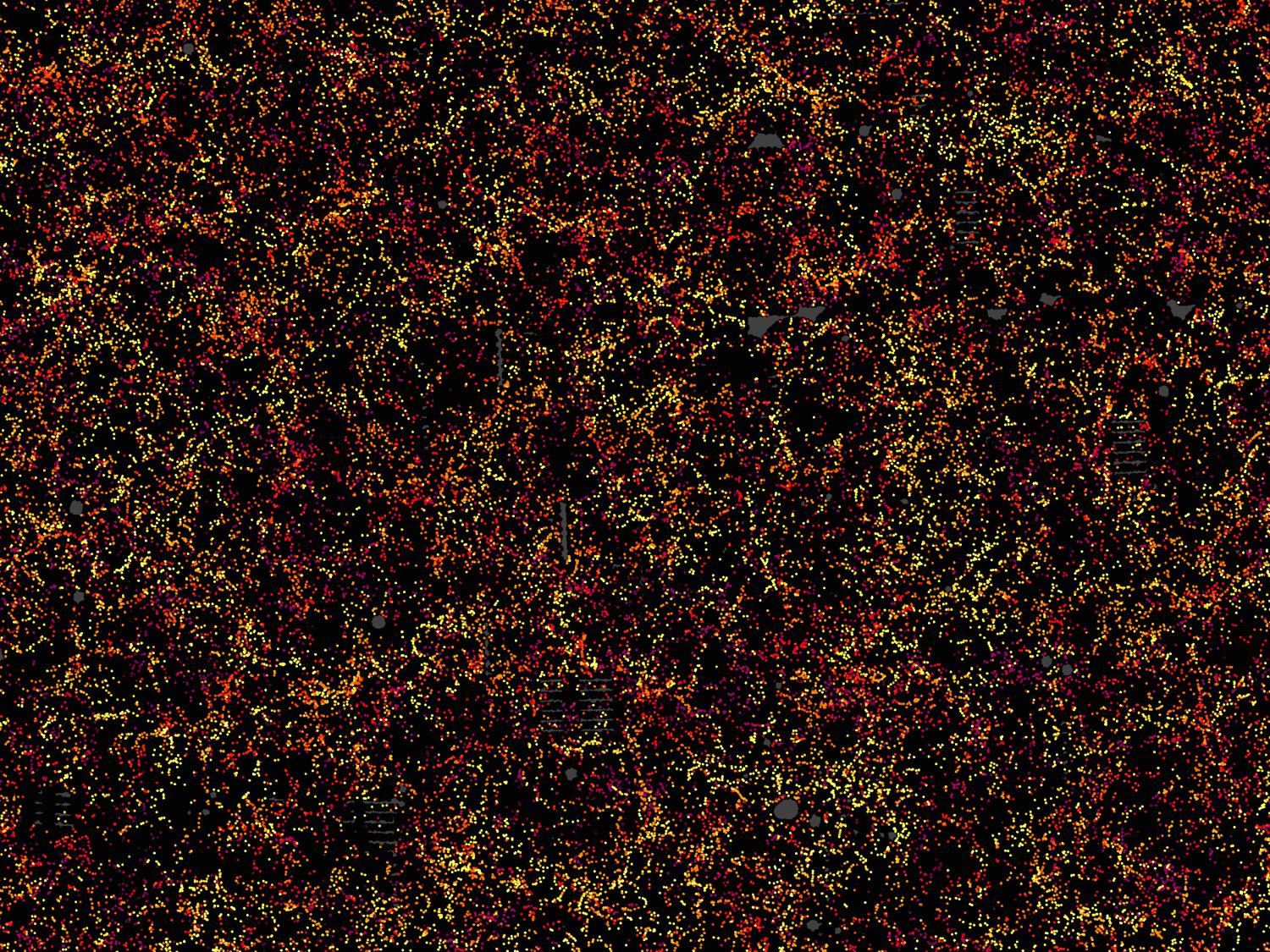
A new study details the results from the largest-ever, three-dimensional map of distant galaxies. The map is one of the most precise measurements yet of the dark energy currently driving the accelerated expansion of the Universe.
A team of hundreds of physicists and astronomers have announced results from the largest-ever, three-dimensional map of distant galaxies. The team constructed this map to make one of the most precise measurements yet of the dark energy currently driving the accelerated expansion of the Universe.
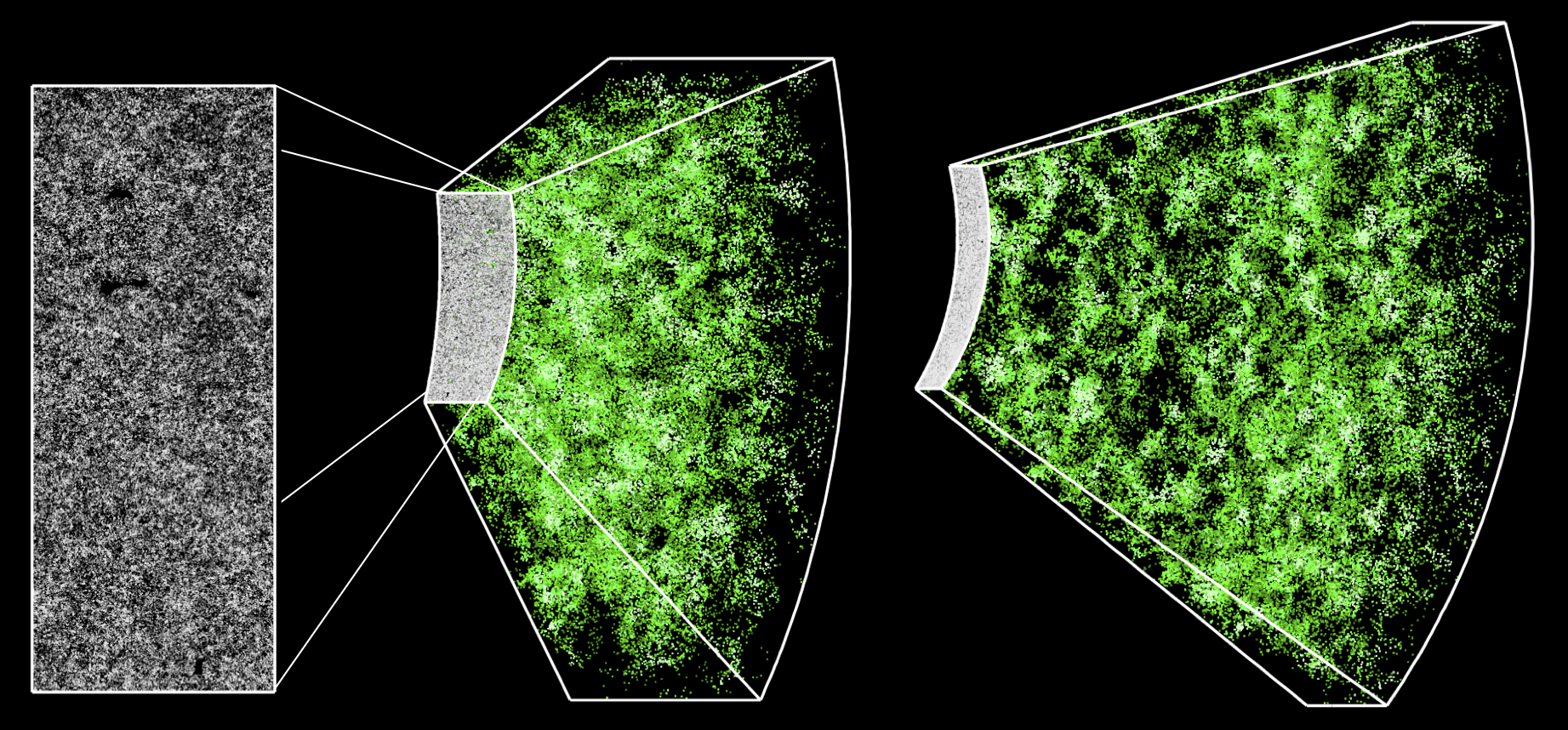
“We have spent five years collecting measurements of 1.2 million galaxies over one quarter of the sky to map out the structure of the Universe over a volume of 650 cubic billion light-years,” says Jeremy Tinker of New York University, a co-leader of the scientific team carrying out this effort. “This map has allowed us to make the best measurements yet of the effects of dark energy in the expansion of the Universe. We are making our results and map available to the world.”
Shirley Ho, an astrophysicist at Berkeley Lab and Carnegie Mellon University (CMU), co-led two of the companion papers and adds, “We can now measure how much the galaxies and stars cluster together as a function of time to such an accuracy we can test General Relativity at cosmological scales.”
Ariel Sanchez of the Max-Planck Institute of Extraterrestrial Physics led the effort to estimate the exact amount of dark matter and dark energy based on the BOSS data and explains: “Measuring the acoustic scale across cosmic history gives a direct ruler with which to measure the Universe’s expansion rate. With BOSS, we have traced the BAO’s subtle imprint on the distribution of galaxies spanning a range of time from 2 to 7 billion years ago.”
To measure the size of these ancient giant waves to such sharp precision, BOSS had to make an unprecedented and ambitious galaxy map, many times larger than previous surveys. At the time the BOSS program was planned, dark energy had been previously determined to significantly influence the expansion of the Universe starting about 5 billion years ago. BOSS was thus designed to measure the BAO feature from before this point (7 billion years ago) out to near the present day (2 billion years ago).
Jose Vazquez of Brookhaven National Laboratory combined the BOSS results with other surveys and searched for any evidence of unexplained physical phenomena in the results. “Our latest results tie into a clean cosmological picture, giving strength to the standard cosmological model that has emerged over the last eighteen years.”
Rita Tojeiro of the University of St. Andrews is the other co-leader of the BOSS galaxy clustering working group along with Tinker. “We see a dramatic connection between the sound wave imprints seen in the cosmic microwave background 400,000 years after the Big Bang to the clustering of galaxies 7-12 billion years later. The ability to observe a single well-modeled physical effect from recombination until today is a great boon for cosmology.”
The map also reveals the distinctive signature of the coherent movement of galaxies toward regions of the Universe with more matter, due to the attractive force of gravity. Crucially, the observed amount of infall is explained well by the predictions of general relativity.
“The results from BOSS provide a solid foundation for even more precise future BAO measurements, such as those we expect from the Dark Energy Spectroscopic Instrument (DESI),” says Natalie Roe, Physics Division director at Berkeley Lab. “DESI will construct a more detailed 3-dimensional map in a volume of space ten times larger to precisely characterize dark energy — and ultimately the future of our universe.”
Reference: “The clustering of galaxies in the completed SDSS-III Baryon Oscillation Spectroscopic Survey: cosmological analysis of the DR12 galaxy sample” by Shadab Alam, Metin Ata, Stephen Bailey, Florian Beutler, Dmitry Bizyaev, Jonathan A. Blazek, Adam S. Bolton, Joel R. Brownstein, Angela Burden, Chia-Hsun Chuang, Johan Comparat, Antonio J. Cuesta, Kyle S. Dawson, Daniel J. Eisenstein, Stephanie Escoffier, Héctor Gil-Marín, Jan Niklas Grieb, Nick Hand, Shirley Ho, Karen Kinemuchi, David Kirkby, Francisco Kitaura, Elena Malanushenko, Viktor Malanushenko, Claudia Maraston, Cameron K. McBride, Robert C. Nichol, Matthew D. Olmstead, Daniel Oravetz, Nikhil Padmanabhan, Nathalie Palanque-Delabrouille, Kaike Pan, Marcos Pellejero-Ibanez, Will J. Percival, Patrick Petitjean, Francisco Prada, Adrian M. Price-Whelan, Beth A. Reid, Sergio A. Rodríguez-Torres, Natalie A. Roe, Ashley J. Ross, Nicholas P. Ross, Graziano Rossi, Jose Alberto Rubiño-Martín, Ariel G. Sánchez, Shun Saito, Salvador Salazar-Albornoz, Lado Samushia, Siddharth Satpathy, Claudia G. Scóccola, David J. Schlegel, Donald P. Schneider, Hee-Jong Seo, Audrey Simmons, Anže Slosar, Michael A. Strauss, Molly E. C. Swanson, Daniel Thomas, Jeremy L. Tinker, Rita Tojeiro, Mariana Vargas Magaña, Jose Alberto Vazquez, Licia Verde, David A. Wake, Yuting Wang, David H. Weinberg, Martin White, W. Michael Wood-Vasey, Christophe Yèche, Idit Zehavi, Zhongxu Zhai and Gong-Bo Zhao, 11 July 2016, MNRAS.
DOI: 10.1093/mnras/stx721
arXiv:1607.03155
Never miss a breakthrough: Join the SciTechDaily newsletter.
Follow us on Google and Google News.
1 Comment
One quarter of the sky with 1.2 million galaxies in space volume of 650 cubic light years reveal the splendid appearance of galaxies at the time of formation into infinite number of super galaxies and galactic clusters which resemble like a turbid liquid in dissolution This itself will prove that all the universe was formed from a single Big Bang and its energy spewed out was only the Dark Energy, which got translated into light energy like matter and galaxies although to only 4%. The rest of the failed energy solidified into Dark Matter of about 25% and the rest remaining as Dark energy 71%. The creation of this observable universe is just a pie from the vast energy given out as Dark Matter. Why only one Big Bang? This answer lies in accepting multiverse theory where big bangs are common in multi universes but due to enormous distances only one big bang will be observable for us where in the Universe we live only for 13 billion years so far. The time scale is short for universal calculations. Thank You.