
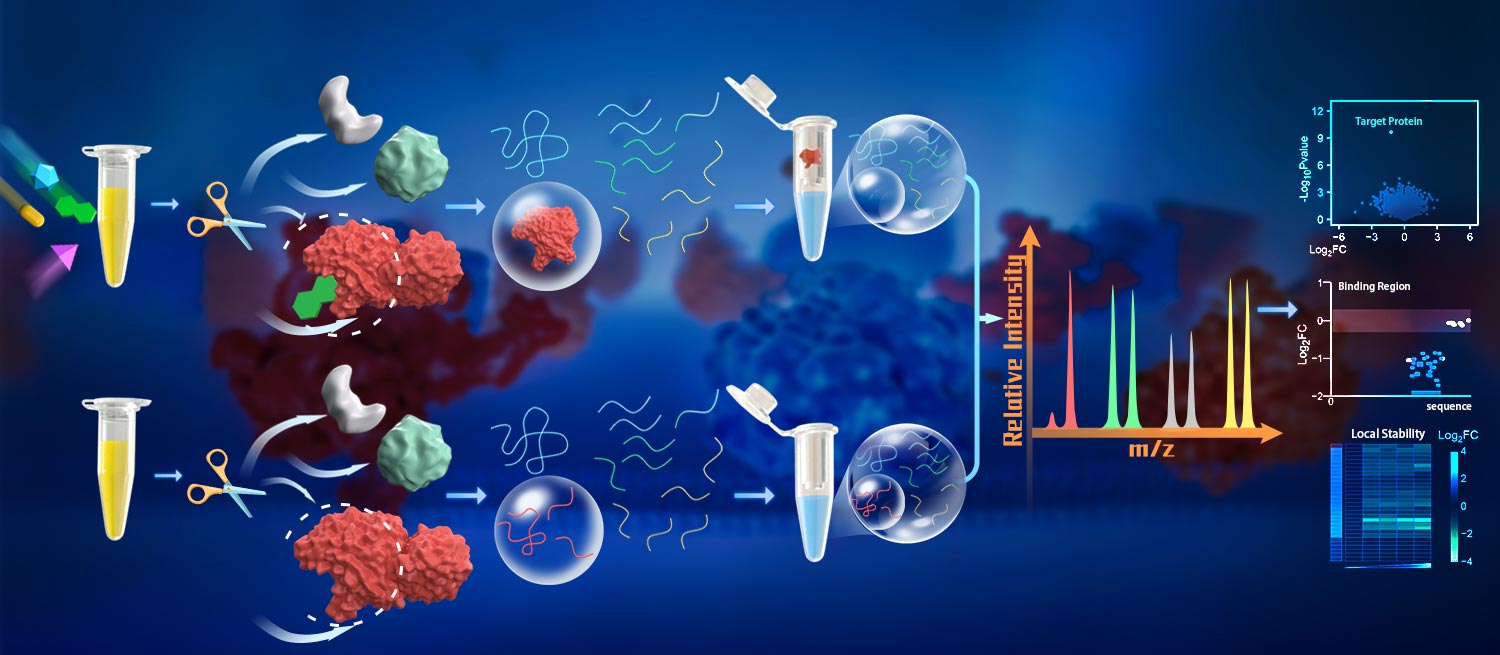
PELSA is a sensitive, versatile method for identifying ligand-binding proteins and sites in native systems without requiring ligand modification. It outperforms traditional approaches in sensitivity, especially for low-affinity metabolite interactions, and offers broad applications in drug design and biological studies.
A research team led by Prof. Mingliang Ye from the Dalian Institute of Chemical Physics, Chinese Academy of Sciences (CAS), in collaboration with Prof. Cheng Luo’s group from the Shanghai Institute of Materia Medica, CAS, has developed a highly sensitive proteomics technique known as the peptide-centric local stability assay (PELSA). Published in Nature Methods, this innovative method enables the simultaneous identification of ligand-binding proteins and their binding sites within complex systems. PELSA is highly versatile, applicable to a wide range of ligands such as metabolites, drugs, and pollutants.
Protein interactions with ligands—acting as enzyme substrates, inhibitors, signaling molecules, allosteric modulators, or structural anchors—are fundamental to their biochemical functions.
Characterizing protein-ligand interactions is crucial for identifying the functions of uncharacterized proteins, studying regulatory mechanisms in cellular metabolism, and understanding the mechanisms of drug action. Furthermore, pinpointing ligand-binding regions is invaluable for structure-based drug design and formulating biological hypotheses.
Limitations of Traditional Methods
Traditional methods for determining binding sites and affinities typically require the purification of recombinant proteins, which can be both time-consuming and labor-intensive. In addition, purified proteins may not fully replicate their native cellular state, resulting in inaccurate affinity measurements. Modification-based proteomics methods offer a powerful solution for identifying ligand-binding proteins and their sites directly in native cellular lysates. However, they often require ligand modification, which can affect ligand activity and cannot be applicable to ligands that cannot be modified.
In the method proposed in this study, the researchers used a large amount of trypsin (E/S ratio of 1:2) to directly generate small peptides from native proteins. As these peptides are generated under native conditions, their abundance represented a measurement of proteins’ local stability.
The large amount of trypsin ensured that even protein segments in low energy states could be cleaved, resulting in the generation of a large number of peptides reflecting protein’s local stability. These peptides were separated from the partially digested proteins, collected, and directly analyzed by mass spectrometry. By measuring the peptide abundance in ligand-treated and vehicle-treated samples, the ligand-binding regions and the corresponding binding proteins can then be determined.
Enhanced Sensitivity and Reliability
PELSA has shown superior sensitivity in target protein identifications. For example, in identifying the target proteins of a pan-kinase inhibitor staurosporine, PELSA showed a 12-fold increase in kinase target identification compared to the state-of-the-art modification-free method, LiP-MS. Compared to the widely used thermal proteome profiling (TPP) technique, which lacks binding site information, PELSA identified 2.4-fold more kinase targets. Dose-dependent PELSA experiments can measure local affinity, providing insights into the dynamic protein structural changes upon ligand binding under physiological conditions.
Metabolites, known for their structural diversity and often low-affinity binding to proteins, pose challenges. PELSA proved particularly effective for the systematic identification of metabolite-binding proteins. For example, PELSA identified 40 candidate target proteins for alpha-ketoglutarate in HeLa cell lysates, 30 of which were well-known binding proteins of alpha-ketoglutarate, demonstrating the method’s high sensitivity and reliability. In addition, PELSA identified binding proteins for other metabolites, such as folate, leucine, fumarate, and succinate, showcasing its broad applicability.
PELSA can directly detect ligand-induced local stability shifts of proteins in total cell lysate without the need for chemical modification of ligands. It is broadly applicable to diverse ligands, and allows for systematic analysis of ligand-binding proteins, their binding sites, and local binding affinities in cell lysate, where proteins carry physiological post-translational modifications and are associated with interacting proteins.
Reference: “A peptide-centric local stability assay enables proteome-scale identification of the protein targets and binding regions of diverse ligands” by Kejia Li, Shijie Chen, Keyun Wang, Yan Wang, Lianji Xue, Yuying Ye, Zheng Fang, Jiawen Lyu, Haiyang Zhu, Yanan Li, Ting Yu, Feng Yang, Xiaolei Zhang, Siqi Guo, Chengfei Ruan, Jiahua Zhou, Qi Wang, Mingming Dong, Cheng Luo and Mingliang Ye, 10 December 2024, Nature Methods.
DOI: 10.1038/s41592-024-02553-7
Never miss a breakthrough: Join the SciTechDaily newsletter.
Follow us on Google and Google News.