
Close Menu
    Facebook X (Twitter) Instagram
    SciTechDaily
    • Biology
    • Chemistry
    • Earth
    • Health
    • Physics
    • Science
    • Space
    • Technology
    Facebook X (Twitter) Pinterest YouTube RSS
    SciTechDaily
    Home»Science»New Possibilities for Characterizing Nanoparticle Interactions
    Science

    New Possibilities for Characterizing Nanoparticle Interactions

    By Environmental Molecular Sciences LaboratoryDecember 24, 2013No Comments3 Mins Read
    Facebook Twitter Pinterest Telegram LinkedIn WhatsApp Email Reddit
    Share
    Facebook Twitter LinkedIn Pinterest Telegram Email Reddit
    New Possibilities for Characterizing Nanoparticle Interactions
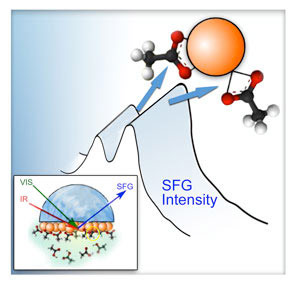
    Researchers used advanced techniques and a custom experimental setup to study how carboxylic acid molecules bind to ceria nanoparticle surfaces, shedding light on surface interactions that affect nanoparticle behavior. Credit: Environmental Molecular Sciences Laboratory

    New research from the Environmental Molecular Sciences Laboratory opens a new and potentially powerful way to characterize the interactions of nanoparticles with molecules in a range of environments.

    The Science

    Molecules anchored to the surfaces of nanoparticles modify and even control many characteristics of the particles, including how they interact with cells or react to light. The type of binding affects the nanoparticle’s behavior and interaction with surrounding particles, atoms, and molecules. Unfortunately, methods to directly study the surface bonding at a nanoparticle solid/liquid interface have been elusive, as the interface is usually not accessible by most existing techniques. Researchers at EMSL took advantage of advanced instrumental capabilities, a specially designed experimental cell, and theoretical modeling to successfully deduce how molecules of carboxylic acid– a common organic acid found in nature – bind to ceria nanoparticle surfaces.

    The Impact

    Because of this research, the scientific community now has a new and potentially powerful way to characterize the interactions of nanoparticles with molecules in a range of environments, possibly extending to their behaviors in living cells. As such “hidden” interfaces are common in nature and in our bodies, characterizing and understanding the structure and interactions where liquids and solids meet can accelerate the design of new molecules to solve problems in medicine, environmental remediation, climate studies, biofuels, catalysts, and energy storage.

    Summary

    The experimental work was performed on EMSL’s sum-frequency generation vibrational spectrometer (SFG-VS). SFG-VS is a sensitive optical spectroscopy that can selectively measure vibrational spectra of molecules bonded on surfaces with the “fingerprint” frequencies to help determine the bonding species and their structures. Because of experimental challenges and the difficulty of interpretation without theoretical guidance, SFG has not usually been extended to probe nanoparticle surfaces buried in liquid. At EMSL, an optical cell was designed to perform in-situ experiments using a CaF2 window (which can transmit infrared light) deposited with ceria nanoparticles in contact with acetic acid solution. SFG-VS identified resonant frequencies of the vibrations of molecular bonds between the acid and the ceria surfaces in different oxidation states.

    Theoretical modeling was crucial to the successful identification of the bonds. First-principles theory was used to predict the stable structures by modeling various ways acetic acid can bind to surface sites on ceria clusters. The resonant frequencies of thermodynamically favored structures were calculated to compare with those from the SFG-VS experiment. Modeling results revealed that acetic acid binds differently on reduced surfaces of ceria than on oxidized surfaces, in accord with experimental results.

    This work was supported by EMSL’s Intramural Research and Capability Program and the Laboratory Directed Research and Development program at Pacific Northwest National Laboratory.

    Reference: “Dissociative Binding of Carboxylic Acid Ligand on Nanoceria Surface in Aqueous Solution: A Joint In Situ Spectroscopic Characterization and First-Principles Study” by Zhou Lu, Ajay Karakoti, Luis Velarde, Weina Wang, Ping Yang, Suntharampillai Thevuthasan and Hong-fei Wang, 11 November 2013, Journal of Physical Chemistry C.
    DOI: 10.1021/jp4068747


    Never miss a breakthrough: Join the SciTechDaily newsletter.
    Follow us on Google and Google News.

    Environmental Molecular Sciences Laboratory Nanoparticles Nanoscience Nanotechnology
    Share. Facebook Twitter Pinterest LinkedIn Email Reddit

    Related Articles

    Researchers Combine Nanoparticles and Machines To Improve Transplant Outcomes

    Small Nanoparticles Provide Dramatic Improvements in Polymer Materials

    How Nanoscience Will Improve Our Lives in the Coming Years

    Engineers Develop New Lightweight Metal from Carbide Nanoparticles

    Nanoparticles and UV Light Clean Up Environmental Pollutants

    Nanoparticles Shut Down Cancer Growth

    Solid Nanoparticles Keep Their Internal Structure While Deforming Like a Liquid

    Study Shows Nanoparticles in Consumer Products Can Damage DNA

    Berkeley Lab Reports Direct Observation of Oriented Attachment in Nanocrystal Growth

    Leave A Reply Cancel Reply

    • Facebook
    • Twitter
    • Pinterest
    • YouTube

    Don't Miss a Discovery

    Subscribe for the Latest in Science & Tech!

    Trending News

    The Universe Is Expanding Too Fast and Scientists Can’t Explain Why

    “Like Liquid Metal”: Scientists Create Strange Shape-Shifting Material

    Early Warning Signals of Esophageal Cancer May Be Hiding in Plain Sight

    Common Blood Pressure Drug Shows Surprising Power Against Deadly Antibiotic-Resistant Superbug

    Scientists Uncover Dangerous Connection Between Serotonin and Heart Valve Disease

    Scientists Discover a “Protector” Protein That Could Help Reverse Hair Loss

    Bone-Strengthening Discovery Could Reverse Osteoporosis

    Scientists Uncover Hidden Trigger Behind Stem Cell Aging

    Follow SciTechDaily
    • Facebook
    • Twitter
    • YouTube
    • Pinterest
    • Newsletter
    • RSS
    SciTech News
    • Biology News
    • Chemistry News
    • Earth News
    • Health News
    • Physics News
    • Science News
    • Space News
    • Technology News
    Recent Posts
    • A Common Diabetes Drug May Hold the Key to Stopping HIV From Coming Back
    • Ancient “Syphilis-Like” Disease in Vietnam Challenges Key Scientific Assumptions
    • Drinking Alcohol To Cope in Your 20s Could Damage Your Brain for Life
    • Scientists Crack Alfalfa’s Chromosome Mystery After Decades of Debate
    • Ancient Ant-Plant Alliance Collapses As Predatory Wasps Move In
    Copyright © 1998 - 2026 SciTechDaily. All Rights Reserved.
    • Science News
    • About
    • Contact
    • Editorial Board
    • Privacy Policy
    • Terms of Use

    Type above and press Enter to search. Press Esc to cancel.