
Close Menu
    Facebook X (Twitter) Instagram
    SciTechDaily
    • Biology
    • Chemistry
    • Earth
    • Health
    • Physics
    • Science
    • Space
    • Technology
    Facebook X (Twitter) Pinterest YouTube RSS
    SciTechDaily
    Home»Biology»Power of Stem Cells Harnessed To Create Human Cartilage Tissue
    Biology

    Power of Stem Cells Harnessed To Create Human Cartilage Tissue

    By University of SouthamptonOctober 6, 20211 Comment3 Mins Read
    Facebook Twitter Pinterest Telegram LinkedIn WhatsApp Email Reddit
    Share
    Facebook Twitter LinkedIn Pinterest Telegram Email Reddit
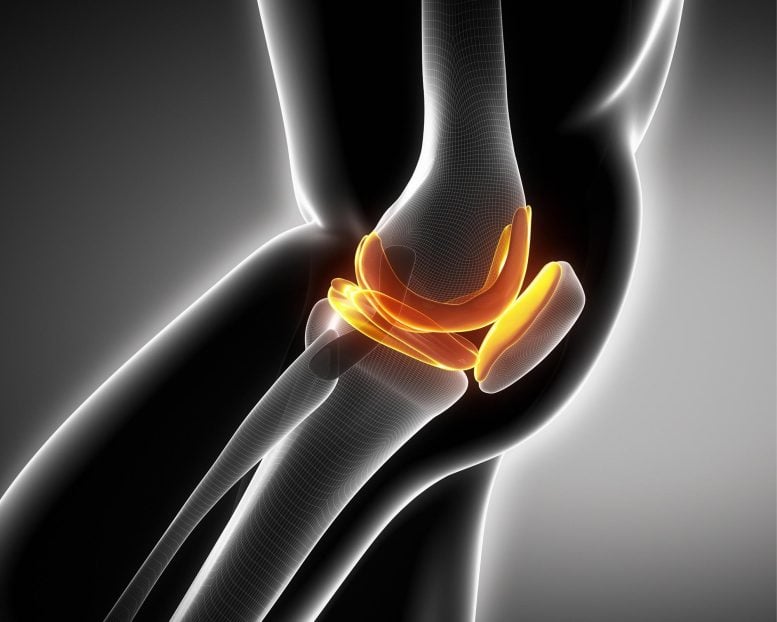
    Knee Cartilage Illustration
    Researchers have invented a novel method to produce human cartilage tissue from stem cells, offering potential for a new treatment for individuals with cartilage damage.

    Lab-engineered cartilage from stem cells offers a promising, longer-lasting alternative for joint damage repair.

    Researchers at the University of Southampton have invented a new way to generate human cartilage tissue from stem cells. The technique could pave the way for the development of a much-needed new treatment for people with cartilage damage.

    Cartilage acts as a shock absorber in joints, but it is susceptible to damage through daily wear-and-tear, or trauma from sports injuries and falls. The current gold-standard surgical approach to restore regions of damaged cartilage, using cartilage cells, is not wholly successful. This is because survival of the repair tissue, generated by cartilage cells at the site of damage, has been shown to decrease significantly after 5-10 years. As such, there is a need for a new way to promote robust, long-term repair through the implantation of cartilage tissue, as opposed to cartilage cells, at the site of damage.

    Scaffold-Free Cartilage Engineered from Stem Cells

    Scientists at the Centre for Human Development, Stem Cells and Regeneration think they may have found the answer. They generated cartilage tissue in the laboratory by successfully differentiating embryonic stem cells into cartilage cells, and then used these to generate three-dimensional pieces of cartilage tissue without any synthetic or natural supporting materials. This is known as a ‘scaffold-free’ cartilage tissue engineering technique. The generated cartilage tissue is structurally and mechanically comparable to normal human cartilage with the potential to form a stable and longer lasting repair than current treatment options available to patients.

    The researchers are the first to use the scaffold-free technique to generate cartilage tissue, which is scaled up beyond 1 mm without adversely affecting its structural and mechanical properties. The team hopes that eventually, after more research is conducted, this lab-created tissue could be routinely used in surgery to mend damaged cartilage.

    The interdisciplinary study, published in the journal Scientific Reports, was led by Dr. Franchesca Houghton and Dr Rahul Tare from the Faculty of Medicine at the University of Southampton.

    Dr. Houghton said: “This research is exciting as our ability to generate cartilage with properties akin to normal human cartilage has the potential to provide a robust tissue engineered product for cartilage repair.”

    Dr. Tare adds: “This tissue-based approach of replacing ‘like-for-like’ has the potential to constitute a step-change improvement in current cell-based surgical approaches for repairing damaged cartilage and improve long-term patient outcomes.”

    Reference: “A scaffold-free approach to cartilage tissue generation using human embryonic stem cells” by Lauren A. Griffith, Katherine M. Arnold, Bram G. Sengers, Rahul S. Tare and Franchesca D. Houghton, 28 September 2021, Scientific Reports.
    DOI: 10.1038/s41598-021-97934-9

    This research was funded by the Institute for Life Sciences and the Faculty of Medicine, University of Southampton; Rosetrees Trust; MRC CiC and EPSRC IAA.

    Never miss a breakthrough: Join the SciTechDaily newsletter.
    Follow us on Google and Google News.

    Biomedical Engineering Stem Cells Tissue University of Southampton
    Share. Facebook Twitter Pinterest LinkedIn Email Reddit

    Related Articles

    Bioengineers at Tufts Create Functional 3D Brain-Like Tissue

    Researchers Convert Human Stem Cells to Functional Lung Cells

    3D Printing of Human Embryonic Stem Cell Cultures

    Nanoparticle-Based System Advances Stem Cell Culture Techniques

    Stem Cells Regenerate Tissue in an Uninjured Mammal

    Physical Properties of Stem Cells Predict What They Will Become

    UCLA Discovery Suggests a Mechanism and Design Principle for the Engineering of Tissue

    Working To Save Infants, Researchers Transform Stem Cells Into Cells That Form Blood Vessels

    Researchers Use “Fracture Putty” to Quickly Repair Broken Bones

    1 Comment

    1. Sue Donem on October 11, 2021 8:28 am

      The day after my demise, there’ll be a cure. Yippee!

      Reply
    Leave A Reply Cancel Reply

    • Facebook
    • Twitter
    • Pinterest
    • YouTube

    Don't Miss a Discovery

    Subscribe for the Latest in Science & Tech!

    Trending News

    Wasp Colonies Explode Into Violence After Losing Their Queen

    Scientists Create “Living Plastic” That Self-Destructs in Just Six Days

    Your Blood May Carry a 700-Million-Year-Old Secret

    Scientists Discover Some “Zombie Cells” May Actually Help You Live Longer

    Earth May Be Seeding Venus With Life, According to New Research

    What Scientists Found Inside a 117-Year-Old Woman Reveals New Clues to Long Life

    Scientists Discover Mysterious Creature Living in the Great Salt Lake – and It Exists Nowhere Else on Earth

    It’s Alive? Surprising Discovery Changes What We Know About Fog

    Follow SciTechDaily
    • Facebook
    • Twitter
    • YouTube
    • Pinterest
    • Newsletter
    • RSS
    SciTech News
    • Biology News
    • Chemistry News
    • Earth News
    • Health News
    • Physics News
    • Science News
    • Space News
    • Technology News
    Recent Posts
    • Scientists Crack Major Ammonia Problem With a Platinum Catalyst Breakthrough
    • MIT Engineers Solve a Major Lidar Problem That Has Stumped Researchers for Years
    • NASA’s X-59 Sonic Boom Killer Is Ready for Its Biggest Test Yet
    • Why Some Cancers Turn Deadly: Researchers Uncover a Hidden Trigger
    • The Best Exercise Combination for Longevity, According to a 30-Year Study
    Copyright © 1998 - 2026 SciTechDaily. All Rights Reserved.
    • Science News
    • About
    • Contact
    • Editorial Board
    • Privacy Policy
    • Terms of Use

    Type above and press Enter to search. Press Esc to cancel.