
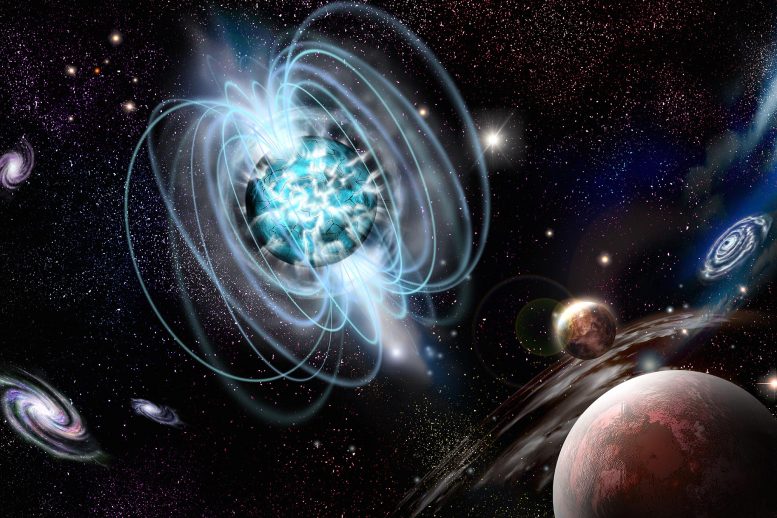
German-British research team simulates basic conditions for the formation of magnetic stars.
How do some neutron stars become the strongest magnets in the Universe? A German-British team of astrophysicists has found a possible answer to the question of how these so-called magnetars form. The researchers used large computer simulations to demonstrate how the merger of two stars creates strong magnetic fields. If such stars explode in supernovae, magnetars could result. Scientists from Heidelberg University, the Max Planck Society, the Heidelberg Institute for Theoretical Studies, and the University of Oxford were involved in the research. The results were published today (October 9, 2019) in Nature.
Our Universe is threaded by magnetic fields. The Sun, for example, has an envelope in which convection continuously generates magnetic fields. “Even though massive stars have no such envelopes, we still observe a strong, large-scale magnetic field at the surface of about ten percent of them,” explains Dr. Fabian Schneider from the Center for Astronomy of Heidelberg University, who is the first author of the study in Nature. Although such fields were already discovered in 1947, their origin has remained elusive so far.
Over a decade ago, scientists suggested that strong magnetic fields are produced when two stars collide. “But until now, we weren’t able to test this hypothesis because we didn’t have the necessary computational tools,” says Dr. Sebastian Ohlmann from the computing center of the Max Planck Society in Garching near Munich. This time, the researchers used the AREPO code, a highly dynamic simulation code running on compute clusters of the Heidelberg Institute for Theoretical Studies (HITS), to explain the properties of Tau Scorpii (τ Sco), a magnetic star located 500 light-years from Earth.
Already in 2016, Fabian Schneider and Philipp Podsiadlowski from the University of Oxford realized that τ Sco is a so-called blue straggler. Blue stragglers are the product of merged stars. “We assume that Tau Scorpii obtained its strong magnetic field during the merger process,” explains Prof. Dr. Philipp Podsiadlowski. Through its computer simulations of τ Sco, the German-British research team has now demonstrated that strong turbulence during the merger of two stars can create such a field.
Stellar mergers are relatively frequent: Scientists assume that about ten percent of all massive stars in the Milky Way are the products of such processes. This is in good agreement with the occurrence rate of magnetic massive stars, according to Dr. Schneider. Astronomers think that these very stars could form magnetars when they explode in supernovae.
This may also happen to τ Sco when it explodes at the end of its life. The computer simulations suggest that the magnetic field generated would be sufficient to explain the exceptionally strong magnetic fields in magnetars. “Magnetars are thought to have the strongest magnetic fields in the Universe – up to one hundred million times stronger than the strongest magnetic field ever produced by humans,” says Prof. Dr. Friedrich Röpke from HITS.
Reference: “Stellar mergers as the origin of magnetic massive stars” by Fabian R. N. Schneider, Sebastian T. Ohlmann, Philipp Podsiadlowski, Friedrich K. Röpke, Steven A. Balbus, Rüdiger Pakmor and Volker Springel, 9 October 2019, Nature.
DOI: 10.1038/s41586-019-1621-5
The research was funded by the Oxford Hintze Center for Astrophysical Surveys and the Klaus Tschira Foundation (Heidelberg).
Never miss a breakthrough: Join the SciTechDaily newsletter.
Follow us on Google and Google News.