
Our Immune Systems Blanket the SARS-CoV-2 Spike Protein With Antibodies
The most complete picture yet is coming into focus of how antibodies produced in people who effectively fight off SARS-CoV-2 work to neutralize the part of the virus responsible for causing infection. In the journal Science, researchers at The University of Texas at Austin describe the finding, which represents good news for designing the next generation of vaccines to protect against variants of the virus or future emerging coronaviruses.
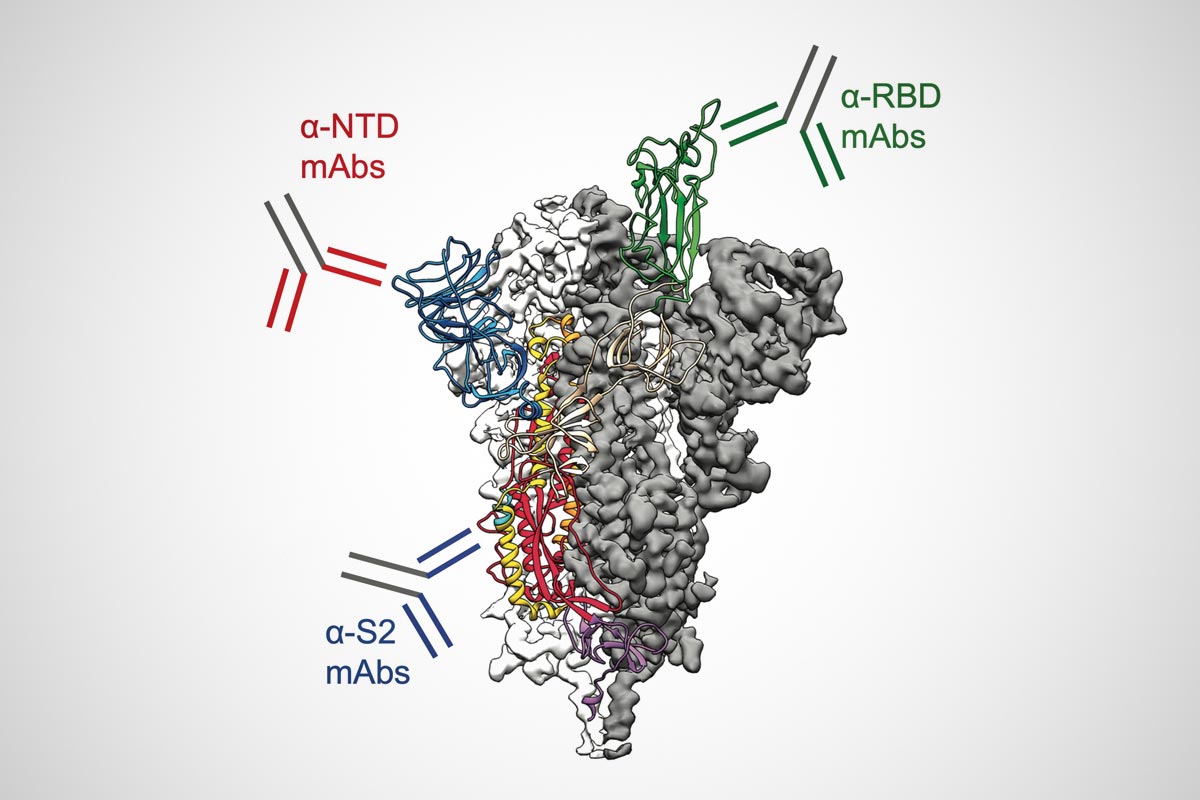
Previous research focused on one group of antibodies that target the most obvious part of the coronavirus’s spike protein, called the receptor-binding domain (RBD). Because the RBD is the part of the spike that attaches directly to human cells and enables the virus to infect them, it was rightly assumed to be a primary target of the immune system. But, testing blood plasma samples from four people who recovered from SARS-CoV-2 infections, the researchers found that most of the antibodies circulating in the blood — on average, about 84% — target areas of the viral spike protein outside the RBD — and, apparently, for good reason.
“We found these antibodies are painting the entire spike, both the arc and the stalk of the spike protein, which looks a bit like an umbrella,” said co-corresponding author Greg Ippolito, who is a research associate professor in UT Austin’s Department of Molecular Biosciences and an assistant professor of oncology at the university’s Dell Medical School. “The immune system sees the entire spike and tries to neutralize it.”
The Power of NTD-Directed Antibodies
Many of these non-RBD-directed antibodies the team identified act as a potent weapon against the virus by targeting a region in a part of the spike protein located in what would be the umbrella’s canopy called the N-terminal domain (NTD). These antibodies neutralize the virus in cell cultures and were shown to prevent a lethal mouse-adapted version of the virus from infecting mice.
The NTD is also a part of the viral spike protein that mutates frequently, especially in several variants of concern. This suggests that one reason these variants are so effective at evading our immune systems is that they can mutate around one of the most common and potent types of antibodies in our arsenals.
“There’s an evolutionary arms race going on between the virus and our immune systems,” said Jason Lavinder, research associate in the McKetta Department of Chemical Engineering and co-corresponding author of the new study. “We’re all developing a standard immune response to this virus that includes targeting this one spot and that’s exerting selective pressure on the virus. But then the virus is also exerting its evolutionary strength by trying to change around our selective immune pressures.”
The S2 Subunit: A Stable Target for Immunity
Despite these maneuvers by SARS-CoV-2, the researchers said about 40% of the circulating antibodies target the stalk of the spike protein, called the S2 subunit, which is also a part that the virus does not seem able to change easily.
“That’s reassuring,” Ippolito said. “That’s an advantage our immune system has. It also means our current vaccines are eliciting antibodies targeting that S2 subunit, which are likely providing another layer of protection against the virus.”
That’s also good news for designing vaccine boosters or next-generation vaccines against variants of concern, and even for developing a vaccine that can protect against future pandemics from other strains of the coronavirus.
Universal Coronavirus Vaccine
“It means we have a strong rationale for developing next-generation SARS-CoV-2 vaccines or even a pan-coronavirus vaccine that targets every strain,” Ippolito said.
UT Austin researchers are among several in the world now aiming to develop a single coronavirus vaccine to fight infection from all coronaviruses, not just SARS-CoV-2.
Reference: “Prevalent, protective, and convergent IgG recognition of SARS-CoV-2 non-RBD spike epitopes” by William N. Voss, Yixuan J. Hou, Nicole V. Johnson, George Delidakis, Jin Eyun Kim, Kamyab Javanmardi, Andrew P. Horton, Foteini Bartzoka, Chelsea J. Paresi, Yuri Tanno, Chia-Wei Chou, Shawn A. Abbasi, Whitney Pickens, Katia George, Daniel R. Boutz, Dalton M. Towers, Jonathan R. McDaniel, Daniel Billick, Jule Goike, Lori Rowe, Dhwani Batra, Jan Pohl, Justin Lee, Shivaprakash Gangappa, Suryaprakash Sambhara, Michelle Gadush, Nianshuang Wang, Maria D. Person, Brent L. Iverson, Jimmy D. Gollihar, John Dye, Andrew Herbert, Ilya J. Finkelstein, Ralph S. Baric, Jason S. McLellan, George Georgiou, Jason J. Lavinder and Gregory C. Ippolito, 4 May 2021, Science.
DOI: 10.1126/science.abg5268
The first author of the study is William Voss, a graduate student at UT Austin. In addition to Lavinder and Ippolito, senior authors from UT Austin are Jimmy Gollihar, Ilya Finkelstein, Brent Iverson, Jason McLellan and George Georgiou. Georgiou and Ippolito are also affiliated with UT Austin’s Dell Medical School. Gollihar is also affiliated with the Army Research Laboratory South.
Collaborating institutions are the University of North Carolina at Chapel Hill, the U.S. Army Medical Research Institute of Infectious Diseases and the Centers for Disease Control and Prevention.
This research was funded in part by the National Institutes of Health, the Clayton Foundation and the Welch Foundation.
Never miss a breakthrough: Join the SciTechDaily newsletter.
Follow us on Google and Google News.