
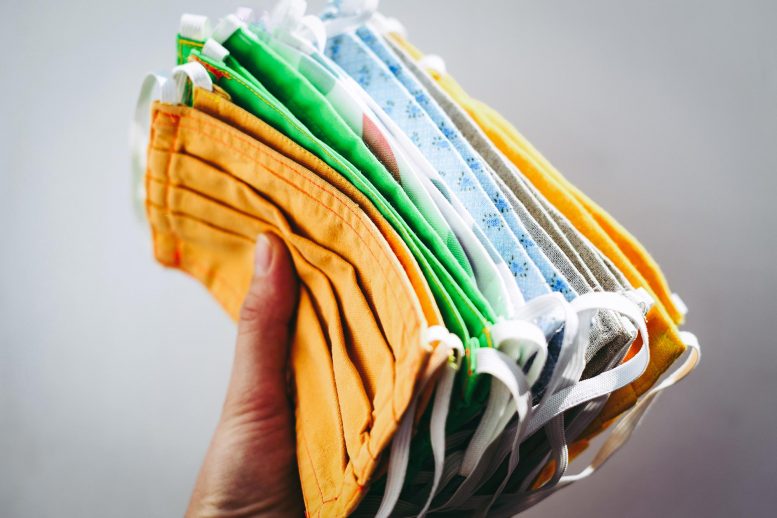
A three-layer cloth mask with a baby wipe filter can block up to 90% of large droplets when properly fitted. Researchers stress that fit and correct usage matter more than mask type alone.
In the race to stop the spread of COVID-19, a three-layer cloth mask that fits well can effectively filter COVID particles, says a group of UBC researchers.
After testing several different mask styles and 41 types of fabrics, they found that a mask consisting of two layers of low-thread-count quilting cotton plus a three-ply dried baby wipe filter was as effective as a commercial non-surgical mask at stopping particles–and almost as breathable.
The cloth masks filtered out up to 80 percent of 3-micron particles, and more than 90 percent of 10-micron particles.
“We focused on particles larger than one micron because these are likely most important to COVID-19 transmission,” explains researcher Dr. Steven Rogak, a professor of mechanical engineering who studies aerosols. “While the COVID-19 virus is only around 0.1 micron in size, it is always attached to something larger, like the droplets produced by breathing, talking, and coughing, which are typically in the micron and not submicron range.”
World Health Organization guidelines recommend three layers for a non-medical mask: an absorbent inner layer near the mouth, a middle filtration layer, and an outer layer exposed to the external environment.

Mask Materials
The team recommends specific fabrics for different parts of the mask: double-knit cotton, quilting cotton, knit nylon or polyester satin for the outer layer, and double-knit cotton, quilting cotton or simple-weave silk for the inner layer that sits closest to the skin.
Nylon and polyester repel water, keeping harmful droplets from penetrating through to the inner layers. Cotton and silk feel comfortable, breathe well, and wick away moisture. Importantly, fabric construction is important to breathability and filtration efficiency. For example, fabrics such as polyester crepe (finely woven polyester), high thread-count cotton and dupion silk are not very breathable.
Dried baby wipes, which can be swapped out, make surprisingly good filters.
“Baby wipes are typically made of spunlace and spunbond polypropylene–similar to the types of polypropylene found in medical masks and N95 respirators,” said researcher Dr. Jane Wang, a clinical professor in the faculty of medicine.
“They are breathable and trap particles efficiently. They’re biocompatible, containing minimal preservatives and chemicals that may otherwise cause irritation or breathing problems.”

Fit Is Paramount
Aside from choosing efficient, breathable materials, it’s important to have a good seal around the mask, say the researchers.
“Even an N95 mask is going to take in large, massive droplets with lots of viruses if it does not seal against the face. A well-fitted, well-designed cloth mask with a baby-wipe filter will be more effective at filtering 5- or 10-micron particles than a poorly fitted N95 mask,” said Dr. Rogak.
He added that the highest leak rates are around the nose, chin and the cheeks, and pleated-style masks tend to leak the most.
“The mask should not sit flat against your mouth and nose, because it will be less breathable, as there’s only one very tiny portion of the fabric actually exchanging air. Even if it’s made of breathable material, it won’t feel that way. You need to create a bit of an air pocket, with a bigger curvature in front, so that the whole mask is engaged in air exchange.”
In the end, masking is an intervention aimed at risk reduction, not risk elimination, says Dr. Wang.
“For the intervention to be effective, people need to have access to the intervention and to apply the intervention correctly. An N95 mask will not be effective if people are wearing it halfway down the face. Double masking will not be effective if people cannot tolerate it because of overheating, breathability or CO2 retention problems. The focus should always be to wear a mask correctly by choosing a design that offers a good seal around the nose and mouth and to avoid cross-contamination.”
Reference: “Properties of materials considered for improvised masks” by Steven N. Rogak, Timothy A. Sipkens, Mark Guan, Hamed Nikookar, Daniela Vargas Figueroa and Jing Wang, 28 December 2020, Aerosol Science and Technology.
DOI: 10.1080/02786826.2020.1855321
This study was recently published in the journal Aerosol Science and Technology. An interactive version of the data, and simplified mask design tool, is available at https:/
Dr. Wang continues to share information on The Free Mask Project website, a grassroots initiative she is spearheading.
Never miss a breakthrough: Join the SciTechDaily newsletter.
Follow us on Google and Google News.
2 Comments
The n95 mask literally prints “does not prevent covid” on the box. Why? Because they KNOW masks dont work and dont want to be sued when you get sick.
N95 mask only filters down to 0.3 microns. Covid is significantly smaller (like .0125). Those masks are not doing a goddamn thing except making you look like an idiot.
If you ACTUALLY believe in science. You KNOW these masks ain’t stopping sh*t. Because actual viralogists have special suits to handle viruses like covid. Those whimpy *ss masks aint doing sh*t.
We are just figuring out how masks should be worn?? Do we really need to pay the director of the National Institute of Allergy, over half a million a year, and this is what we get…