
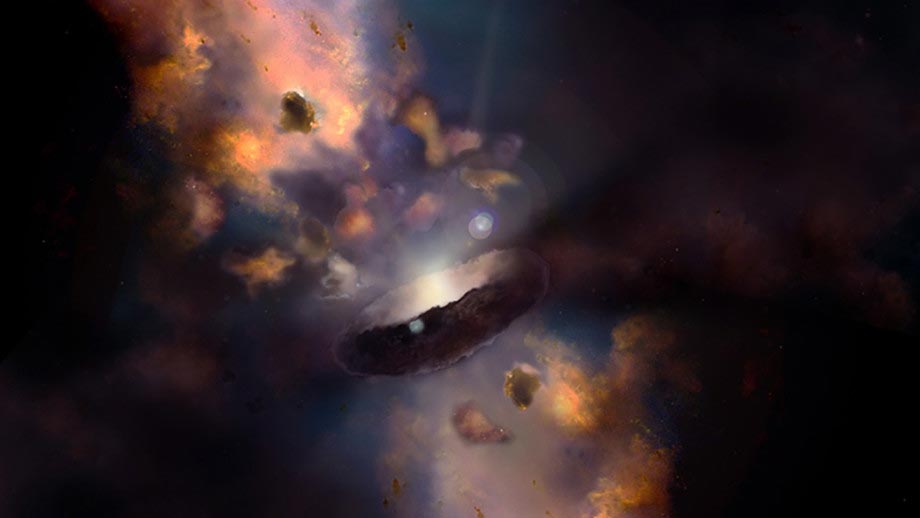
We now know just how massive the fastest-growing black hole in the Universe actually is, as well as how much it eats, thanks to new research led by The Australian National University (ANU).
It is 34 billion times the mass of our sun and gorges on nearly the equivalent of one sun every day, according to Dr. Christopher Onken and his colleagues.
“The black hole’s mass is also about 8,000 times bigger than the black hole in the center of the Milky Way,” Dr. Onken said. “If the Milky Way’s black hole wanted to grow that fat, it would have to swallow two-thirds of all the stars in our Galaxy.”
This giant black hole — known as J2157 — was discovered by the same research team in 2018.
“We’re seeing it at a time when the universe was only 1.2 billion years old, less than 10 percent of its current age,” Dr. Onken said.
“It’s the biggest black hole that’s been weighed in this early period of the Universe.”
“If the Milky Way’s black hole wanted to grow that fat, it would have to swallow two-thirds of all the stars in our Galaxy.” Dr. Christopher Onken
Exactly how black holes grew so big so early in the life-span of the Universe is still a mystery, but the team is now searching for more black holes in the hope they might provide some clues.
“We knew we were onto a very massive black hole when we realized its fast growth rate,” said team member Dr. Fuyan Bian, a staff astronomer at the European Southern Observatory (ESO).
“How much black holes can swallow depends on how much mass they already have.
“So, for this one to be devouring matter at such a high rate, we thought it could become a new record holder. And now we know.”
The team, including researchers from the University of Arizona, used ESO’s Very Large Telescope in Chile to accurately measure the black hole’s mass.
“With such an enormous black hole, we’re also excited to see what we can learn about the galaxy in which it’s growing,” Dr. Onken said.
“Is this galaxy one of the behemoths of the early Universe, or did the black hole just swallow up an extraordinary amount of its surroundings? We’ll have to keep digging to figure that out.”
The research has been published in Monthly Notices of the Royal Astronomical Society.
References:
“A thirty-four billion solar mass black hole in SMSS J2157–3602, the most luminous known quasar” by Christopher A Onken, Fuyan Bian, Xiaohui Fan, Feige Wang, Christian Wolf and Jinyi Yang, 30 June 2020, Monthly Notices of the Royal Astronomical Society.
DOI: 10.1093/mnras/staa1635
“Discovery of the Most Ultra-Luminous QSO Using GAIA, SkyMapper, and WISE” by Christian Wolf, Fuyan Bian, Christopher A. Onken, Brian P. Schmidt, Patrick Tisserand, Noura Alonzi, Wei Jeat Hon and John L. Tonry, 18 June 2018, Publications of the Astronomical Society of Australia.
DOI: 10.1017/pasa.2018.22
Never miss a breakthrough: Join the SciTechDaily newsletter.
Follow us on Google and Google News.
7 Comments
Gigantische Schwarze Löcher wachsen aus der Dunklen Materie . Siehe hierzu :
” The Dark Expansion Theorie ” im youtube
I didn’t look very far, already the search result show that it is pseudoscience (“smash big bang”). It is also self promotion at a guess from the name.
Are there any theories on how big this black hole is today (~12.6 billion years later)?
Astronomers use the “here and now” reference for convenience, along with noting the distance (and time the light traveled) by redshift z. So they would answer 34 billion solar masses.
But if you want to extrapolate and start with naively assuming constant growth rate (say), it would now be ~ 50 billion solar masses.
Oops. I forgot the year-to-day conversion. So more like ~ 4,000 billion solar masses. The largest observed super massive black holes today are ~40 solar masses [ https://astronomy.com/news/2019/12/this-huge-galaxy-has-the-biggest-black-hole-ever-measured ], so a growth rate of one solar mass/day isn’t sustainable.
It’s fun spending so much money on blackholes and galaxy gazing
While kids and people and various animals die each day everyday as a direct result of such activities.
? There is zero evidence that astronomy cause “kids and people and various animals die each day everyday as a direct result of such activities.” And no one spends money on “blackholes” outside of astronomy and cosmology – we can’t make any, say.
It’s honestly not fun seeing comments trolling science with ideas of how the experts should spend their money, seeing 1) how much good science does and 2) removing resources to any area will diminish the output overall. I.e. if we spend research money solely on kids, people and various animals, more of them will die each day as a result of removing science.