

Mount Sinai Researchers have just discovered that patients in the Ashkenazi Jewish population with Crohn’s disease (a chronic inflammatory of the digestive system) are more likely to carry the LRRK2 gene mutation. This gene is the major genetic cause of Parkinson’s disease, which is a movement disorder. The study’s findings, published in the January 10, 2018 issue of Science Translational Medicine, and featured on the cover, could help doctors better understand Crohn’s disease, determine specifically who’s at risk, and develop new drugs for treatment and/or prevention by targeting this specific gene.
“Crohn’s disease is a complex disorder with multiple genes and environmental factors involved, which disproportionally affects individuals of Ashkenazi Jewish ancestry,” explained lead researcher Inga Peter, Professor of Genetics and Genomic Sciences at the Icahn School of Medicine at Mount Sinai in New York City. “The presence of shared LRRK2 mutations in patients with Crohn’s disease and Parkinson’s disease provides refined insight into disease mechanisms and may have major implications for the treatment of these two seemingly unrelated diseases.”
Dr. Peter and a team of Mount Sinai Investigators used international data from the last decade up to the present to analyze the occurrence of 230,000 coding genetic mutations in the human genome of 2,066 patients with Crohn’s disease and compared them to 3,633 people without the disorder. All were of Ashkenazi Jewish descent. They identified mutations in the LRRK2 gene that are more frequently found in Crohn’s disease cases as compared to unaffected individuals. When they discovered a link between Crohn’s and the LRRK2 gene mutations they went further to assess the possible genetic link between Crohn’s and Parkinson’s. The team then looked at a much larger sample of 24,570 people including patients with Crohn’s, Parkinson’s, and no disease at all (each group consisted of Jewish and non-Jewish subjects).
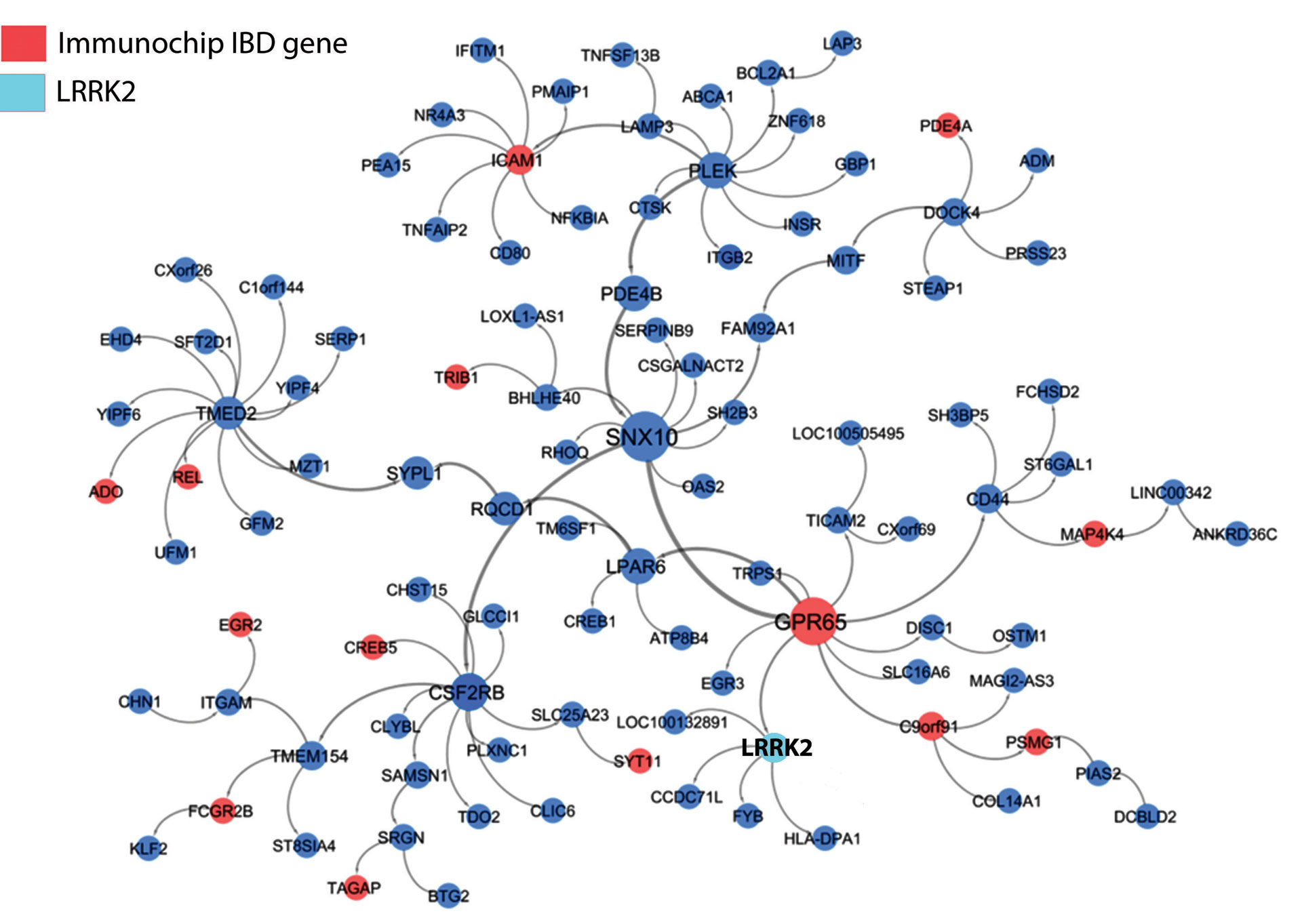
The study found two mutations of the LRRK2 gene in Crohn’s disease patients. One of them (called the risk mutation) was more common in patients with Crohn’s, while the other (the protective mutation) was more prevalent in patients without the disease. Most Crohn’s disease patients who carried the risk mutation developed the disease on average six years earlier than those who did not carry this mutation. The research also shows that more Crohn’s patients with the risk mutation developed the disease in the small intestine, compared to those without the mutation. If the disease starts in the small intestine, it becomes more difficult to manage and often leads to complications and surgeries. It’s important to note that the effect of these mutations was observed in Ashkenazi Jewish populations and non-Jewish populations.
“Defining the biology of naturally occurring protective mutations is quite important, because they define desired outcomes for potential new therapies,” explained the study’s co-author Judy H. Cho, MD, Director of the Sanford Grossman Center for Integrative Studies in Crohn’s disease, and the Charles F. Bronfman Institute for Personalized Medicine at the Icahn School of Medicine at Mount Sinai.
“Identifying genetic mutations associated with disease risk is an effective way to better understand disease mechanisms, identify individuals at risk, and develop novel drug targets to treat the disease,” Dr. Peter added. “Our research may also help identify individuals who would benefit the most of LRRK2-directed therapies, thereby contributing to the field of personalized medicine.”
Reference: “Functional variants in the LRRK2 gene confer shared effects on risk for Crohn’s disease and Parkinson’s disease” by Ken Y. Hui, Heriberto Fernandez-Hernandez, Jianzhong Hu, Adam Schaffner, Nathan Pankratz, Nai-Yun Hsu, Ling-Shiang Chuang, Shai Carmi, Nicole Villaverde, Xianting Li, Manual Rivas, Adam P. Levine, Xiuliang Bao, Philippe R. Labrias, Talin Haritunians, Darren Ruane, Kyle Gettler, Ernie Chen, Dalin Li, Elena R. Schiff, Nikolas Pontikos, Nir Barzilai, Steven R. Brant, Susan Bressman, Adam S. Cheifetz, Lorraine N. Clark, Mark J. Daly, Robert J. Desnick, Richard H. Duerr, Seymour Katz, Todd Lencz, Richard H. Myers, Harry Ostrer, Laurie Ozelius, Haydeh Payami, Yakov Peter, John D. Rioux, Anthony W. Segal, William K. Scott, Mark S. Silverberg, Jeffery M. Vance, Iban Ubarretxena-Belandia, Tatiana Foroud, Gil Atzmon, Itsik Pe’Er, Yiannis Ioannou, Dermot P. B. Mcgovern, Zhenyu Yue, Eric E. Schadt, Judy H. Cho and Inga Peter, 10 Jan 2018, Science Translational Medicine.
DOI: 10.1126/scitranslmed.aai7795
Never miss a breakthrough: Join the SciTechDaily newsletter.
Follow us on Google and Google News.