
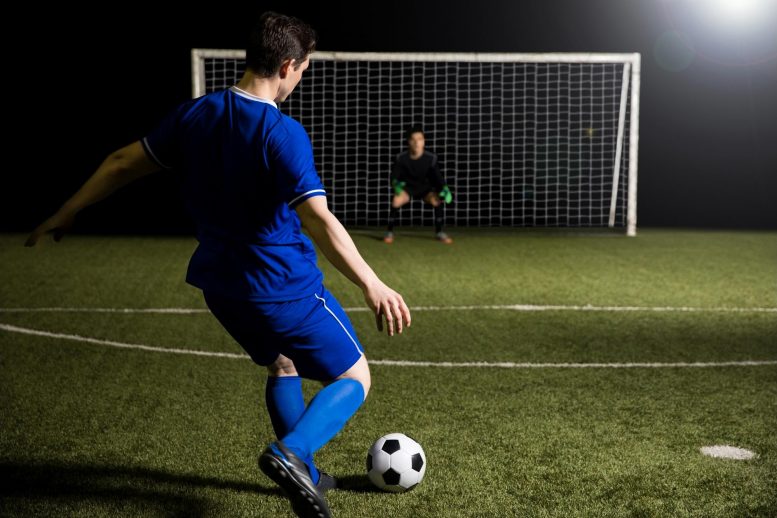
Study finds that beneficial brain regions, including those involved in movement, underlie successful kicks and overthinking may be a factor in missed kicks.
Are penalty shots a soccer player’s dream or nightmare? What should be an easy shot can become a mammoth task when the hopes and fears of an entire nation rest on a player’s shoulders, leading them to choke under pressure. Understanding the brain activity behind choking is the driving force behind a new study in open-access journal Frontiers in Computer Science. The study is the first to measure brain activity during penalty shots in a soccer pitch environment. It finds that people who choked activated areas of the brain involved in long-term thinking, suggesting that they were overthinking the consequences of missing the shot.
Penalty shootouts hold a special fear for many soccer fans. For instance, the English team has suffered some infamous misses over the years and their record at the penalty spot is fairly bleak. Remember Beckham’s slip on the penalty spot against Portugal in the 2004 European Cup? He certainly does. Penalties can go either way, which makes them exciting to watch, but they raise some questions about performance under pressure.
The Psychology Behind the Miss
“How can it be that football players with a near perfect control over the ball (they can very precisely kick a ball over more than 50 meters or 165 feet) fail to score a penalty kick from only 11 meters (36 feet)?” asks coauthor Max Slutter, an MSc student at the faculty of electrical engineering, mathematics, and computer science at the University of Twente, the Netherlands. “Obviously, huge psychological pressure plays a role, but why does this pressure cause a missed penalty? We tried to answer this by measuring the brain activity of football players during the physical execution of a penalty kick.”
Slutter and colleagues recruited 22 volunteers to kick penalties and measured their brain activity using a technique called functional near-infrared spectroscopy (fNIRS). fNIRS involves wearing a headset, and can measure brain activity on the move. The study is the first to investigate the neuroscience behind choking under realistic conditions outside a laboratory.
The volunteers attempted to score penalties under different pressure conditions: with an open goal, against a friendly goalkeeper, and in a high-pressure situation where the goalkeeper attempted to distract them and there was a prize at stake.
Thinking Too Much Can Ruin the Shot
“We found that players who were able to perform under pressure activated task-relevant areas of the brain,” explained Dr. Nattapong Thammasan, of the University of Twente. “For example, increased activation of the motor cortex was related to performing under pressure. This seems logical, as movement is one of the most important elements when taking a penalty.”
For players who tended to experience more anxiety and miss penalties, another area of the brain was more active — the pre-frontal cortex. This brain region is involved in long-term thinking, suggesting that such players were thinking about the consequences of missing the shot, which impaired their performance.
Strikingly, the researchers believe that the fNIRS technology could assist players to perform better under pressure by letting them know how their brains are behaving. They hypothesize that players could train themselves to activate beneficial brain regions in high-pressure situations.
Excitingly, the technique could also be beneficial for other professions where performance under high pressure is important, such as brain surgery. It may be too late for Beckham, but next-generation brain surgeons could be on the way.
Reference: “Exploring the Brain Activity Related to Missing Penalty Kicks: An fNIRS Study” by Max W. J. Slutter, Nattapong Thammasan and Mannes Poel, 7 May 2021, Frontiers in Computer Science.
DOI: 10.3389/fcomp.2021.661466
Never miss a breakthrough: Join the SciTechDaily newsletter.
Follow us on Google and Google News.