

This is the first report of remote touch in humans. It changes how we understand the human perceptual world and may have applications in robotics and assistive technologies, including exploration, search and rescue, and archaeology.
Researchers from Queen Mary University of London and University College London have uncovered evidence that humans possess a previously unrecognized sensory ability known as remote touch. This refers to the capacity to detect objects without making direct contact, a skill already documented in certain animal species.
Touch in humans is usually described as a short-range sense that depends on physical contact. Yet studies of animal perception have begun to challenge that assumption. Some shorebirds, including sandpipers and plovers, can locate prey buried beneath sand by sensing subtle mechanical disturbances in the grains around it (du Toit et al. 2020; de Fouw et al. 2016). This process, known as remote touch, relies on detecting tiny changes in pressure and movement transmitted through granular materials when something nearby shifts.

To test whether humans share a similar ability, the research team conducted experiments reported at the IEEE International Conference on Development and Learning (ICDL). Participants were asked to gently move their fingers through sand to find a hidden cube before physically touching it.
The results showed that people could reliably sense the object’s presence in advance, demonstrating a capacity comparable to that seen in shorebirds, even though humans lack the specialized anatomical structures birds use for this task.
Results show human hands have more sensitivity than expected
Further analysis revealed why this is possible. By modeling the underlying physics, the researchers found that the human hand is far more sensitive than previously believed. Participants were able to perceive extremely small shifts in the sand caused by the buried object. This level of sensitivity comes close to the theoretical physical limit for detecting mechanical reflections in granular material, where moving sand subtly changes direction or resistance when it encounters a stable surface beneath it.
Do humans or robots perform better on remote touch?
When comparing a human’s performance with a robotic tactile sensor trained using a Long Short-Term Memory (LSTM) algorithm, humans achieved an impressive 70.7% precision within the expected detectable range. Interestingly, the robot could sense objects from slightly farther distances on average but often produced false positives, yielding only 40% overall precision.
These findings confirm that people can genuinely sense an object before physical contact, a surprising capacity for a sense that is usually concerned with objects that enter in direct contact with us. Both humans and robots performed very close to the maximum sensitivity predicted with physical models and displacement.
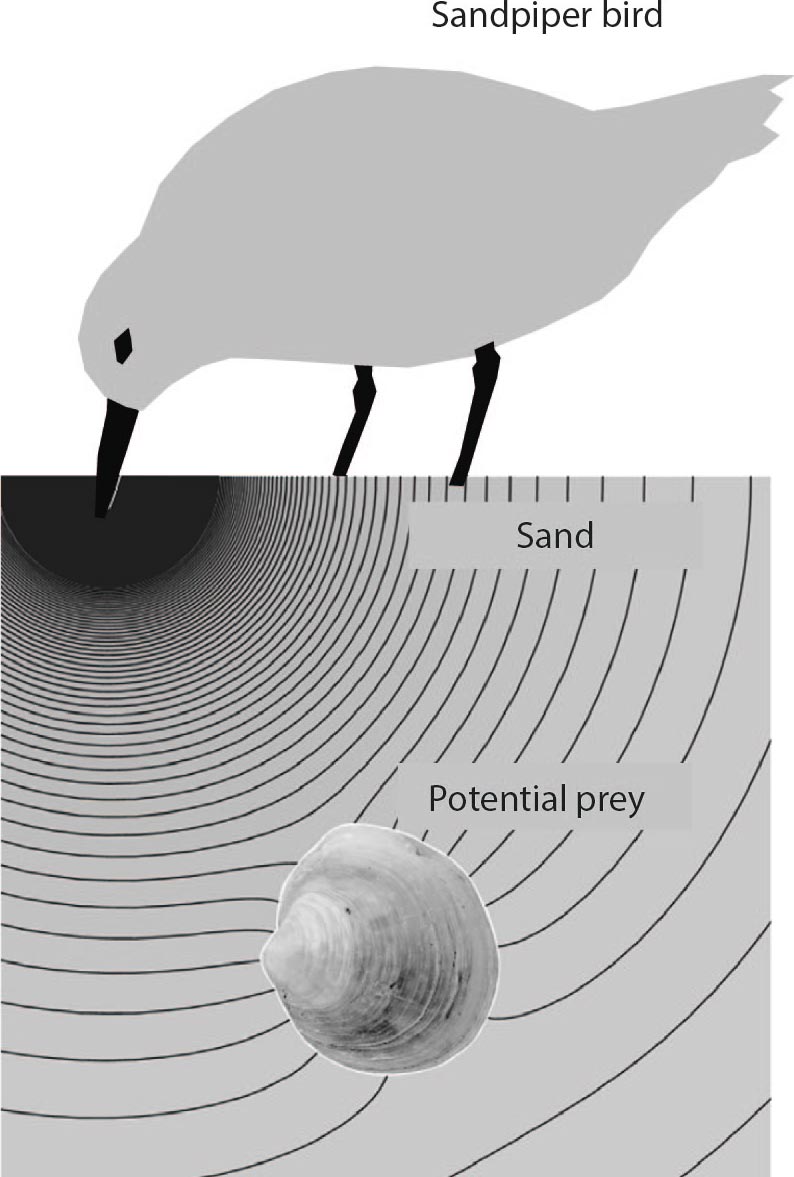
Why is the study important?
This research reveals that humans can detect objects buried in sand before actual contact, expanding our understanding of how far the sense of touch can reach. It provides quantitative evidence for a tactile skill not previously documented in humans.
The findings also offer valuable benchmarks for improving assistive technology and robotic tactile sensing. By using human perception as a model, engineers can design robotic systems that integrate natural-like touch sensitivity for real-world applications such as probing, excavation, or search tasks where vision is limited.
What are the wider implications?
Elisabetta Versace, Senior Lecturer in Psychology and lead of the Prepared Minds Lab at Queen Mary University of London who conceived the human experiments said: “It’s the first time that remote touch has been studied in humans and it changes our conception of the perceptual world (what is called the “receptive field”) in living beings, including humans.”
Zhengqi Chen, PhD student of Advanced Robotics Lab at Queen Mary University of London said: : “The discovery opens possibilities for designing tools and assistive technologies that extend human tactile perception. These insights could inform the development of advanced robots capable of delicate operations, for example, locating archaeological artifacts without damage, or exploring sandy or granular terrains such as Martian soil or ocean floors. More broadly, this research paves the way for touch-based systems that make hidden or hazardous exploration safer, smarter, and more effective.”
Lorenzo Jamone, Associate Professor in Robotics & AI at University College London, said:
“What makes this research especially exciting is how the human and robotic studies informed each other. The human experiments guided the robot’s learning approach, and the robot’s performance provided new perspectives for interpreting the human data. It’s a great example of how psychology, robotics, and artificial intelligence can come together, showing that multidisciplinary collaboration can spark both fundamental discoveries and technological innovation.”
Reference: “Exploring Tactile Perception for Object Localization in Granular Media: A Human and Robotic Study” by Zhengqi Chen, Laura Crucianelli, Elisabetta Versace and Lorenzo Jamone, 21 October 2025, 2025 IEEE International Conference on Development and Learning (ICDL).
DOI: 10.1109/ICDL63968.2025.11204359
Researchers carried out two studies: the first, a human study assessing fingertip sensitivity to tactile cues from buried objects; the second, a robotic experiment using a tactile-equipped robotic arm and a Long Short-Term Memory model to detect object presence.
Never miss a breakthrough: Join the SciTechDaily newsletter.
Follow us on Google and Google News.
10 Comments
Try including spiritual community who have been using consciousness for remote healing, etc.. The Clairs..
I agree 👍
Provide proof this has ever happened.
Sure it makes you reinforce the floors by 4x or so, but who hasn’t thought of making things easier to find by a 5″ sand cover. This is the extended Tatami Galaxy.
In that vein the ED ad makes more sense, but not the Taco Tools one.
They did not explain why they assume this ability is through the sense of touch. And they didn’t explain what “in advance” meant when finding the objects. They need to rule out sensing EMFs or other object’s energy, and psychic abilities like remote viewing and precognition. I’ve seen evidence that I myself have both these abilities, as well as a few of my pets in my life have had psychic abilities. These things can’t be proven because they can’t be controlled or predicted. It’s exactly like how I can’t prove to anyone that I get the hiccups but I KNOW they are real because I experience them.
It seems very unlikely that our hands are as sensitive as they are saying in this article. It is much more likely to me that it is due to some kind of psychic ability to know what is in the sand without touching, seeing, hearing, smelling it, or that we are unconsciously sensing the presence of an object from its electromagnetic field.
They need to do further experiments where people simply hover their hand over the sand without putting their hand into the sand and see if they can find the location of the hidden object. If they can’t locate the objects, that would rule out EMFs and psychic abilities.
The telepathy tapes reveal autistic kids with 95% accuracy using their psychic abilities.
Cornell University isrealie Jews are murdering Americans with mkultra and everyone knows
Wait I’ve always known i could do that, it works through air too if you get close enough and focus in on your senses, this isn’t a known phenomenon?
This is not a 7th sense or “remote“ anything. It’s just the sense of touch. Sand will feel different as you approach an object because it pushes up against the object duh. There are no psychic abilities 😔
I think most of the people is misunderstanding what this article is trying to explain. Is not about psychic abilities at all. When they say remote means that there is distance between the objects at the skin, instead of direct contact. When they say “in advance” means before actually touching the surface of the targeted object. And sensing this object means detecting diferences in pressure and tension in the material that surrounds it, kind of feeling the remote under the cushion of your couch. Is not new just overlooked. We feel things even when there is something in the middle.