
Close Menu
    Facebook X (Twitter) Instagram
    SciTechDaily
    • Biology
    • Chemistry
    • Earth
    • Health
    • Physics
    • Science
    • Space
    • Technology
    Facebook X (Twitter) Pinterest YouTube RSS
    SciTechDaily
    Home»Biology»New Research Reveals That Complex Green Organisms Emerged a Billion Years Ago
    Biology

    New Research Reveals That Complex Green Organisms Emerged a Billion Years Ago

    By University of GöttingenFebruary 11, 2024No Comments4 Mins Read
    Facebook Twitter Pinterest Telegram LinkedIn WhatsApp Email Reddit
    Share
    Facebook Twitter LinkedIn Pinterest Telegram Email Reddit
    Liquid Samples of Different Algal Species
    Liquid samples of different algal species investigated in the study, all stored in the Culture Collection of Algae at Göttingen University. Credit: Tatyana Darienko

    OK

    A research team at Göttingen University is leading an investigation into the emergence of multicellularity.

    Of all the organisms that photosynthesize, land plants have the most complex bodies. How did this morphology emerge? A team of scientists led by the University of Göttingen has taken a deep dive into the evolutionary history of morphological complexity in streptophytes, which include land plants and many green algae.

    Their research allowed them to go back in time to investigate lineages that emerged long before land plants existed. Their results revise the understanding of the relationships of a group of filamentous algal land colonizers much older than land plants. Using modern gene sequencing data, researchers pinpoint the emergence of multicellularity to almost a billion years ago. The results were published in the journal Current Biology.

    The Diversity and Adaptability of Klebsormidiophyceae

    The study focused on Klebsormidiophyceae, a class of green algae known for its ability to colonize diverse habitats worldwide. The team of researchers conducted extensive sampling, investigating habitats ranging from streams, rivers, and lake shores to bogs, soil, natural rocks, tree bark, acidic post-mining sites, sand dunes, urban walls, and building façades.
    Overcoming Challenges with Phylogenomics
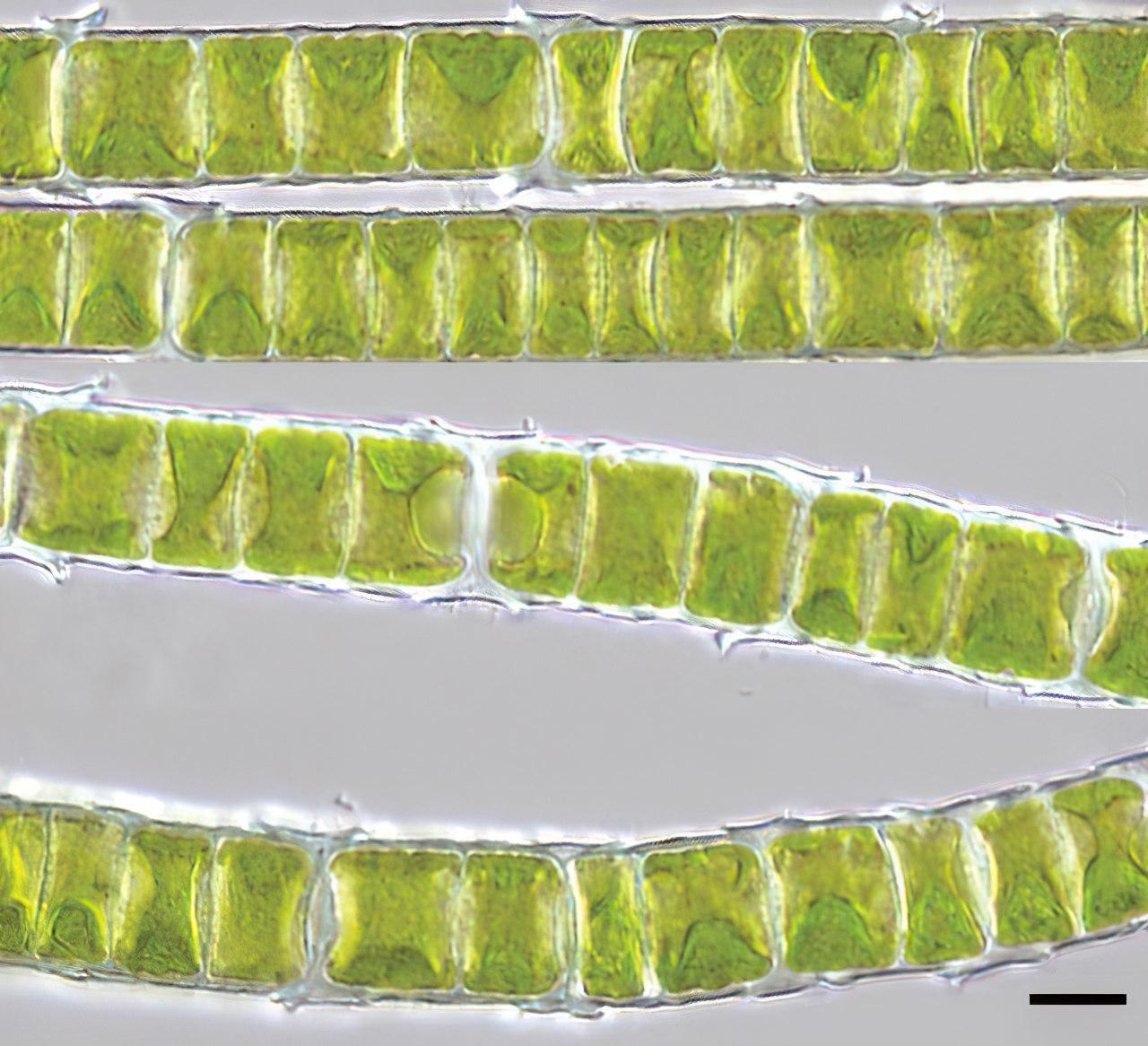
    Microscope image of the filamentous alga Klebsormidium crenulatum, a land-dwelling alga that is very dessication resistant due to its thick cell wall. (scale is 10 µm, corresponding to 0.01 mm). Credit: Tatyana Darienko

    “It’s really fascinating that these tiny robust little organisms have such a high diversity in their morphology and also are extremely well adapted to live in sometimes very harsh environments,” says Dr Tatyana Darienko, University of Göttingen’s Institute for Microbiology and Genetics. This comprehensive sampling aimed to create a global distribution map for Klebsormidiophyceae, emphasizing their adaptability, ecological significance, and hidden diversity. Based on genetic data calibrated by fossils, the researchers performed “molecular clock analyses”.

    Overcoming Challenges with Phylogenomics

    While delving into the complex evolutionary history of Klebsormidiophyceae, the researchers faced challenges in resolving phylogenetic relationships using traditional markers. To overcome this, they employed hundreds of genes obtained from the transcriptomes of 24 isolates from different continents and habitats.

    “Our approach, known as phylogenomics, was to reconstruct the evolutionary history taking into account whole genomes or large fractions of genomes,” explains Dr Iker Irisarri, Leibniz Institute for the Analysis of Biodiversity Change. “This extremely powerful method can reconstruct evolutionary relationships with very high precision.”

    Microscope Image of the Multicellular Alga Streptosarcina arenaria
    Microscope image of the multicellular alga Streptosarcina arenaria, another terrestrial alga, which inhabits dry and tropical areas. (scale is 10 µm, corresponding to 0.01 mm). Credit: Tatyana Darienko

    Discovering the Roots of Multicellularity in Streptophytes

    Their research revealed a new phylogenomic tree of life for Klebsormidiophyceae which is divided into three orders. “This deep dive into the phylogenomic framework and our molecular clock unveiled Klebsormidiophyceae’s ancient ancestor – a multicellular entity thriving millions of years ago whose descendants began to split into three distinct branches over 800 million years ago,” says Maaike Bierenbroodspot, PhD researcher in Applied Bioinformatics, University of Göttingen.

    These results were used to explore the evolutionary history of multicellularity within streptophytes. The study showed that an ancient common ancestor of land plants, other streptophyte algae, and Klebsormidiophyceae was already multicellular. Professor Jan de Vries, Göttingen University’s Institute for Microbiology and Genetics, concludes: “This finding sheds light on the genetic potential for multicellularity among streptophytes, indicating an ancient origin for this crucial trait almost a billion years ago.”

    Reference: “Phylogenomic insights into the first multicellular streptophyte” by Maaike J. Bierenbroodspot, Tatyana Darienko, Sophie de Vries, Janine M.R. Fürst-Jansen, Henrik Buschmann, Thomas Pröschold, Iker Irisarri and Jan de Vries, 19 January 2024, Current Biology.
    DOI: 10.1016/j.cub.2023.12.070

    Never miss a breakthrough: Join the SciTechDaily newsletter.
    Follow us on Google and Google News.

    Evolution Genetics Life Microbiology Plants Popular University of Göttingen
    Share. Facebook Twitter Pinterest LinkedIn Email Reddit

    Related Articles

    They Crawled Out of the Cave – And Into Your Mattress: The 60,000-Year Reign of Bed Bugs

    Green Ancestors: Decoding the Secrets of 600 Million Years of Plant Life

    Tiny Ocean Conquerors: How Ancestors of Prochlorococcus Microbes Mastered the Seas on Exoskeleton Rafts

    Virus Variants: A Vital Tool to Study Viral Evolution in the Test Tube

    Scientists Use DNA To Trace the Origins of Giant Viruses

    “Evolutionary Rosetta Stone” – New Insight Into the Biology of a Deadly Fungus

    Timeline Unveiled for One of the Most Important and Puzzling Events in the Evolution of Life

    The Toughest Organisms on Earth: Evolution of Radio-Resistance Is More Complicated Than Previously Thought

    MSU Researchers Show How New Viruses Evolve Through Mutations

    Leave A Reply Cancel Reply

    • Facebook
    • Twitter
    • Pinterest
    • YouTube

    Don't Miss a Discovery

    Subscribe for the Latest in Science & Tech!

    Trending News

    Artificial Sweeteners May Harm Future Generations, Study Suggests

    Splashdown! NASA Artemis II Returns From Record-Breaking Moon Mission

    What If Consciousness Exists Beyond Your Brain

    Scientists Finally Crack the 100-Million-Year Evolutionary Mystery of Squid and Cuttlefish

    Beyond “Safe Levels”: Study Challenges What We Know About Pesticides and Cancer

    Researchers Have Found a Dietary Compound That Increases Longevity

    Scientists Baffled by Bizarre “Living Fossil” From 275 Million Years Ago

    Your IQ at 23 Could Predict Your Wealth at 27, Study Finds

    Follow SciTechDaily
    • Facebook
    • Twitter
    • YouTube
    • Pinterest
    • Newsletter
    • RSS
    SciTech News
    • Biology News
    • Chemistry News
    • Earth News
    • Health News
    • Physics News
    • Science News
    • Space News
    • Technology News
    Recent Posts
    • What if Dark Matter Has Two Forms? Bold New Hypothesis Could Explain a Cosmic Mystery
    • Researchers Expose Hidden Chemistry of “Ore-Forming” Elements in Biology
    • Geologists Reveal the Americas Collided Earlier Than We Thought
    • 20x Difference: Study Reveals True Source of Airborne Microplastics
    • Scientists Uncover Hidden Force Powering Yellowstone’s Supervolcano
    Copyright © 1998 - 2026 SciTechDaily. All Rights Reserved.
    • Science News
    • About
    • Contact
    • Editorial Board
    • Privacy Policy
    • Terms of Use

    Type above and press Enter to search. Press Esc to cancel.