
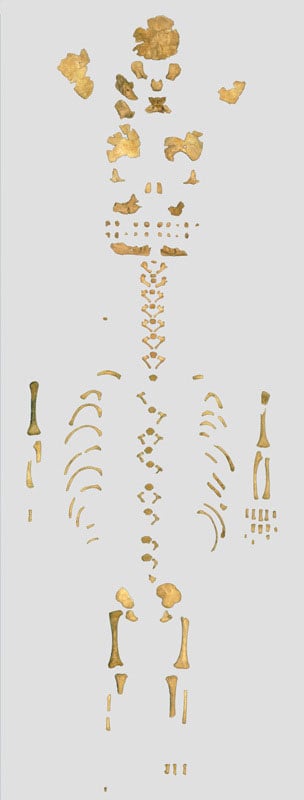
Scientists investigated whether the differences in physique between Neanderthals and modern humans are genetic or caused by differences in lifestyle, finding that Neanderthals’ wide bodies and robust bones were formed by birth.
If a Neanderthal were to sit down next to us on the underground, we would probably first notice his receding forehead, prominent brow ridges, and projecting, chinless face. Only on closer inspection would we notice his wider and thicker body. Researchers from the Max Planck Institute for Evolutionary Anthropology in Leipzig have now investigated whether the differences in physique between Neanderthals and modern humans are genetic or caused by differences in lifestyle. Their analysis of two well-preserved skeletons of Neanderthal neonates shows that Neanderthals’ wide bodies and robust bones were formed by birth.
The evolutionary lines of modern humans and Neanderthals diverged around 600,000 years ago. Paleoanthropologists know from bone finds that Neanderthals possessed not only a receding forehead, prominent brow ridges, and projecting, chinless face, but also a different physique. They had more robust bones, a wider pelvis, and shorter limbs. This may have been an evolutionary adaptation to the colder climate of Europe and Asia, as a more compact body loses less heat to the environment. However, the skeletal differences may also have arisen as a result of different lifestyles and activity patterns, because mechanical stresses affect the formation of bones.
To address this conundrum, Max Planck scientists examined two skeletons of Neandertal babies. One of the skeletons was from Mezmaiskaya Cave in the Caucasus, where in 1993 archaeologists discovered one of the best-preserved Neandertal skeletons ever found in an area only slightly larger than an A4 page. As it turned out, Neandertals had buried a roughly two-week-old newborn in the cave 70,000 years ago. The second specimen was an infant no more than four months old from a cave near the village of Le Moustier in the French Dordogne. “Both skeletons were exceptionally well preserved. Moreover, they come from two sites that are widely separated geographically, so they aren’t just sampling a restricted part of the Neandertal range,” says Tim Weaver from the University of California, Davis, and the Max Planck Institute for Evolutionary Anthropology.
The researchers determined the length and thickness of pelvic, leg, and arm bones and compared them with data from 68 newborns or fetuses of modern humans from a collection at the National Museum of Natural History in Washington. The results show that the Neandertal babies were born with many features of adult Neandertals. The differences in physique are likely genetic in nature, as different habits, such as hunting and use of tools, wouldn’t have affected the skeleton at that age. “The study of exceptional specimens such as those of Mezmaisakya and Le Moustier show us that the Neandertal ‘bauplan’ was most likely determined by their genes and not by their environment or behavior,” says Jean-Jacques Hublin, Director at the Leipzig-based Max Planck Institute.
Although maternal diet and activity may have influenced the development of the neonatal skeleton, the researchers believe that genetic differences are a more likely explanation. Some findings, such as shorter limbs, are consistent with the climate hypothesis, which states that the Neanderthal body was adapted to cold, while others, such as an elongated pubic bone, are more difficult to explain but may be related to birth or gait.
Reference: “Neonatal postcrania from Mezmaiskaya, Russia, and Le Moustier, France, and the development of Neandertal body form” by Timothy D. Weaver, Hélène Coqueugniot, Liubov V. Golovanova, Vladimir B. Doronichev, Bruno Maureille and Jean-Jacques Hublin, 31 March 2016, PNAS.
DOI: 10.1073/pnas.1523677113
Never miss a breakthrough: Join the SciTechDaily newsletter.
Follow us on Google and Google News.