
A new four minute ScienceCasts video examines evidence that our solar system is inside a bubble of hot gas created by supernova explosions.
ScienceCasts: Evidence for Supernovas Near Earth. A NASA sounding rocket has confirmed that the solar system is inside an ancient supernova remnant. Life on Earth survived despite the nearby blasts.
Once every 50 years, more or less, a massive star explodes somewhere in the Milky Way. The resulting blast is terrifyingly powerful, pumping out more energy in a split second than the sun emits in a million years. At its peak, a supernova can outshine the entire Milky Way.
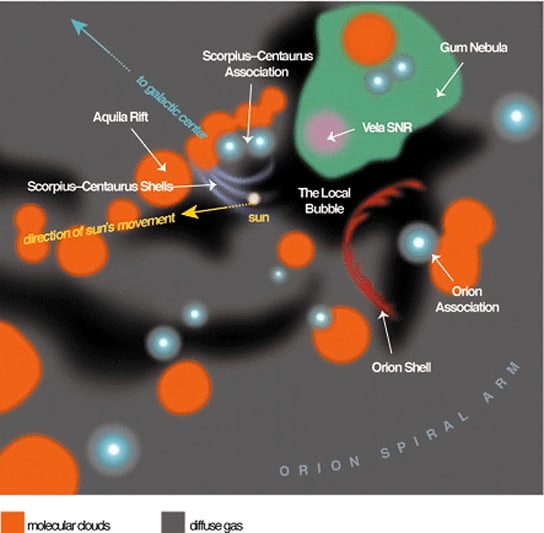
It seems obvious that you wouldn’t want a supernova exploding near Earth. Yet there is growing evidence that one did—actually, more than one. About 10 million years ago, a nearby cluster of supernovas went off like popcorn. We know because the explosions blew an enormous bubble in the interstellar medium, and we’re inside it.
Astronomers call it “the Local Bubble.” It is peanut-shaped, about 300 light-years long, and filled with almost nothing. Gas inside the bubble is very thin (0.001 atoms per cubic centimeter) and very hot (roughly a million degrees)—a sharp departure from ordinary interstellar material.
The Local Bubble was discovered gradually in the 1970s and 1980s. Optical and radio astronomers looked carefully for interstellar gas in our part of the galaxy, but couldn’t find much in Earth’s neighborhood. Meanwhile, X-ray astronomers were getting their first look at the sky using sounding rockets and orbiting satellites, which revealed a million-degree X-ray glow coming from all directions. It all added up to Earth being inside a bubble of hot gas blown by exploding stars.
However, not all researchers agreed.
“Within the last decade, some scientists have been challenging the [supernova] interpretation, suggesting that much or all of the soft X-ray diffuse background is instead a result of charge exchange,” says F. Scott Porter of the Goddard Space Flight Center.
“Charge exchange”: Basically, it happens when the electrically-charged solar wind comes into contact with a neutral gas. The solar wind can steal electrons from the neutral gas, resulting in an X-ray glow that looks a lot like the glow from an old supernova. Charge exchange has been observed many times in comets.
So, is the X-ray glow that fills the sky a sign of peaceful “charge exchange” in the solar system or evidence of terrifying explosions in the distant past?
To find out, an international team of researchers including Porter and led by physics professor Massimiliano Galeazzi at the University of Miami in Coral Gables, developed an X-ray detector that could distinguish between the two possibilities. The device was named DXL, for Diffuse X-ray emission from the Local Galaxy.
On December 12, 2012, DXL launched from White Sands Missile Range in New Mexico atop a NASA Black Brant IX sounding rocket, reaching a peak altitude of 160 miles (260 kilometers) and spending five minutes above Earth’s atmosphere. That was all the time they needed to measure the amount of “charge exchange” X-rays inside the solar system.
The results, published online in the journal Nature on July 27, indicate that only about 40 percent of the soft X-ray background originates within the solar system. The rest must come from a Local Bubble of hot gas, the relic of ancient supernovas outside the solar system.
Obviously, those supernovas were not close enough to exterminate life on Earth—but they were close enough to wrap our solar system in a bubble of hot gas that persists millions of years later.
“This is a significant discovery,’ said Galeazzi. “[It] affects our understanding of the area of the galaxy close to the sun, and can, therefore, be used as a foundation for future models of the galaxy structure.”
Galeazzi and collaborators are already planning the next flight of DXL, which will include additional instruments to better characterize the emission. The launch is currently planned for December 2015.
Reference: “The origin of the local 1/4-keV X-ray flux in both charge exchange and a hot bubble” by M. Galeazzi, M. Chiao, M. R. Collier, T. Cravens, D. Koutroumpa, K. D. Kuntz, R. Lallement, S. T. Lepri, D. McCammon, K. Morgan, F. S. Porter, I. P. Robertson, S. L. Snowden, N. E. Thomas, Y. Uprety, E. Ursino and B. M. Walsh, 27 July 2014, Nature.
DOI: 10.1038/nature13525
Never miss a breakthrough: Join the SciTechDaily newsletter.
Follow us on Google and Google News.