
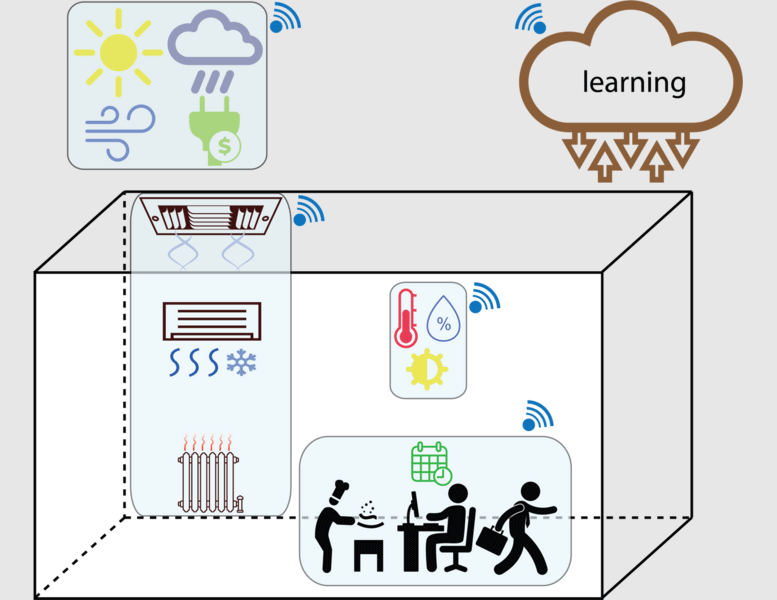
A smart thermostat quickly learns to optimize building microclimates for both energy consumption and user preference.
Buildings account for about 40 percent of U.S. energy consumption, and are responsible for one-third of global carbon dioxide emissions. Making buildings more energy-efficient is not only a cost-saving measure, but a crucial climate change mitigation strategy. Hence the rise of “smart” buildings, which are increasingly becoming the norm around the world.
Smart buildings automate systems like heating, ventilation, and air conditioning (HVAC); lighting; electricity; and security. Automation requires sensory data, such as indoor and outdoor temperature and humidity, carbon dioxide concentration, and occupancy status. Smart buildings leverage data in a combination of technologies that can make them more energy-efficient.
Since HVAC systems account for nearly half of a building’s energy use, smart buildings use smart thermostats, which automate HVAC controls and can learn the temperature preferences of a building’s occupants.
Data-Efficient Smart Thermostat
In a paper published in the journal Applied Energy, researchers from the MIT Laboratory for Information and Decision Systems (LIDS), in collaboration with Skoltech scientists, have designed a new smart thermostat that uses data-efficient algorithms that can learn optimal temperature thresholds within a week.
“Despite recent advances in internet-of-things technology and data analytics, implementation of smart buildings is impeded by the time-consuming process of data acquisition in buildings,” says co-author Munther Dahleh, professor of electrical engineering and computer science and director of the Institute for Data, Systems, and Society (IDSS). Smart thermostat algorithms use building data to learn how to operate optimally, but the data can take months to collect.
To speed up the learning process, the researchers used a method called manifold learning, where complex and “high-dimensional” functions are represented by simpler and lower-dimensional functions called “manifolds.” By leveraging manifold learning and knowledge of building thermodynamics, the researchers replaced a generic control method, which can have many parameters, with a set of “threshold” policies that each have fewer, more interpretable parameters. Algorithms developed to learn optimal manifolds require fewer data, so they are more data-efficient.
Applying Reinforcement Learning to Building Thermodynamics
The algorithms developed for the thermostat employ a methodology called reinforcement learning (RL), a data-driven sequential decision-making and control approach that has gained much attention in recent years for mastering games like backgammon and Go.
“We have efficient simulation engines for computer games that can generate abundant data for the RL algorithms to learn a good playing strategy,” says Ashkan Haji Hosseinloo, a postdoc at LIDS and the lead author of the paper. “However, we do not have the luxury of big data for microclimate control in buildings.”
With a background in mechanical engineering and training in methods like RL, Hosseinloo can apply insights from statistics and state-of-the-art computing to real-world physical systems. “My main motivation is to slow down, and even prevent, an energy and environmental crisis by improving the efficiency of these systems,” he says.
The smart thermostat’s new RL algorithms are “event-triggered,” meaning they make decisions only when certain events occur, rather than on a predetermined schedule. These “events” are defined by certain conditions reaching a threshold — such as the temperature in a room dropping out of optimal range. “This enables less-frequent learning updates and makes our algorithms computationally less expensive,” Hosseinloo says.
Balancing On-Device vs. Cloud-Based Learning
Computational power is a potential constraint for learning algorithms, and computational resources depend on whether algorithms run in the cloud or on a device itself — such as a smart thermostat. “We need learning algorithms that are both computationally efficient and data-efficient,” says Hosseinloo.
Energy-efficient buildings offer additional advantages beyond reducing emissions and cutting costs. A building’s “microclimate” and air quality can directly affect the productivity and decision-making performance of building occupants. Considering the many large-scale economic, environmental, and societal impacts, microclimate control has become an important issue for governments, building managers, and even homeowners.
Next-Gen Smart Buildings Learn Autonomously
“The new generation of smart buildings aims to learn from data how to operate autonomously and with minimum user interventions,” says co-author Henni Ouerdane, a professor on the Skoltech side of the collaboration. “A learning thermostat can potentially learn how to adjust its set-point temperatures in coordination with other HVAC devices, or based on its prediction of electricity tariffs in order to save energy and cost.”
Hosseinloo also believes their methodology and algorithms apply to a diverse range of other physics-based control problems in areas including robotics, autonomous vehicles, and transportation, where data- and computational efficiency are of paramount importance.
Reference: “Data-driven control of micro-climate in buildings: An event-triggered reinforcement learning approach” by Ashkan Haji Hosseinloo, Alexander Ryzhov, Aldo Bischi, Henni Ouerdane, Konstantin Turitsyn and Munther A.Dahleh, 25 July 2020, Applied Energy.
DOI: 10.1016/j.apenergy.2020.115451
This research was a Skoltech-MIT Joint Project conducted as part of the MIT Skoltech Next Generation Program.
Never miss a breakthrough: Join the SciTechDaily newsletter.
Follow us on Google and Google News.