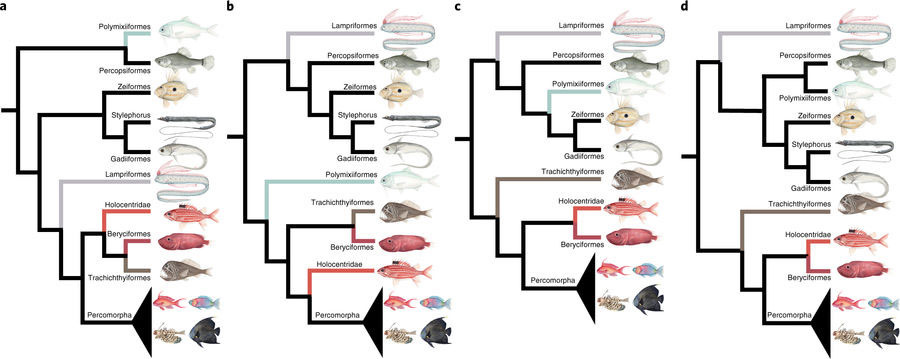
Fig. 1: Previous hypotheses for relationships among early diverging acanthomorphs. Recent multilocus studies conflict over the position of lampriforms, polymixiiforms and the arrangement of ‘beryciform’ lineages, which are thought to be most closely related to the percomorphs. a, resolves polymixiiforms as the sister group to percopsiforms, and lampriforms as sister to a clade comprising holocentrids + beryciforms (here taken to include berycoids and stephanoberycoids) + trachichthyiforms and percomorphs. b, resolves lampriforms as the sister lineage to a clade containing percopsiforms, zeiforms and gadiiforms, and places polymixiiforms as the sister lineage to a clade with beryciforms + trachichthyiforms and holocentrids as successive sister lineages to percomorphs. c, resolves lampriforms as the sister group to percopsiforms, polymixiiforms and zeiforms + gadiiforms, and resolves trachichthyiforms as the sister group to a clade consisting of beryciforms + holocentrids and percomorphs. d, The UCE topology resolves the backbone of the acanthomorph tree with high support, revealing an early divergence between a clade containing lampriforms, percopsiforms, polymixiiforms, zeiforms and gadiiforms, and a clade containing trachichthyiforms as the sister lineage to a clade consisting of beryciforms + holocentrids and percomorphs. Nature Ecology & Evolution (2018) doi:10.1038/s41559-018-0494-6
As dinosaurs and huge ocean predators disappeared 66 million years ago in a mass extinction event, lineages that comprise the bulk of marine fish species diversity began evolving and filled the seas, a new, multi-institution analysis shows.
The findings by researchers from Yale, the University of California-Los Angeles, Louisiana State University, and the University of Michigan were published March 12 in the journal Nature Ecology and Evolution.
About 18,000 species of spiny-rayed fishes exist today, a diverse group that includes basses, tunas, deep-sea anglerfishes, pufferfishes, and seahorses, and that comprises more than 25% of all living vertebrate species.
The research team analyzed more than 1,000 genes in living fish species and the spiny-rayed fish fossil record in order to estimate the timing of the evolutionary origin of the lineages that account for most of the species diversity of modern marine fishes. They found the evolutionary origin of these species’ lineages occurred at what scientists called Cretaceous and Paleogene boundary 66 million years ago.
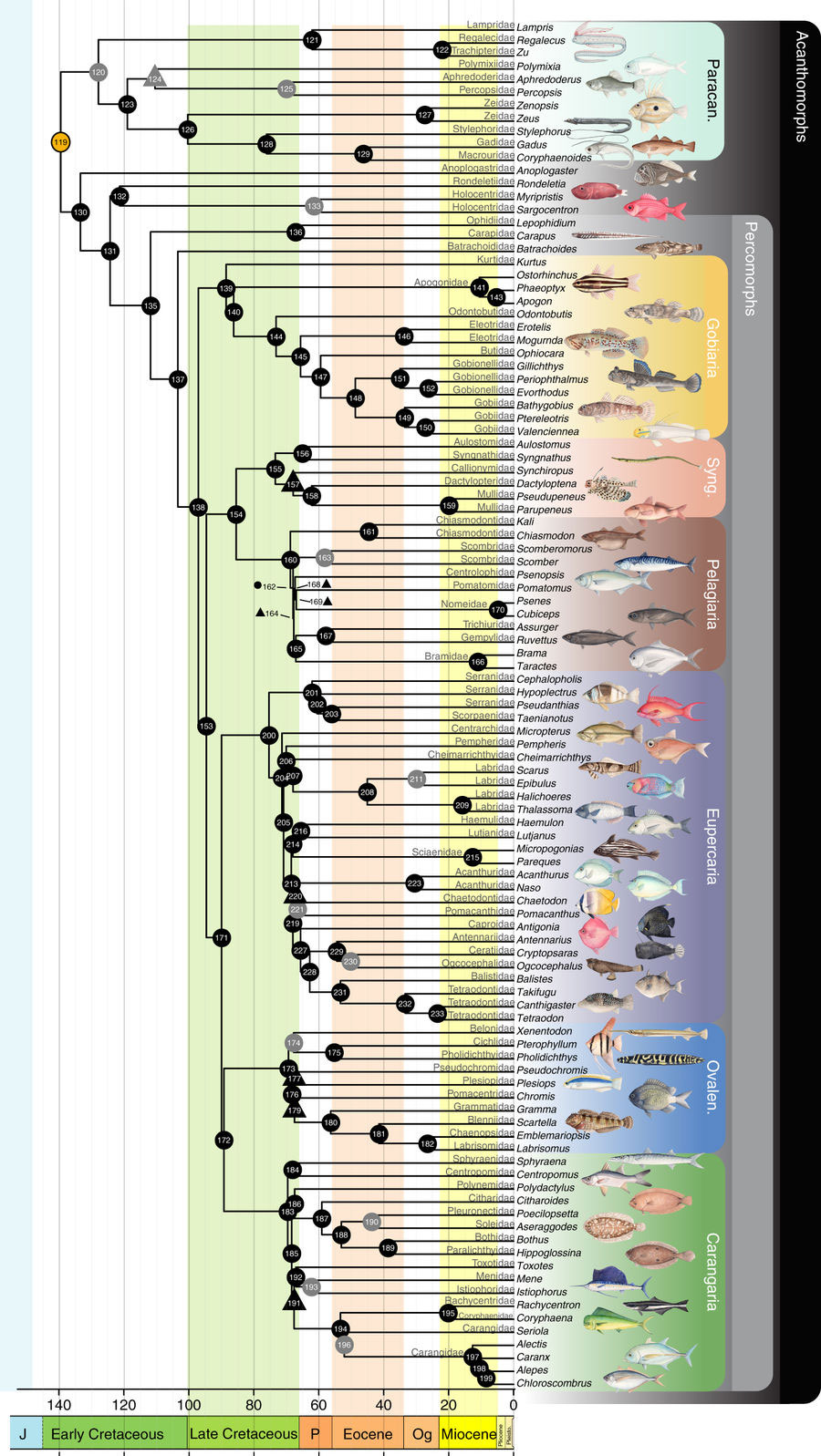
Fig. 3: Evolutionary timescale for acanthomorph fishes. Phylogeny inferred for 120 species of acanthomorph fishes based on Bayesian analysis of 1,100 UCE loci in the partitioned, 75% complete matrix using ExaBayes47. All nodes in the phylogeny are supported by a posterior probability ≥0.95 except node 191 (posterior probability = 0.82). Nodes with non-parametric, maximum-likelihood bootstrap support ≥70% are indicated by circles. Nodes with bootstrap support <70% are indicated by triangles. Grey nodes represent fossil-constrained ages, whereas the orange node indicates the constraint placed on the root. Tip labels indicate the genus of sampled species, with family designations in grey text to the left. Shaded tabs indicate acanthomorph higher taxonomic groups, including six major percomorph subdivisions. The time axis represents divergences in Myr. See Supplementary Table 1 for details of taxonomic samples and Supplementary Information for additional phylogenetic analyses. J, Jurassic; Og, Oligocene; Ovalen., Ovalentaria; P, Palaeocene; Paracan., Paracanthopterygii; Pleisto., Pleistocene; Syng., Syngnatharia. Nature Ecology & Evolution (2018) doi:10.1038/s41559-018-0494-6
“These lineages diversified just as dinosaurs were going extinct and placental mammals on land were emerging,” said Thomas Near, professor of ecology and evolutionary biology, the Bingham Oceanographic Curator at the Peabody Museum of Natural History, head of Saybrook College, and senior author of the study.
The work was primarily supported by the National Science Foundation.
Reference: “Explosive diversification of marine fishes at the Cretaceous–Palaeogene boundary” by Michael E. Alfaro, Brant C. Faircloth, Richard C. Harrington, Laurie Sorenson, Matt Friedman, Christine E. Thacker, Carl H. Oliveros, David Černý and Thomas J. Near, 12 March 2018, Nature Ecology & Evolution. DOI: 10.1038/s41559-018-0494-6

1 Comment
If it was 66 million years ago, it was an OLD species of fish rather than a NEW one.