
Close Menu
    Facebook X (Twitter) Instagram
    SciTechDaily
    • Biology
    • Chemistry
    • Earth
    • Health
    • Physics
    • Science
    • Space
    • Technology
    Facebook X (Twitter) Pinterest YouTube RSS
    SciTechDaily
    Home»Space»New Study Confirms the Ideas About Galaxy Cluster Evolution
    Space

    New Study Confirms the Ideas About Galaxy Cluster Evolution

    By Harvard-Smithsonian Center for AstrophysicsJanuary 20, 2017No Comments3 Mins Read
    Facebook Twitter Pinterest Telegram LinkedIn WhatsApp Email Reddit
    Share
    Facebook Twitter LinkedIn Pinterest Telegram Email Reddit
    The Evolution of Massive Galaxy Clusters
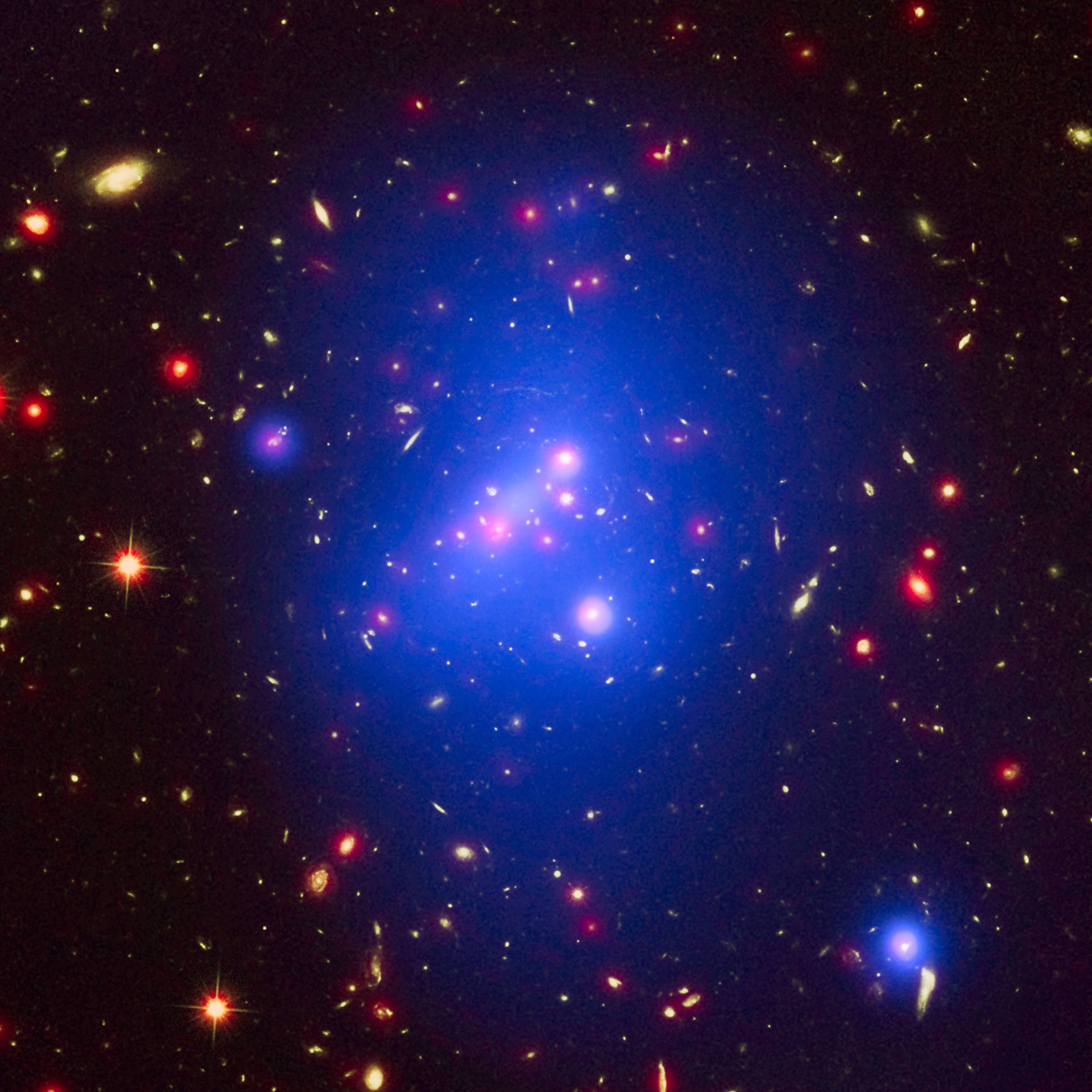
    A multi-wavelength image of the distant massive galaxy cluster, IDCS J1426.5+3508 (X-rays from Chandra in blue, visible light from Hubble in green, and infrared data from Spitzer in red).

    A new millimeter wavelength study of massive clusters from the Harvard-Smithsonian Center for Astrophysics has found good agreement with current ideas about galaxy cluster evolution.

    Galaxy clusters have long been recognized as important laboratories for the study of galaxy formation and evolution. The advent of the new generation of millimeter and submillimeter wave survey telescopes, like the South Pole Telescope (SPT), has made it possible to identify faint galaxy clusters over large fractions of the sky using an effect first recognized by Rashid Sunyaev and Yakov Zel’dovich in 1969: When hot electrons in the cluster gas interact with light from the ubiquitous cosmic microwave background they increase its brightness very slightly.

    SAO is a partner institution in the South Pole Telescope, which has been conducting a large survey covering about six percent of the whole sky with a sensitivity and angular resolution suitable for spotting galaxy clusters as far away as those from the epoch about four billion years after the big bang. One advantage of studying this sample of clusters is that because they have been identified from their hot gas signatures (rather than from the starlight of their member galaxies), the evolution of the cluster and its ensemble population is easier to disentangle.

    CfA astronomer Brian Stalder and a team of colleagues used the SPT survey data to identify twenty-six of the most massive clusters known, each with a mass of over about a million billion solar masses. They find that the clusters are broadly in agreement with the current thinking about the evolution of massive clusters and the stars in these galaxies. The models suggest a generally passive evolution (that is, without unusual disruptions by collisions or nuclear black hole feedback) and imply that most of the star formation and galaxy merging took place at an even earlier epoch than this sample covers. The scientists note, however, that a larger sample is needed to extend the conclusions, and it is currently being undertaken using other large optical telescopes including the Magellan twin 6.5-meter (21-foot) telescopes in Chile of which SAO is also a leading partner.

    Reference: “Galaxy Populations in the 26 Most Massive Galaxy Clusters in the South Pole Telescope SPT-SZ Survey” by A. Zenteno, J. J. Mohr, S. Desai, B. Stalder, A. Saro, J. P. Dietrich, M. Bayliss, S. Bocquet, I. Chiu, A. H. Gonzalez, C. Gangkofner, N. Gupta, J. Hlavacek-Larrondo, M. McDonald, C. Reichardt and A. Rest, 8 July 2016, MNRAS.
    DOI: 10.1093/mnras/stw1649

    Never miss a breakthrough: Join the SciTechDaily newsletter.
    Follow us on Google and Google News.

    Astronomy Astrophysics Cosmology Harvard-Smithsonian Center for Astrophysics
    Share. Facebook Twitter Pinterest LinkedIn Email Reddit

    Related Articles

    Webb’s Mysterious “Little Red Dots” May Be the Cradle of the First Black Holes

    Mysterious Radio Signals Reveal What’s Hiding Between Galaxies

    Cosmic Mystery Solved: Astronomers Have Discovered the Universe’s “Missing” Matter

    Invisible Storm Lights Up Galaxy Cluster With Record-Breaking Radio Glow

    Astronomers Search for Trigger of Nearby Supernova

    Herschel Observations Help Identify the Physical Processes Underway in Cold, Dense Clouds

    CfA Scientists Measure the Rate of Expansion of the Universe

    New Study Challenges Planck Results

    Calculations Show the Ideal Time to Study the Cosmos

    Leave A Reply Cancel Reply

    • Facebook
    • Twitter
    • Pinterest
    • YouTube

    Don't Miss a Discovery

    Subscribe for the Latest in Science & Tech!

    Trending News

    Scientists Uncover Potential Brain Risks of Popular Fish Oil Supplements

    Scientists Discover a Surprising Way To Make Bread Healthier and More Nutritious

    After 60 Years, Scientists Uncover Unexpected Brain Effects of Popular Diabetes Drug Metformin

    New Research Uncovers Hidden Side Effects of Popular Weight-Loss Drugs

    Scientists Rethink Extreme Warming After Surprising Ocean Discovery

    Landmark Study Links Never Marrying to Significantly Higher Cancer Risk

    Researchers Discover Unknown Beetle Species Just Steps From Their Lab

    Largest-Ever Study Finds Medicinal Cannabis Ineffective for Anxiety, Depression, PTSD

    Follow SciTechDaily
    • Facebook
    • Twitter
    • YouTube
    • Pinterest
    • Newsletter
    • RSS
    SciTech News
    • Biology News
    • Chemistry News
    • Earth News
    • Health News
    • Physics News
    • Science News
    • Space News
    • Technology News
    Recent Posts
    • Scientists Discover Hidden Pathway Inside Catalysts That Defies Decades of Assumptions
    • Scientists Finally Crack Decades-Old Mystery of “Breathing” Lasers
    • “Like Liquid Metal”: Scientists Create Strange Shape-Shifting Material
    • Early Warning Signals of Esophageal Cancer May Be Hiding in Plain Sight
    • Researchers Have Discovered a THC-Free Cannabis Compound That May Replace Opioids
    Copyright © 1998 - 2026 SciTechDaily. All Rights Reserved.
    • Science News
    • About
    • Contact
    • Editorial Board
    • Privacy Policy
    • Terms of Use

    Type above and press Enter to search. Press Esc to cancel.