
Close Menu
    Facebook X (Twitter) Instagram
    SciTechDaily
    • Biology
    • Chemistry
    • Earth
    • Health
    • Physics
    • Science
    • Space
    • Technology
    Facebook X (Twitter) Pinterest YouTube RSS
    SciTechDaily
    Home»Biology»New Study Explains Why Individuals Heal Differently
    Biology

    New Study Explains Why Individuals Heal Differently

    By Bill Hathaway, Yale UniversityNovember 23, 20185 Comments2 Mins Read
    Facebook Twitter Pinterest Telegram LinkedIn WhatsApp Email Reddit
    Share
    Facebook Twitter LinkedIn Pinterest Telegram Email Reddit
    Cells Beneath Skin Explain Differences in Healing
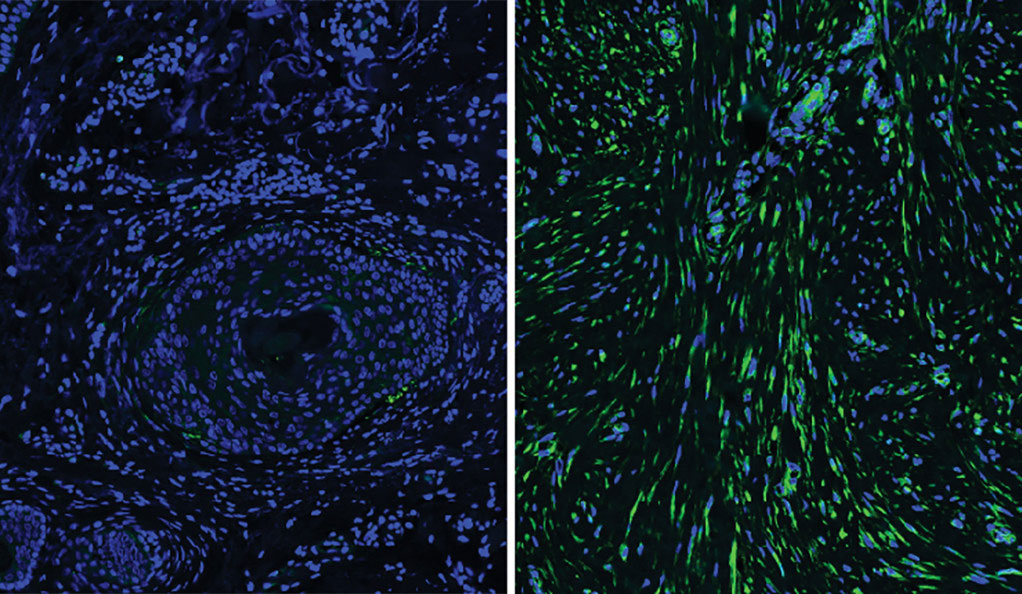
    A microscopic comparison between normal skin (left) and scarred skin.

    Differences in the cells that give skin its resilience and strength during wound repair may explain why individuals heal differently, according to a new Yale study published November 23 in the journal Science.

    Fibroblasts, the cells that form the protein structure beneath the surface of the skin, were once thought to be fairly uniform in their function. However, the new study found that subsets of fibroblasts may explain why skin regeneration is less robust in older people and how certain types of scars form.

    “These subsets of cells may explain different healing potentials in different people,” said senior author Valerie Horsley, associate professor of molecular, cellular, and developmental biology.

    Horsley and first author Brett Shook studied the genetics of fibroblasts and looked at their effects in mice and humans and found multiple differences in how these cells respond to injury and changes that occur during aging. For instance, after injury, a subset of fibroblasts that normally produce adipocytes, or fat cells, start forming scar tissue to repair the skin tissue. Interestingly, say the researchers, these cells are reduced in human skin compared to mouse skin, which may explain why scars are more prevalent in people than mice.

    The study also identified the essential role of immune cells called macrophages in not only fighting infection but also healing wounds and scar formation. Macrophages that appear at the peak of tissue regeneration can selectively signal to a subset of fibroblasts. Human scar tissue contains more macrophages and fibroblast subsets and both populations are reduced in poorly healing wounds from aged mice.

    “By identifying functionally distinct populations of skin cells and revealing the signals that control their behavior, we hope to develop new targeted therapies for the treatment of defective wound healing and scar formation,” Shook said.

    Reference: “Myofibroblast proliferation and heterogeneity are supported by macrophages during skin repair” by Brett A. Shook, Renee R. Wasko, Guillermo C. Rivera-Gonzalez, Emilio Salazar-Gatzimas, Francesc López-Giráldez, Biraja C. Dash, Andrés R. Muñoz-Rojas, Krystal D. Aultman, Rachel K. Zwick, Vivian Lei, Jack L. Arbiser, Kathryn Miller-Jensen, Damon A. Clark, Henry C. Hsia And Valerie Horsley, 23 November 2018, Science.
    DOI: 10.1126/science.aar2971

    Never miss a breakthrough: Join the SciTechDaily newsletter.
    Follow us on Google and Google News.

    Cell Biology Skin Yale University
    Share. Facebook Twitter Pinterest LinkedIn Email Reddit

    Related Articles

    Researchers Identify Molecular Factors that Push the Domino of Life into Motion

    Researchers Solve Biological Mystery about the Common Genesis of Many Serious Diseases

    Cancer Scientists Prove Long-Standing Theory on How Cancer Spreads

    Combination of Immune Stimulating Antibodies Shows Promising Results Against Advanced Melanoma

    Scientists Peer Into a Cell in Real Time

    Researchers Uncover Molecular Pathway to Grow New Arteries

    A Closer Look at the Antifreeze Protein That Allows Siberian Beetles to Survive

    Understanding How Cells Package Fat

    Optogenetics Regulates Metabolic Activity in the Membranes of Cells

    5 Comments

    1. run 3 on July 20, 2019 12:20 am

      Brains of people at risk of psychosis exhibit a pattern that can help predict whether they will go on to develop full-fledged schizophrenia, a new Yale-led study shows.

      Reply
    2. Bobbie T Barclay on October 7, 2019 2:46 am

      A microscopic comparison between normal skin (left) and scarred skin.

      Reply
    3. george bennett on June 29, 2021 4:50 pm

      I broke 6 vertebrate in my back,all of my ribs. My neck was broken and my faceplate,hand plus clavicle. I was able to work exactly 9 weeks exactly to the day. Now I have a broken shoulder (4 pieces) and still no surgeries.

      Reply
    4. george bennett on June 29, 2021 4:52 pm

      I’m 54

      Reply
    5. george bennett on June 29, 2021 4:56 pm

      I take (NO) drugs. Pain inflammation ext. I heal faster than people half my age. And I can prove it on my chart com. I have medical proof.

      Reply
    Leave A Reply Cancel Reply

    • Facebook
    • Twitter
    • Pinterest
    • YouTube

    Don't Miss a Discovery

    Subscribe for the Latest in Science & Tech!

    Trending News

    Your Blood Pressure Reading Could Be Wrong Because of One Simple Mistake

    Astronomers Stunned by Ancient Galaxy With No Spin

    Physicists May Be on the Verge of Discovering “New Physics” at CERN

    Scientists Solve 320-Million-Year Mystery of Reptile Skin Armor

    Scientists Say This Daily Walking Habit May Be the Secret to Keeping Weight Off After Dieting

    New Therapy Rewires the Brain To Restore Joy in Depression Patients

    Giant Squid Detected off Western Australia in Stunning Deep-Sea Discovery

    Popular Sugar-Free Sweetener Linked to Liver Disease, Study Warns

    Follow SciTechDaily
    • Facebook
    • Twitter
    • YouTube
    • Pinterest
    • Newsletter
    • RSS
    SciTech News
    • Biology News
    • Chemistry News
    • Earth News
    • Health News
    • Physics News
    • Science News
    • Space News
    • Technology News
    Recent Posts
    • Fur Seals’ Hearts Suddenly Spike Hours After Returning to Land
    • Scientists Say Cognitive Decline Isn’t Inevitable — Your Brain Can Improve at Any Age
    • This Weird Sea Creature May Have Rewritten Life’s Genetic Rulebook
    • The Hidden Types of Dementia Most People Have Never Heard Of
    • Scientists Discover Why Alcohol Prevents the Liver From Healing, Even After You Quit
    Copyright © 1998 - 2026 SciTechDaily. All Rights Reserved.
    • Science News
    • About
    • Contact
    • Editorial Board
    • Privacy Policy
    • Terms of Use

    Type above and press Enter to search. Press Esc to cancel.