
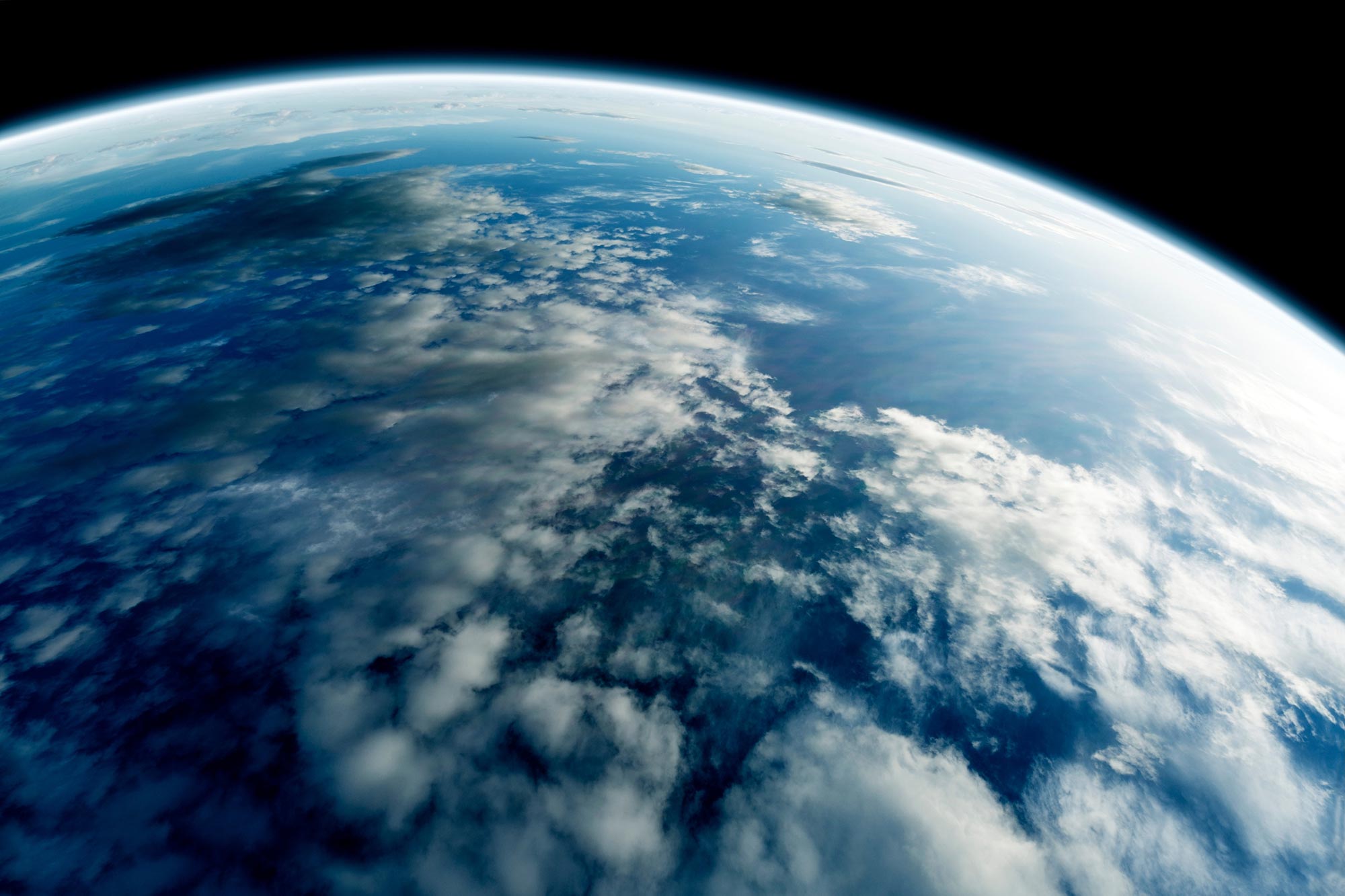
Researchers have discovered that the same principles governing air turbulence in the troposphere also apply to the thermosphere.
A study published in Geophysical Research Letters reveals that turbulence in the thermosphere follows the same physical laws as wind in the lower atmosphere. Additionally, the study found that wind in the thermosphere mainly rotates cyclonically, meaning it turns counterclockwise in the Northern Hemisphere and clockwise in the Southern Hemisphere.
The findings reveal a new unified principle for the Earth’s varied environmental systems and can potentially improve future forecasting of both Earth and space weather.
Noctilucent clouds seen in the German city of Kühlungsborn. Its delicate and complex structure and flow indicate the presence of atmospheric gravity waves and turbulence. Credit: Gerd Baumgarten/Leibniz-Institute of Atmospheric Physics
One time or another we’ve tuned in to see the latest weather forecast, and while they give us a good idea of our daily atmospheric conditions the research that goes into studying how Earth’s air moves around is dizzyingly complex.
“At the fundamental level, we study the interplay of kinetic energy in the atmosphere at different sizes and scales, that energy is mostly in the form of wind and turbulence. Over the decades, a massive amount of data has given us insight into how this energy flows and dissipates to affect the weather in the troposphere, the lowest layer of the atmosphere” explains Professor Huixin Liu of Kyushu University’s Faculty of Science who led the study. “My research focuses on the movements in the upper atmosphere, specifically the thermosphere, where we explore the corresponding laws governing the dynamics and energy flow in the region.”
Research Collaboration and Findings
The thermosphere is a section of the atmosphere roughly 80-550 km above sea level and is often referred to as the gateway to space. It is a critical region for space operation, and is where you will find the International Space Station as well as most satellites. It is also where auroras are formed.
Liu collaborated with meteorology researcher Dr. Facundo L. Poblet of Leibniz Institute of Atmospheric Physics at the University of Rostock, whose work focuses on the dynamics and turbulence in the lower atmosphere below an altitude of 100 km.
“My research is in space physics, and I wanted to see if we could apply his meteorological methods to my research domain,” explains Liu.
The team analyzed the thermosphere wind data from two satellites, the Challenging Minisatellite Payload (CHAMP) and the Gravity Field and Steady State Ocean Circulation Explorer (GOCE). With the data, the team calculated the third-order structure function of the wind, a statistical quantity that provides information on the underlying turbulence. To their astonishment, they discovered that the thermosphere exhibits a similar scaling law to that of the lower atmosphere.
“This means that both the thermosphere and the troposphere—despite having drastically different atmospheric compositions and dynamics—follow the same physical laws. How the energy flows and dissipates in these two regions are very similar,” continues Liu.
Despite remarkable strides in understanding the thermosphere, the intricate interplay of turbulence and waves at different scales has remained largely elusive, and the team is happy that their findings shed new light onto this underexplored aspect of near-space dynamics.
“Similar to atmospheric weather forecasting, comprehending the energy distributions in the thermosphere is vital to advance our understanding of space dynamics,” concludes Liu. “We hope these findings can be used to improve space weather forecasting and ensuring the continued functionality and safety of satellite-based technologies essential to everyday life.”
Reference: “Third-Order Structure Functions of Zonal Winds in the Thermosphere Using CHAMP and GOCE Observations” by Facundo L. Poblet, Huixin Liu and Jorge L. Chau, 3 June 2024, Geophysical Research Letters.
DOI: 10.1029/2024GL108367
The study was funded by the Japan Society for the Promotion of Science.
Never miss a breakthrough: Join the SciTechDaily newsletter.
Follow us on Google and Google News.
1 Comment
Let me guess: they forgot to include thermosphere in the climate models, right?