
Close Menu
    Facebook X (Twitter) Instagram
    SciTechDaily
    • Biology
    • Chemistry
    • Earth
    • Health
    • Physics
    • Science
    • Space
    • Technology
    Facebook X (Twitter) Pinterest YouTube RSS
    SciTechDaily
    Home»Earth»How a Sudden Stratospheric Warming Event Over Antarctica Affected the Northern Hemisphere
    Earth

    How a Sudden Stratospheric Warming Event Over Antarctica Affected the Northern Hemisphere

    By Nancy Wolfe Kotary, MIT Haystack ObservatoryJuly 25, 2021No Comments4 Mins Read
    Facebook Twitter Pinterest Telegram LinkedIn WhatsApp Email Reddit
    Share
    Facebook Twitter LinkedIn Pinterest Telegram Email Reddit
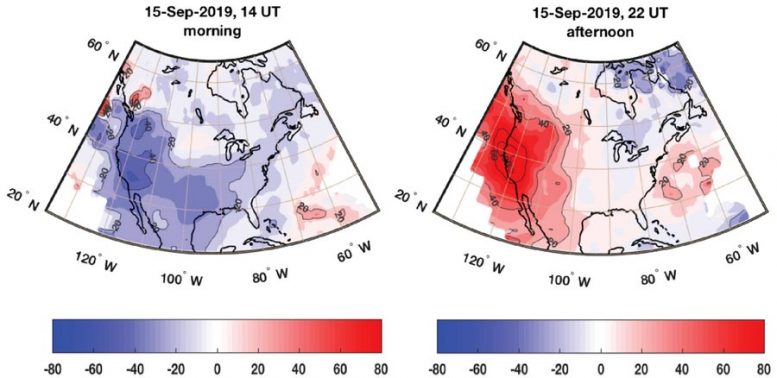
    Ionospheric Anomalies Over North America 2019
    Ionospheric anomalies observed on September 15, 2019, over North America. Anomalies are shown for TEC (total electron content) and expressed as percentage compared to the average values for this season. A 50-80 percent increase in TEC observed over the western United States is linked to the Antarctic sudden stratospheric warming. The colored areas show where the TEC levels are shifted over North America and Europe in the afternoon; red indicates an increase of up to 80 percent versus the baseline regular levels, and blue indicates a decrease of up to –40 percent versus regular levels. Credit: Image courtesy of Goncharenko et al.

    Research from MIT Haystack Observatory finds a stratospheric warming event over Antarctica linked to anomalies in near-Earth space above North America and Europe.

    Weather is a tricky science — even more so at very high altitudes, with a mix of plasma and neutral particles.

    In sudden stratospheric warmings (SSWs) — large meteorological disturbances related to the polar vortex in which the polar stratosphere temperature increases as it is affected by the winds around the pole — the polar vortex is weakened. SSWs also have profound atmospheric effects at great distances, causing changes in the hemisphere opposite from the location of the original SSW — changes that extend all the way to the upper thermosphere and ionosphere.

    Interhemispheric Atmospheric Effects

    A study published on July 16, 2021, in Geophysical Research Letters by MIT Haystack Observatory’s Larisa Goncharenko and colleagues examines the effects of a recent major Antarctic SSW on the Northern Hemisphere by studying changes observed in the upper atmosphere over North America and Europe.

    In an SSW-caused anomaly, changes over the pole cause changes in the opposite hemisphere. This important interhemispheric linkage was identified as drastic shifts at altitudes greater than 100 km — for example, in total electron content (TEC) measurements as well as variations in the thermospheric O/N2 ratio.

    SSWs are more frequent over the Arctic; these cause TEC and other related anomalies in the Southern Hemisphere, and thus more observations have been made on this linkage. Since the Antarctic SSWs are less common, there are fewer opportunities to study their effects on the Northern Hemisphere. However, the greater density of TEC observation locations in the Northern Hemisphere allows for precise measurement of these upper atmospheric anomalies when they do occur.

    In September 2019, an extreme, record-breaking SSW event occurred over Antarctica. Goncharenko and colleagues found significant resulting changes in the upper atmosphere in mid-latitudes over the Northern Hemisphere following this event; more observations are available for this region than in the Southern Hemisphere. The changes were notable not only in severity, but also because they are limited to a narrow (20–40 degrees) longitude range, differ between North America and Europe, and persist for a long time.

    Regional Differences Between North America and Europe

    In the figure above, red areas show where TEC levels are shifted over North America and Europe in the afternoon; red indicates an increase of up to 80 percent versus the baseline regular levels, and blue indicates a decrease of up to –40 percent versus regular levels. This TEC shift persisted throughout September 2019 over the western United States, but was short-lived over Europe, indicating different mechanisms at play.

    The authors suggest that a change in the thermospheric zonal (east–west) winds are one reason for the variance between regions. Another factor is differences in magnetic declination angles; in areas with greater declination, the zonal winds can more efficiently transport plasma to higher or lower altitudes, leading to the build-up or depletion of plasma density.

    More study is needed to determine the precise extent to which these factors affect the linkage between polar stratospheric events and near-Earth space in the opposite hemisphere. These studies remain a challenge, given the relative rarity of Antarctic SSWs and sparse availability of ionospheric data in the Southern Hemisphere.

    Reference: “Impact of September 2019 Antarctic Sudden Stratospheric Warming on Mid-Latitude Ionosphere and Thermosphere over North America and Europe” by Larisa P. Goncharenko, V. Lynn Harvey, Katelynn R. Greer, Shun-Rong Zhang, Anthea J. Coster and Larry J. Paxton, 16 July 2021, Geophysical Research Letters.
    DOI: 10.1029/2021GL094517

    Never miss a breakthrough: Join the SciTechDaily newsletter.
    Follow us on Google and Google News.

    Atmospheric Science Geophysics Geoscience MIT Weather
    Share. Facebook Twitter Pinterest LinkedIn Email Reddit

    Related Articles

    Amazon Rainfall Sparks Tiny Cloud Factories in the Sky

    Predicting the Unpredictable: New Equation Could Transform Atmospheric River Forecasting

    Hydraulic Jump Drives Stratospheric Hydration Above Intense Supercell Thunderstorms

    Isotopes From Cave Stalactites Show More Intense and Frequent Thunderstorms Linked to Global Climate Variability

    “Beast From the East” – Snow Chaos in Europe Caused by Melting Sea-Ice in the Arctic

    How Airplanes Counteract Luminous Plasma Phenomenon, St. Elmo’s Fire, During Thunderstorms

    “Grey Swan” Cyclones Will Become More Frequent and Intense

    The Mystery of India’s Rapid Move toward Eurasia 80 Million Years Ago

    Small Volcanoes Underestimated in Climate Models

    Leave A Reply Cancel Reply

    • Facebook
    • Twitter
    • Pinterest
    • YouTube

    Don't Miss a Discovery

    Subscribe for the Latest in Science & Tech!

    Trending News

    AI Could Detect Early Signs of Alzheimer’s in Under a Minute – Far Before Traditional Tests

    What if Dark Matter Has Two Forms? Bold New Hypothesis Could Explain a Cosmic Mystery

    This Metal Melts in Your Hand – and Scientists Just Discovered Something Strange

    Beef vs. Chicken: Surprising Results From New Prediabetes Study

    Alzheimer’s Breakthrough: Scientists Discover Key Protein May Prevent Toxic Protein Clumps in the Brain

    Quantum Reality Gets Stranger: Physicists Put a Lump of Metal in Two Places at Once

    Scientists May Have Found the Key to Jupiter and Saturn’s Moon Mystery

    Scientists Uncover Brain Changes That Link Pain to Depression

    Follow SciTechDaily
    • Facebook
    • Twitter
    • YouTube
    • Pinterest
    • Newsletter
    • RSS
    SciTech News
    • Biology News
    • Chemistry News
    • Earth News
    • Health News
    • Physics News
    • Science News
    • Space News
    • Technology News
    Recent Posts
    • What if Your Memories Never Happened? Physicists Take a New Look at the Boltzmann Brain Paradox
    • Students Found an Ancient Star That Shouldn’t Be in the Milky Way
    • Astronomers Solve 50-Year Mystery and Reveal Hidden Culprit Behind Strange X-Ray Emissions
    • One of the Universe’s Largest Stars May Be Getting Ready To Explode
    • Scientists Discover Enzyme That Could Supercharge Ozempic-Like Weight Loss Drugs
    Copyright © 1998 - 2026 SciTechDaily. All Rights Reserved.
    • Science News
    • About
    • Contact
    • Editorial Board
    • Privacy Policy
    • Terms of Use

    Type above and press Enter to search. Press Esc to cancel.