

Obesity causes temporary disruptions, but not permanent structural changes, in the liver’s molecular network that regulates adaptation to starvation.
Researchers led by Keigo Morita and Shinya Kuroda at the University of Tokyo have discovered that obesity causes a temporary disruption in how the liver adapts to starvation. Despite this functional disturbance, the underlying structure of the liver’s molecular network remains intact.
This is a major breakthrough because incorporating time-based analysis in biology has long been a complex challenge, and drawing systematic insights from large-scale data has proven difficult.
The findings open new avenues for studying broader metabolic processes, including food intake and disease progression. The study was published in Science Signaling.
Liver plays key role in metabolic adaptation
To survive, living organisms must constantly extract energy from food and distribute it throughout the body to maintain a stable internal state known as homeostasis. Starvation poses one of the most extreme challenges to this balance. In response, the liver, a central organ in metabolism, must coordinate not only which molecules are activated but also the precise timing of their actions.
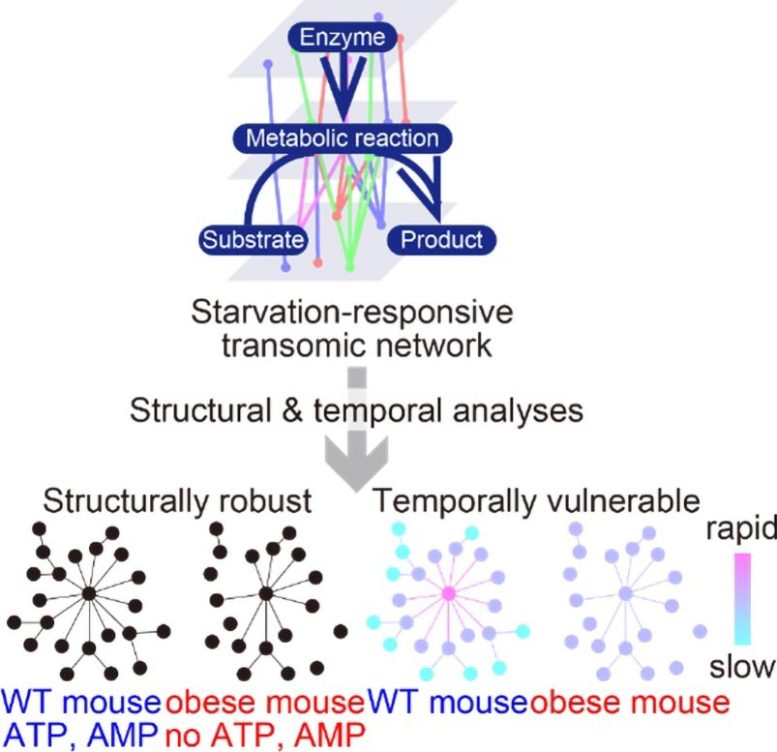
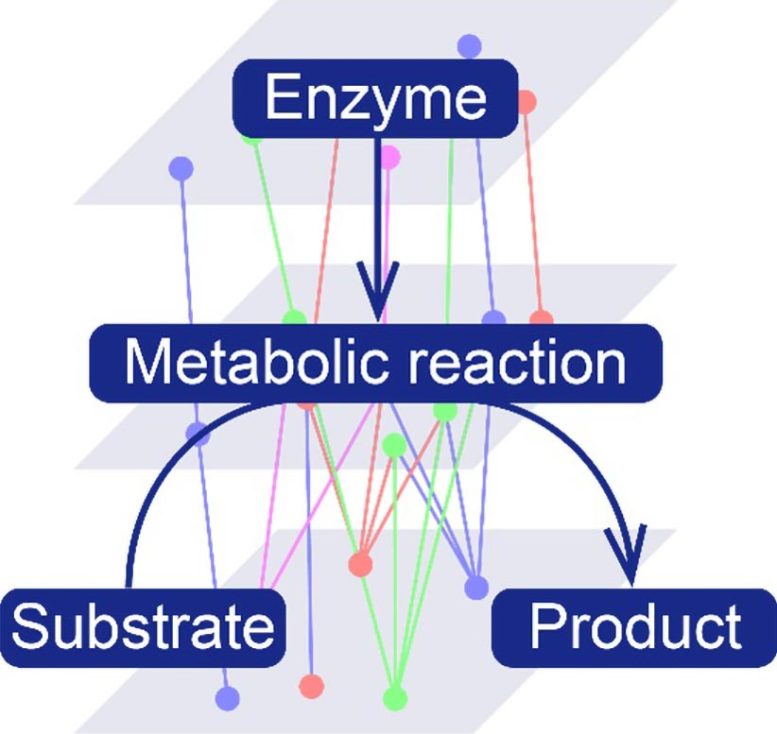
“Molecules inside cells form a large network,” says Kuroda, the principal investigator, “containing a small number of molecules regulating many metabolic reactions called hub molecules. However, a systematic understanding of the temporal coordination of molecules in the liver had been elusive due to the lack of comprehensive time-series data during starvation.”
Comparing healthy and obese livers
To better understand this process, the researchers analyzed the liver function of healthy and obese mice. They found distinct differences in the composition of hub molecules. In healthy mice, ATP and AMP—key molecules in energy regulation—were present, while in obese mice, these molecules were missing.
While this difference might suggest structural damage to the molecular network, further investigation revealed that the network structure remained intact. Instead, the disruption appeared in the timing and coordination of the liver’s metabolic responses.
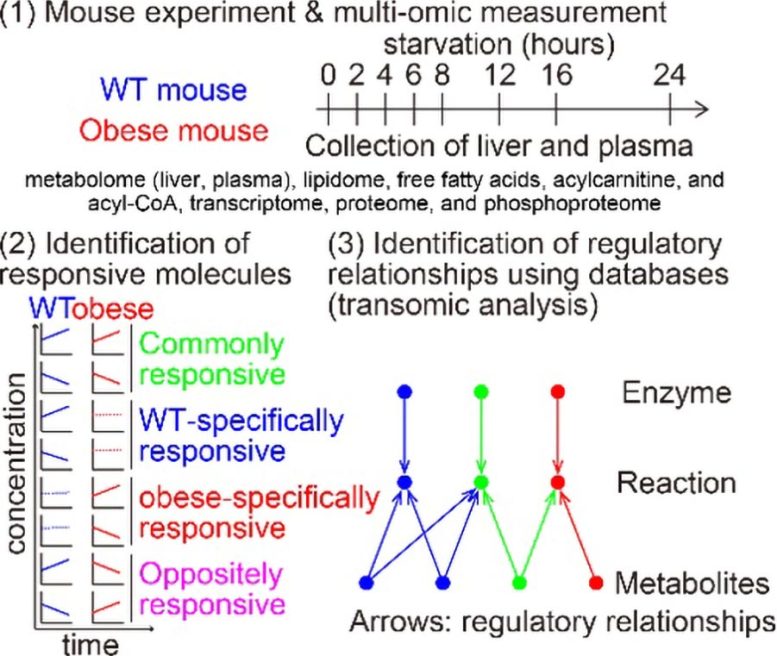
“We comprehensively measured the time courses of various molecules,” says Kuroda, “and found that hub molecules in healthy livers responded to starvation more rapidly than other molecules. This suggested a well-controlled temporal order of the molecular networks in healthy livers during starvation. On the other hand, this coordination disappeared in the liver of obese mice.”
Robust structure, disrupted timing
In other words, even though the structure of the molecular network during starvation remained robust, it became temporally vulnerable to obesity. The method that led to this discovery, combining structural and temporal analysis of the intracellular molecular network, can be applied to other studies that include data sets from multiple “omes” such as the genome or the microbiome, opening avenues for further research. Kuroda describes their next project.
“Our approach successfully described the global landscape of adaptation to starvation, a complicated biological phenomenon. We would like to generalize our insights of the metabolic network during starvation to the metabolic network during food intake or disease progression.”
Reference: “Structural robustness and temporal vulnerability of the starvation-responsive metabolic network in healthy and obese mouse liver” by Keigo Morita, Atsushi Hatano, Toshiya Kokaji, Hikaru Sugimoto, Takaho Tsuchiya, Haruka Ozaki, Riku Egami, Dongzi Li, Akira Terakawa, Satoshi Ohno, Hiroshi Inoue, Yuka Inaba, Yutaka Suzuki, Masaki Matsumoto, Masatomo Takahashi, Yoshihiro Izumi, Takeshi Bamba, Akiyoshi Hirayama, Tomoyoshi Soga and Shinya Kuroda, 22 April 2025, Science Signaling.
DOI: 10.1126/scisignal.ads2547
Never miss a breakthrough: Join the SciTechDaily newsletter.
Follow us on Google and Google News.
1 Comment
Think of it like a messy kitchen during a dinner rush — things get chaotic for a bit, but the layout stays the same. Big win for science thanks to some serious time-lapse bio-analysis!
Liver’s still got the beats to keep the metabolic band together, even when obesity crashes the jam session.