

UNSW scientists found that HFOs, marketed as eco-friendly refrigerants, degrade into harmful greenhouse gases, raising concerns about their long-term environmental impact.
A team of scientists at UNSW has discovered that some of the most important new refrigerants partially break down into persistent greenhouse gas pollutants, including compounds that have been banned internationally.
Refrigerants are chemicals that transition between liquid and gas states, transferring heat in the process. They are widely used in refrigeration, as well as indoor heating and cooling. Additionally, these chemicals serve as aerosol propellants, fire retardants, and are used in the production of foamed plastics.
Hydrofluoroolefins (HFOs), which react rapidly in the lower atmosphere, have emerged as the leading synthetic chemicals for refrigerants and are considered a more environmentally friendly alternative to their predecessors.
While it’s known that HFOs decompose into chemicals like trifluoroacetaldehyde, there has been persistent discussion about whether this compound further breaks down into fluoroform – the most environmentally damaging hydrofluorocarbon (HFC) they were used to replace.
A paper led by Dr Christopher Hansen from UNSW Chemistry, and published in the Journal of the American Chemical Society, has demonstrated that HFOs do break down into a small amount of fluoroform. This new research suggests we need to more closely examine HFOs’ environmental impact, raising questions about their long-term safety.
“We don’t fully understand the environmental impacts of HFOs at this point,” says Dr Hansen. “But, unlike previous examples such as the CFCs and leaded petrol, we are trying to figure out the consequences of large-scale emission before we’ve potentially harmed the environment and human health in an irreversible way. We’re trying to try to change the way that science introduces new products.”
The story so far
The hole in the ozone layer is a result of human activities that have released ozone-depleting chemicals, including chlorofluorocarbons (CFCs) – some of the first synthetic chemicals used as refrigerants and in aerosol cans.
Thanks to The Montreal Protocol, society began phasing these out internationally, and they were largely replaced with HFCs, which were used on a global scale from the mid 90s.
Although HFCs don’t cause any ozone layer depletion, they turned out to be potent greenhouse gases. “In the end, scientists discovered that 1kg of fluoroform – a once commonly used HFC – emitted today will contribute to as much to surface heating of the planet over the next century as more than 14,000kg of carbon dioxide,” says Dr Hansen.
After realizing the extreme greenhouse warming potential of HFCs, their global phaseout began in 2016.
HFOs, which have a shorter atmospheric lifetime, are now the leading synthetic replacements and are being rapidly proliferated as refrigerants, foam-blowing agents – such as those used in insulating foam – and aerosol propellants.
While scientists know some information about the chemical pathways of HFO decomposition, there has been a longstanding debate about whether they actually break down into some of the most environmentally unfriendly HFCs.
Experiments simulating the atmosphere
HFOs are made up of chemical units that are more reactive than their previous counterparts, so they don’t rise to the upper atmosphere and become long-lived greenhouse gases.
“But as chemists, we look at the structures of these molecules and we start to try and imagine what they are turned into,” says Dr Hansen. “So rather than just go, oh, this thing only has a lifetime of two weeks, it can’t be a greenhouse gas, we must see what it’s turned into.
“And most chemists will look at these structures, and they can draw reactions that actually lead to HFCs.”
But confirming whether HFOs break down into HFCs in low yields requires difficult experiments and most existing techniques and instruments lack the sensitivity and specificity to do so.
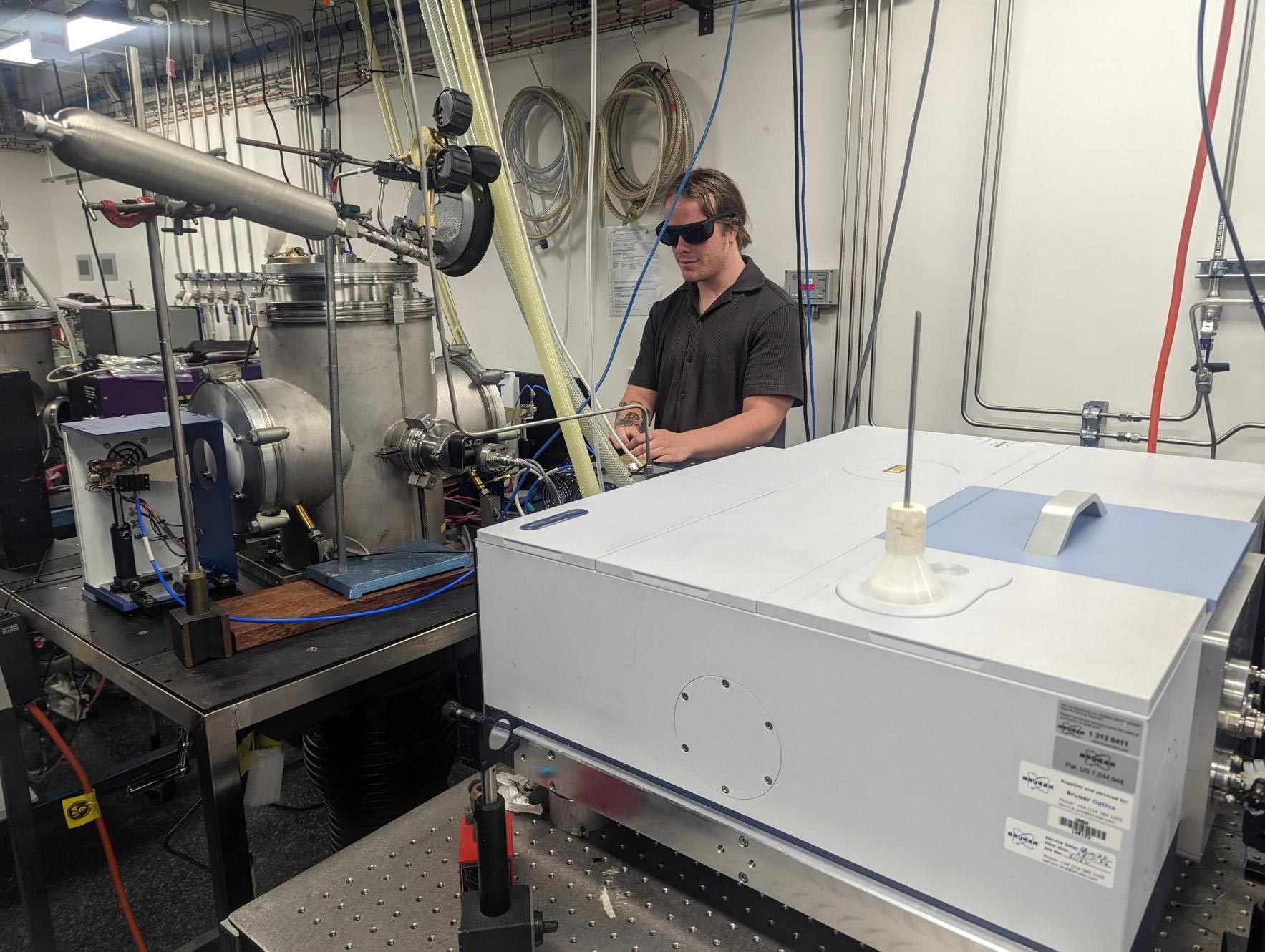
Dr Hansen and his team used multiple techniques, including two invented just for this study, to measure and evaluate the chemical reaction across the full range of pressures expected in the atmosphere.
“We used a variety of spectroscopic techniques to observe the reaction. And we made up a gas mixture at various pressures to simulate an atmosphere polluted with a trace amount of the immediate HFO decomposition product. Then we used a laser to simulate the photons that would otherwise come from the sun, to drive the reaction,” says Dr Hansen.
New data for climate models
We know that HFOs decompose into fluorinated carbonyls such as trifluoroacetaldehyde at a yield up to, or greater than, 100%. This means all the molecules of HFO turn into the first product and, for some HFOs, you might get two molecules of that product for each molecule of HFO that breaks down. This study reveals that the next step of the reaction, driven by light, produces a small amount of fluoroform from the decomposition of trifluoroacetaldehyde. Fluoroform is the HFC with the greatest global warming potential.
“We have demonstrated comprehensively that some of the most important HFOs do break down into HFCs and have provided the first hard scientific data needed to model and predict the consequences of large-scale emission,” says Dr Hansen. “Although the reaction only produces a small amount of fluoroform, the chemical can exist in the atmosphere for up to 200 years, and with a global warming potential more than 14000 times greater than CO2, a small yield can still have a significant impact.”
Many atmospheric crises have caught us by surprise. “Think leaded petrol, lethal smog events of the 20th century, the ozone hole crisis,” Dr Hansen explains. “But this wasn’t because our models were not good enough, but rather because the important chemistry was missing from the models,” he says.
Now, this study settles a longstanding controversy and provides the hard, scientific data needed to model and predict the impact of large-scale emission of HFOs, before policymakers may need to react to an emerging environmental crisis.
Climate modelling groups at UNSW, as well as scientists around the world, are now ready to input this data into models, to help work out the environmental impact of continuing to use HFOs.
“Although questions remain, this paper offers crucial evidence that should inform the next steps in addressing the environmental impact of the chemicals we release into the atmosphere,” Dr Hansen says.
Dr Hansen and his team are planning further novel experimental work. “For this paper, we performed the experiments at a single wavelength, the wavelength used in studies that are presently guiding regulators, industry, and governments,” he says. “We plan to study this chemistry using other wavelengths of light, where the yield could be higher or lower.”
Reference: “Fluoroform (CHF3) Production from CF3CHO Photolysis and Implications for the Decomposition of Hydrofluoroolefins and Hydrochlorofluoroolefins in the Atmosphere” by Joshua D. Thomson, Jyoti S. Campbell, Ethan B. Edwards, Christopher Medcraft, Klaas Nauta, Maria Paula Pérez-Peña, Jenny A. Fisher, David L. Osborn, Scott H. Kable and Christopher S. Hansen, 23 December 2024, Journal of the American Chemical Society.
DOI: 10.1021/jacs.4c11776
The study was funded by the Australian Research Council Discovery Program.
Never miss a breakthrough: Join the SciTechDaily newsletter.
Follow us on Google and Google News.
5 Comments
DuPont & GM partnered early on to destroy Earth’s Ozone. They were incredibly successful. However, scientists called the public’s attention to their rather diabolical conspiracy. Naturally GM & DuPont had to regroup and go their way; GM engineered their Special K!ll!ng Ignitions – very successful in their own right but limited in numbers. DuPont never gave up their goals of mass carnage and destruction, so their best chemical engineers got to work. As it turns out is was their marketing groups who came up with the idea to simply call their new more deadly substance, “Gree.”
“In the end, scientists discovered that 1kg of fluoroform – a once commonly used HFC – emitted today will contribute to as much to surface heating of the planet over the next century as more than 14,000kg of carbon dioxide,”
OK, so the Global Warming Potential, integrated over 100-years, for fluoroform is 14,000X that of CO2 on a weight basis; notably missing is the equivalence factor on a molecule-by-molecule basis, such as is used typically for measurement, say, in parts per trillion. Also, conspicuous by its absence is how much (PPTv) fluoroform is being generated annually? Just saying, “Although the reaction only produces a small amount of fluoroform, … a small yield can still have a significant impact” doesn’t cut for a science article. What is the actual concentration HFOs released annually, and what fraction is converted to an HFC? Why is it that only the big numbers get published and the small numbers are waved off with a “significant impact?”
The yield is in the abstract.
confirms production of CHF3 following excitation at a tropospherically relevant wavelength (λ = 308 nm) and under atmospheric pressure conditions. Pressure-dependent CHF3 quantum (Φ) and molar (Y) yields are reported from Φ = Y = 0.16 ± 0.03 under collision-free conditions to Φ = (2.3 ± 0.3) × 10–4, Y = (1.17 ± 0.27) × 10–3 at 1 bar N2.
Is still an oddity that CFCs migrate to the southern pole to attack the Ozone Only there without having damaged any ozone while in transit from the Northern Hemisphere. That is NOT science is speculative nonsense that CFCs or other similar compounds are in large part attacking Ozone ONLY at the Southern Pole.
Maybe the CFCs are negatively charged particles? Just a guess…