
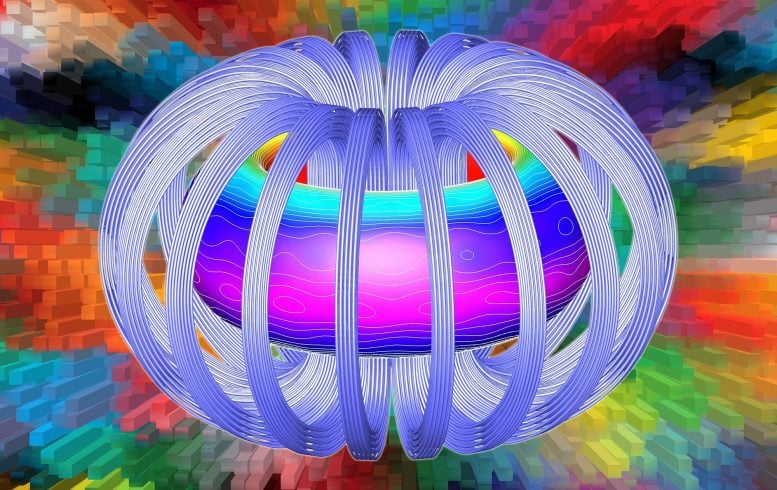
Stellarators, twisty machines that house fusion reactions, rely on complex magnetic coils that are challenging to design and build. Now, a physicist at the U.S. Department of Energy’s (DOE) Princeton Plasma Physics Laboratory (PPPL) has developed a mathematical technique to help simplify the design of the coils, making stellarators a potentially more cost-effective facility for producing fusion energy.
“Our main result is that we came up with a new method of identifying the irregular magnetic fields produced by stellarator coils,” said physicist Caoxiang Zhu, lead author of a paper reporting the results in Nuclear Fusion. “This technique can let you know in advance which coil shapes and placements could harm the plasma’s magnetic confinement, promising a shorter construction time and reduced costs.”
Fusion, the power that drives the sun and stars, is the fusing of light elements in the form of plasma — the hot, charged state of matter composed of free electrons and atomic nuclei — that generates massive amounts of energy. Twisty, cruller-shaped stellarators are an alternative to doughnut-shaped tokamaks that are more commonly used by scientists seeking to replicate fusion on Earth for a virtually inexhaustible supply of power to generate electricity.
A key benefit of stellarators is their production of highly stable plasmas that are less liable to the damaging disruptions that tokamaks can incur. But the complexity of stellarator coils has been a factor holding back the development of such facilities.
The coils of a stellarator must be constructed and arranged around the vacuum chamber very precisely since deviations from the best coil arrangement create bumps and wiggles in the magnetic field that degrade the magnetic confinement and allow the plasma to escape. These problematic magnetic fields can easily be caused by the misplacement of the magnetic coils, so engineers stipulate strict tolerances for these components.
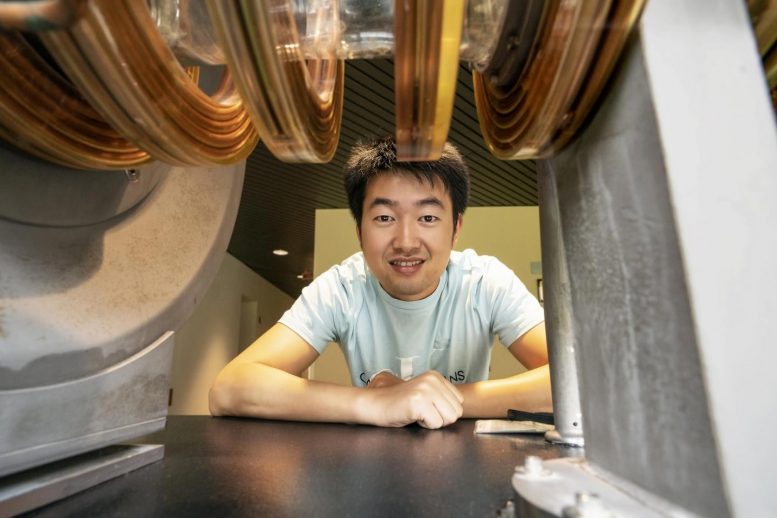
“The big challenge of building stellarators is figuring out how to make them simply and economically,” said PPPL Chief Scientist Michael Zarnstorff. “Zhu’s research is important because he is trying to look more carefully and quantitatively at some of the drivers of the cost. His results suggest that we can simplify the construction of stellarators and thereby make them easier and less expensive to build, by not insisting on tight tolerances for things that don’t matter.”
In the past, scientists have used computer simulations to determine which coil placements would be best, checking the plasma’s reactions to all possible magnetic configurations before the stellarator was built. But because there are many ways for the coils to vary, “this approach requires massive computation resources and man-hours,” said Zhu. “In this paper, we propose a new mathematical method to rapidly identify dangerous coil deviations that could appear during fabrication and assembly.”
The method relies on a Hessian matrix, a mathematical tool that allows researchers to determine which variations of the magnetic coils can make the plasma change its properties. “The idea is to figure out which perturbations you really have to control or avoid, and which you can ignore,” Zhu said.
The team recently confirmed the accuracy of the new method by using it to analyze coil placements for a configuration similar to the Columbia Non-Neutral Torus, a small fusion facility operated by Columbia University. They compared the results to those produced by past studies relying on conventional methods and found that they agreed. The team is now collaborating with researchers in China to use the method to optimize coil placement on the Chinese First Quasi-axisymmetric Stellarator (CFQS), currently under construction.
The new technique could help scientists design better stellarators, Zhu said. It could make possible ways to identify an optimal coil arrangement that no one had considered before.
###
Included in the research team were scientists from China’s Southwest Jiaotong University and Japan’s National Institute for Fusion Science. The research was supported by the United States Department of Energy’s Office of Science and the Max Planck Princeton Center for Plasma Physics.
PPPL, on Princeton University’s Forrestal Campus in Plainsboro, N.J., is devoted to creating new knowledge about the physics of plasmas — ultra-hot, charged gases — and to developing practical solutions for the creation of fusion energy. The Laboratory is managed by the University for the U.S. Department of Energy’s Office of Science, which is the single largest supporter of basic research in the physical sciences in the United States and is working to address some of the most pressing challenges of our time.
Never miss a breakthrough: Join the SciTechDaily newsletter.
Follow us on Google and Google News.
4 Comments
I’m not sure I really understand, but it is so cool. Another step closer to clean fusion power!
Why they collaborate with Chinese for this hitech
This would be amazing I hope they have a fusion generator that can be used for space travel before I pass away,I’m 46.would love to see manned space travel to mars in my time.,and then past pluto our 9th planet.and back.
Seems pretty simple😃