
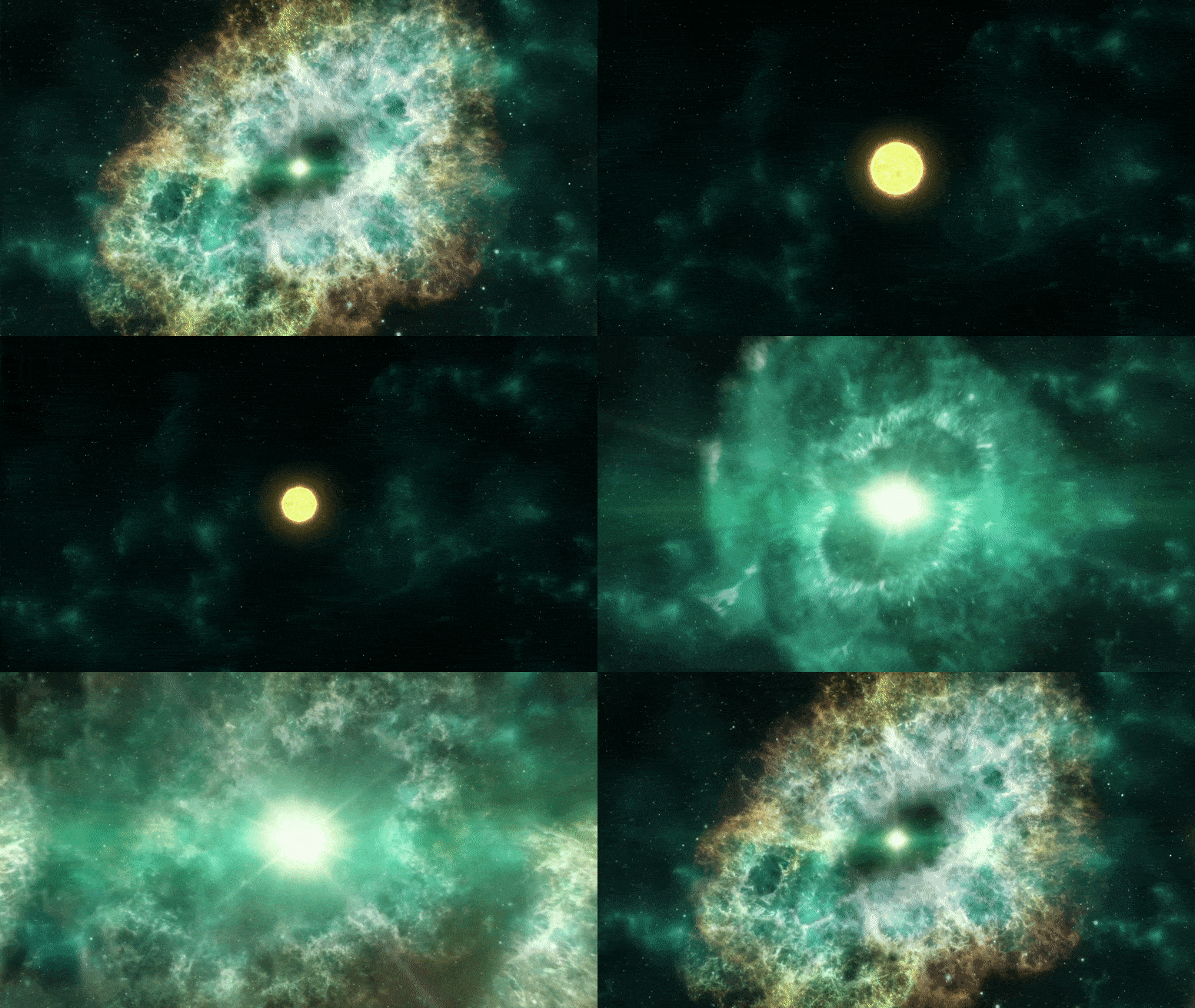
A third type of supernova, the electron capture variety, has been confirmed in SN 2018zd.
An international team of astronomers has observed the first example of a new type of supernova. The discovery, confirming a prediction made four decades ago, could lead to new insights into the life and death of stars. The work was published on June 28, 2021, in Nature Astronomy.
“One of the main questions in astronomy is to compare how stars evolve and how they die,” said Stefano Valenti, professor of physics and astronomy at the University of California, Davis, and a member of the team that discovered and described supernova 2018zd. “There are many links still missing, so this is very exciting.”
There are two known types of supernova. A core-collapse supernova occurs when a massive star, more than 10 times the mass of our sun, runs out of fuel and its core collapses into a black hole or neutron star. A thermonuclear supernova occurs when a white dwarf star — the remains of a star up to eight times the mass of the sun — explodes.
In 1980, Ken’ichi Nomoto of the University of Tokyo predicted a third type called an electron capture supernova.
What keeps most stars from collapsing under their own gravity is the energy produced in their central core. In an electron capture supernova, as the core runs out of fuel, gravity forces electrons in the core into their atomic nuclei, causing the star to collapse in on itself.

Evidence From Late Spectrum
Supernova 2018zd was detected in March 2018, about three hours after the explosion. Archival images from the Hubble Space Telescope and Spitzer Space Telescope showed a faint object that was likely the star before the explosion. The supernova is relatively close to Earth, at a distance of about 31 million light-years in galaxy NGC2146.
The team, led by Daichi Hiramatsu, a graduate student at UC Santa Barbara and Las Cumbres Observatory, collected data on the supernova over the next two years. Astronomers from UC Davis, including Valenti and graduate students Azalee Bostroem and Yize Dong, contributed a spectral analysis of the supernova two years after the explosion, one of the lines of evidence demonstrating that 2018zd was an electron capture supernova.
“We had a really exquisite, really complete dataset following its rise and fade,” Bostroem said. That included very late data collected with the 10-meter (33-foot) telescope at the W.M. Keck Observatory in Hawaii, Dong added.
Theory predicts that electron capture supernovae should show an unusual stellar chemical spectrum years later.
“The Keck spectra we observed clearly confirm that SN 2018zd is our best candidate to be an electron capture supernova,” Valenti said.
The late spectrum data were not the only piece of the puzzle. The team looked through all published data on supernovae, and found that while some had a few of the indicators predicted for electron capture supernovae, only SN 2018zd had all six: an apparent progenitor star of the Super-Asymptotic Giant Branch (SAGB) type; strong pre-supernova mass loss; an unusual stellar chemical spectrum; a weak explosion; little radioactivity; and a neutron-rich core.
“We started by asking ‘what’s this weirdo?’ Then we examined every aspect of SN 2018zd and realized that all of them can be explained in the electron-capture scenario,” Hiramatsu said.
Explaining the Crab Nebula
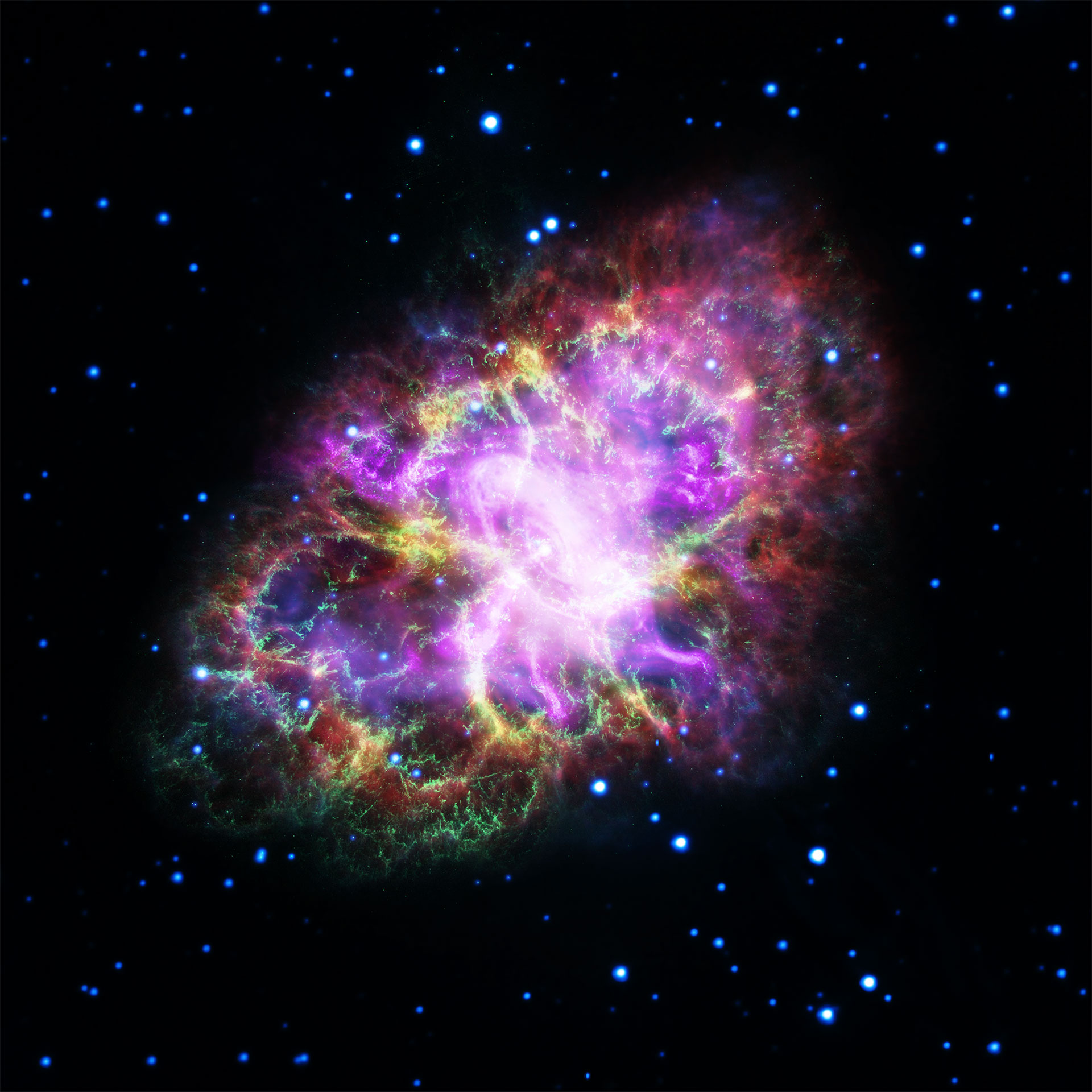
The new discoveries also illuminate some mysteries of the most famous supernova of the past. In A.D. 1054 a supernova occurred in the Milky Way. According to Chinese records, it was so bright that it could be seen in the daytime for 23 days, and at night for nearly two years. The resulting remnant — the Crab Nebula — has been studied in great detail. It was previously the best candidate for an electron capture supernova, but this was uncertain partly because the explosion happened nearly a thousand years ago. The new result increases the confidence that the event that formed the Crab Nebula was an electron capture supernova.
“I am very pleased that the electron capture supernova was finally discovered, which my colleagues and I predicted to exist and have a connection to the Crab Nebula 40 years ago. This is a wonderful case of the combination of observations and theory,” said Nomoto, who is also an author on the current paper.
Read Discovery of a New Type of Stellar Explosion – An Electron-Capture Supernova – Illuminates a Medieval Mystery for more on this research.
Reference: “The electron-capture origin of supernova 2018zd” by Daichi Hiramatsu, D. Andrew Howell, Schuyler D. Van Dyk, Jared A. Goldberg, Keiichi Maeda, Takashi J. Moriya, Nozomu Tominaga, Ken’ichi Nomoto, Griffin Hosseinzadeh, Iair Arcavi, Curtis McCully, Jamison Burke, K. Azalee Bostroem, Stefano Valenti, Yize Dong, Peter J. Brown, Jennifer E. Andrews, Christopher Bilinski, G. Grant Williams, Paul S. Smith, Nathan Smith, David J. Sand, Gagandeep S. Anand, Chengyuan Xu, Alexei V. Filippenko, Melina C. Bersten, Gastón Folatelli, Patrick L. Kelly, Toshihide Noguchi and Koichi Itagaki, 28 June 2021, Nature Astronomy.
DOI: 10.1038/s41550-021-01384-2
The research is part of the Global Supernova Project, led by Professor Andrew Howell at UCSB and Las Cumbres Observatory. Additional co-authors are: Curtis McCully and Jamison Burke, Las Cumbres Observatory and UCSB; Jared Goldberg and Chengyuan Xu, UCSB; Schuyler Van Dyk and Gagandeep Anand, California Institute of Technology; Keiichi Maeda, Kyoto University; Takashi Moriya, National Astronomical Observatory of Japan; Nozomu Tominaga, Konan University, Kobe, Japan; Griffin Hosseinzadeh, Center for Astrophysics, Harvard & Smithsonian; Iair Arcavi, Tel Aviv University, Israel; Peter Brown, Texas A&M University; Jennifer Andrews, Christopher Bilinski, G. Grant Williams, Paul Smith, Nathan Smith and David Sand, Steward Observatory, University of Arizona; Alexei Filippenko, UC Berkeley; Melina Bersten and Gastón Folatelli, Instituto de Astrofísica de La Plata and Universidad Nacional de La Plata, Argentina; Patrick Kelly, University of Minnesota; Toshi- hide Noguchi, Noguchi Astronomical Observatory and Koichi Itagaki, Itagaki Astronomical Observatory, Japan. The work was partly supported by grants from the National Science Foundation and NASA.
Never miss a breakthrough: Join the SciTechDaily newsletter.
Follow us on Google and Google News.
1 Comment
Very very interesting.
Some questions and thoughts for consideration?
1. Does theory capture a proton capture Supernova when the fuel runs out? What would theory predict that will look like?
2. What drives Neutron density and how would existing Theories of mass and energy be impacted if the birth and death of stars in the Galaxy🌌 and our 🌌 and the multiverse?
3. Can we use the data from the entire spectrum of light including ultraviolet to reach meaningful conclusions?