
Close Menu
    Facebook X (Twitter) Instagram
    SciTechDaily
    • Biology
    • Chemistry
    • Earth
    • Health
    • Physics
    • Science
    • Space
    • Technology
    Facebook X (Twitter) Pinterest YouTube RSS
    SciTechDaily
    Home»Physics»New Titania-Based Material Shows Promise as Superconductor Insulator
    Physics

    New Titania-Based Material Shows Promise as Superconductor Insulator

    By North Carolina State UniversitySeptember 4, 2014No Comments2 Mins Read
    Facebook Twitter Pinterest Telegram LinkedIn WhatsApp Email Reddit
    Share
    Facebook Twitter LinkedIn Pinterest Telegram Email Reddit
    Titania Based Material Shows Promise as New Superconductor Insulator
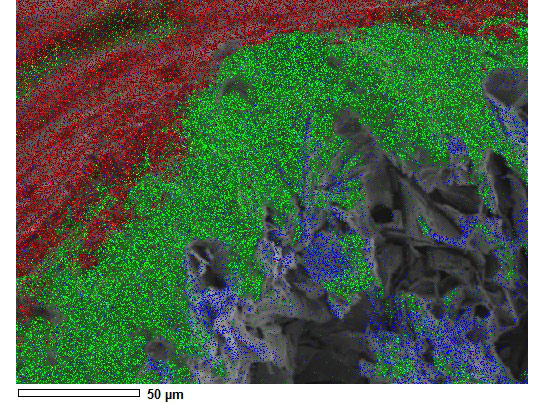
    Energy dispersive x-ray spectroscopy image was taken within a scanning electron microscope, illustrating a Bi2212 wire shown in blue and green, coated with the titania-based insulation shown in red. Credit: Sasha Ishmael

    In a newly published study, a team of researchers at North Carolina State University detail a new titania-based material that shows promise as an insulator for superconductors.

    Research from North Carolina State University shows that a type of modified titania, or titanium dioxide, holds promise as an electrical insulator for superconducting magnets, allowing heat to dissipate while preserving the electrical paths along which current flows. Superconducting magnets are being investigated for use in next-generation power-generating technologies and medical devices.

    Regular conductors conduct electricity, but a small fraction of that energy is lost during transmission. Superconductors can handle much higher currents per square centimeter and lose virtually no energy through transmission. However, superconductors only have these desirable properties at low temperatures.

    “Superconducting magnets need electrical insulators to ensure proper operation,” says Dr. Sasha Ishmael, a postdoctoral researcher at NC State and lead author of a paper describing the work. “Changing the current inside the superconductor is important for many applications, but this change generates heat internally. The magnets will operate much more safely if the electrical insulators are able to shed any excess heat. Otherwise, the higher temperatures could destroy the superconductor.

    “This titania-based material is up to 20 times better at conducting heat than comparable electrical insulators,” Ishmael says. “It has characteristics that are very promising for use as electrical insulators for superconducting technologies.”

    The precise chemical composition of the modified titania is proprietary information. The material’s development and characterization was a joint effort between NC State and nGimat LLC, based in Lexington, Kentucky.

    “We’re now looking at the effect of radiation on this material, to determine if it can be used for high energy physics applications, such as particle colliders,” says Dr. Justin Schwartz, senior author of the paper and Kobe Steel Distinguished Professor and head of the Department of Materials Science and Engineering at NC State.

    Reference: “Thermal conductivity and dielectric properties of a TiO2-based electrical insulator for use with high temperature superconductor-based magnets” by S A Ishmael, M Slomski, H Luo, M White, A Hunt, N Mandzy, J F Muth, R Nesbit, T Paskova, W Straka and J Schwartz, 19 August 2014, Superconductor Science and Technology.
    DOI: 10.1088/0953-2048/27/9/095018


    Never miss a breakthrough: Join the SciTechDaily newsletter.
    Follow us on Google and Google News.

    North Carolina State University Superconductor
    Share. Facebook Twitter Pinterest LinkedIn Email Reddit

    Related Articles

    New Mathematical Relationship for Superconductors

    Atomic Scale Imaging of Magnetic Structures

    Physicists Identify the Origin of Superconductivity in High-Temperature Superconductors

    New Magnetic Phase in Iron-Based Superconductors Discovered

    Physicists Look at the Conditions Necessary for Carbon-Based Life in the Universe

    New Insights Into How Superconducting Materials Interact With Magnetic Ones

    Experimental Evidence Shows Iron-Based Superconductors Exhibit S-Wave Symmetry

    Iron-Based Crystal Superconductor Breaks High-Temperature Record

    ‘Collapsing’ Iron Superconductor Capable of Operating at 47 Degrees Kelvin

    Leave A Reply Cancel Reply

    • Facebook
    • Twitter
    • Pinterest
    • YouTube

    Don't Miss a Discovery

    Subscribe for the Latest in Science & Tech!

    Trending News

    Monster Storms on Jupiter Unleash Lightning Beyond Anything on Earth

    Scientists Create “Liquid Gears” That Spin Without Touching

    The Simple Habit That Could Help Prevent Cancer

    Millions Take These IBS Drugs, But a New Study Finds Serious Risks

    Scientists Unlock Hidden Secrets of 2,300-Year-Old Mummies Using Cutting-Edge CT Scanner

    Bread Might Be Making You Gain Weight Even Without Eating More Calories

    Scientists Discover Massive Magma Reservoir Beneath Tuscany

    Europe’s Most Active Volcano Just Got Stranger – Here’s Why Scientists Are Rethinking It

    Follow SciTechDaily
    • Facebook
    • Twitter
    • YouTube
    • Pinterest
    • Newsletter
    • RSS
    SciTech News
    • Biology News
    • Chemistry News
    • Earth News
    • Health News
    • Physics News
    • Science News
    • Space News
    • Technology News
    Recent Posts
    • Scientists Discover a New Meteor Shower From a Mysterious Crumbling Asteroid
    • This Simple Fruit Wash Could Make Produce Safer and Last Days Longer
    • These Tiny Robots 50x Smaller Than a Hair Can Hunt and Move Bacteria
    • Simple Blood Test May Predict Alzheimer’s Years Before Brain Scans Show Signs
    • Scientists Say Adding This Unusual Seafood to Your Diet Could Reverse Signs of Aging
    Copyright © 1998 - 2026 SciTechDaily. All Rights Reserved.
    • Science News
    • About
    • Contact
    • Editorial Board
    • Privacy Policy
    • Terms of Use

    Type above and press Enter to search. Press Esc to cancel.