
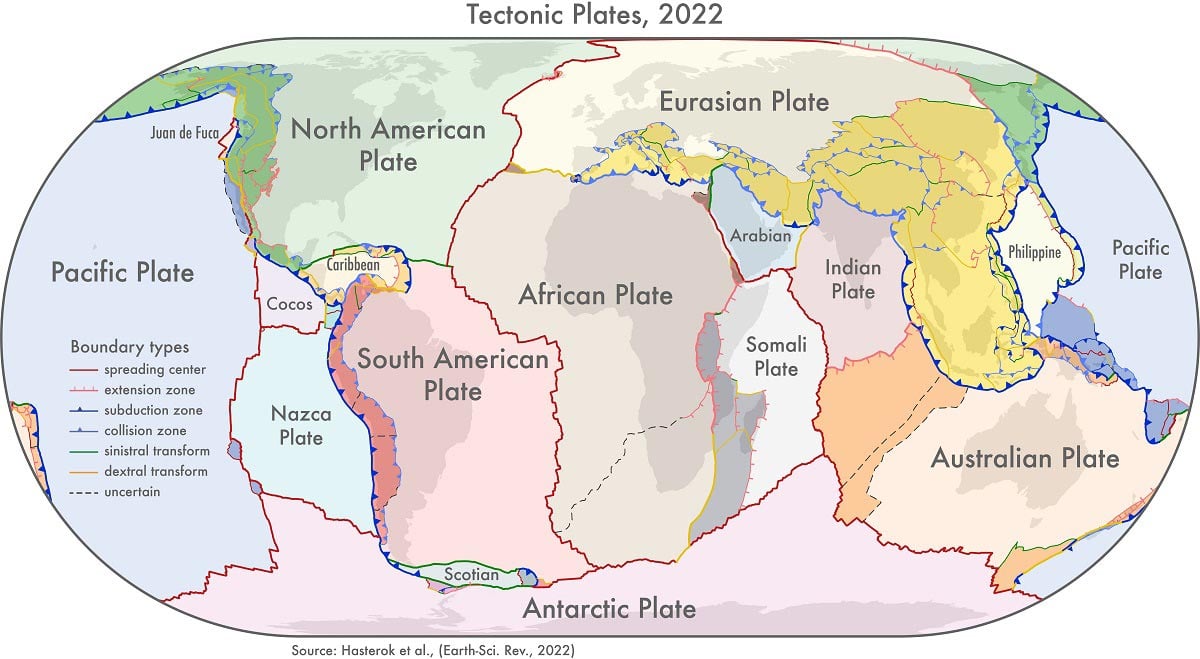
New models that show how the continents were assembled are providing fresh insights into the history of the Earth and will help provide a better understanding of natural hazards like earthquakes and volcanoes.
“We looked at the current knowledge of the configuration of plate boundary zones and the past construction of the continental crust,” said Dr. Derrick Hasterok, Lecturer, Department of Earth Sciences, University of Adelaide who led the team that produced the new models.
“The continents were assembled a few pieces at a time, a bit like a jigsaw, but each time the puzzle was finished it was cut up and reorganized to produce a new picture. Our study helps illuminate the various components so geologists can piece together the previous images.
“We found that plate boundary zones account for nearly 16 percent of the Earth’s crust and an even higher proportion, 27 percent, of continents.”
“Our new model for tectonic plates better explains the spatial distribution of 90 per cent of earthquakes and 80 per cent of volcanoes from the past two million years whereas existing models only capture 65 percent of earthquakes.”
Dr. Derrick Hasterok, Lecturer, Department of Earth Sciences, University of Adelaide
New models showing the Earth’s architecture. Credit: Dr. Derrick Hasterok, University of Adelaide
New Geological Models: Plate, Province, and Orogeny
The team produced three new geological models: a plate model, a province model, and an orogeny model.
“There are 26 orogenies – the process of mountain formation – that have left an imprint on the present-day architecture of the crust. Many of these, but not all, are related to the formation of supercontinents,” said Dr. Hasterok.
“Our work allows us to update maps of tectonic plates and the formation of continents that are found in classroom textbooks. These plate models which have been assembled from topographic models and global seismicity, have not been updated since 2003.”
The new plate model includes several new microplates including the Macquarie microplate which sits south of Tasmania and the Capricorn microplate which separates the Indian and Australian plates.
“To further enrich the model, we added more accurate information about the boundaries of deformation zones: previous models showed these as discrete areas rather than wide zones,” said Dr. Hasterok.
“The biggest changes to the plate model have been in western North America, which often has the boundary with the Pacific Plate drawn as the San Andreas and Queen Charlotte Faults. But the newly delineated boundary is much wider, approximately 1500 km, than the previously drawn narrow zone.
“The other large change is in central Asia. The new model now includes all the deformation zones north of India as the plate bulldozes its way into Eurasia.”
A tale told by the continents. Credit: Dr. Derrick Hasterok, University of Adelaide
Improved Representation of Earth’s Architecture and Applications
Published in the journal Earth-Science Reviews, the team’s work provides a more accurate representation of the Earth’s architecture and has other important applications.
“Our new model for tectonic plates better explains the spatial distribution of 90 percent of earthquakes and 80 percent of volcanoes from the past two million years whereas existing models only capture 65 percent of earthquakes,” said Dr. Hasterok.
“The plate model can be used to improve models of risks from geohazards; the orogeny model helps understand the geodynamic systems and better model Earth’s evolution and the province model can be used to improve prospecting for minerals.”
Reference: “New Maps of Global Geological Provinces and Tectonic Plates” by Derrick Hasterok, Jacqueline A. Halpin, Alan S. Collins, Martin Hand, Corné Kreemer, Matthew G. Gard and Stijn Glorie, 31 May 2022, Earth-Science Reviews.
DOI: 10.1016/j.earscirev.2022.104069
The work included researchers at the Universities of Adelaide, Tasmania, Nevada-Reno, and Geoscience Australia.
Never miss a breakthrough: Join the SciTechDaily newsletter.
Follow us on Google and Google News.