
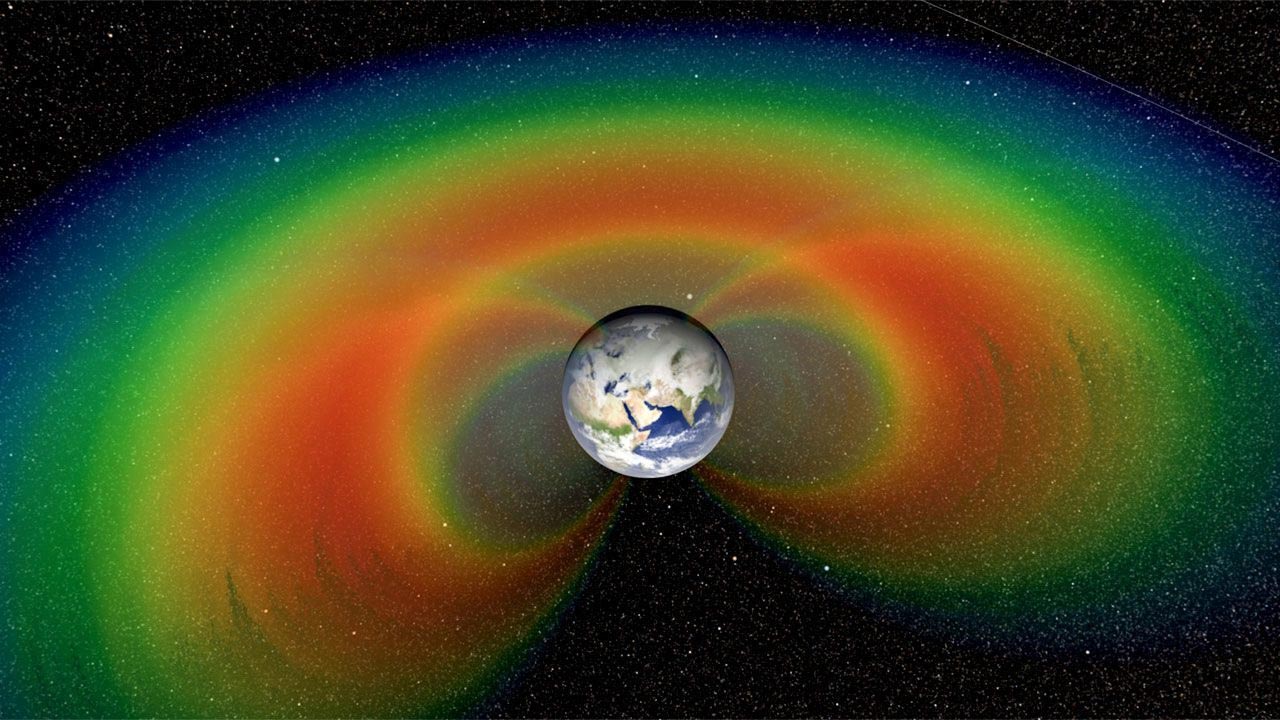
Tiny charged electrons and protons which can damage satellites and alter the ozone have revealed some of their mysteries to University of Otago scientists.
In a study, published in Geophysical Research Letters, the group looked at charged particles interacting with a type of radio wave called ‘EMIC’ — a wave generated in Earth’s radiation belts (invisible rings of charged particles orbiting the Earth).
Lead author Dr. Aaron Hendry, of the Department of Physics, says it is important to understand how these waves affect the belts — which are filled with expensive and important satellites – and Earth’s climate.
“Much like the Earth’s atmosphere, the Earth’s magnetosphere — the region around the Earth where our magnetic field is stronger than the Sun’s — sometimes experiences strong ‘storms’, or periods of high activity. These storms can cause significant changes to the number of particles in the radiation belts and can accelerate some of them to very high speeds, making them a danger to our satellites. Knowing how many of these particles there are, as well as how fast they’re moving, is very important to us, so that we can make sure our satellites keep working.”
“Activity within the radiation belts can sometimes cause the orbits of these particles to change. If these changes bring the particles low enough to reach the Earth’s upper atmosphere, they can hit the dense air, lose all of their energy and fall out of orbit.”
“EMIC waves are known to be able to cause these changes and drive the loss of particles from the radiation belts. As well as causing beautiful light displays that we call aurora, this rain of particles can also cause complex chemical changes to the upper atmosphere that can in turn cause small, but important, changes the amount of ozone present in the atmosphere.”
Subtle Climate Effects from Particle Interactions
“Although these changes are small, understanding them is very important to properly understanding how the chemistry of the atmosphere works, how it is changing over time, and the impact it is having on the climate,” Dr. Hendry says.
For their latest study, the researchers used data from GPS satellites to look at how many electrons EMIC waves can knock into the Earth’s atmosphere.
A general rule in the radiation belts is that at slower speeds, you have many more electrons. So, if the minimum speed of the EMIC wave interaction is lowered, there are a lot more electrons around to interact with waves.
By looking at data from satellites that monitor how many electrons there are in the radiation belts and how fast they’re going, the researchers have been able to show that you can see the number of electrons in the radiation belts go down significantly when EMIC waves are around.
Rethinking Radiation Belt Models
“Excitingly, we have also seen changes in the number of electrons at speeds significantly lower than the current ‘accepted’ minimum speed. This means that EMIC can affect much larger numbers of electrons than we previously thought possible. Clearly, we need to rethink how we’re modelling this interaction, and the impact it has on the radiation belts. There are a lot of electrons in the radiation belts, so being able to knock enough of them into the atmosphere to make a noticeable change is quite remarkable.
“This has shown that we need to take these EMIC waves into account when we’re thinking about how the radiation belts change over time, and how these changes in the radiation belt affect the climate on Earth.”
Dr. Hendry says the impact of EMIC-driven electrons on atmospheric chemistry is not currently being included by major climate models, which try to predict how the Earth’s climate will change over time, so making sure this process is understood and included in these models is very important.
“The changes are very small compared to things like the human impact on climate, but we need to understand the whole picture in order to properly understand how everything fits together.”
Reference: “Evidence of Sub-MeV EMIC-Driven Trapped Electron Flux Dropouts From GPS Observations” by A. T. Hendry, C. J. Rodger, M. A. Clilverd and S. K. Morley, 18 April 2021, Geophysical Research Letters.
DOI: 10.1029/2021GL092664
Never miss a breakthrough: Join the SciTechDaily newsletter.
Follow us on Google and Google News.
1 Comment
… if could use those particle to smash them and figure out…