
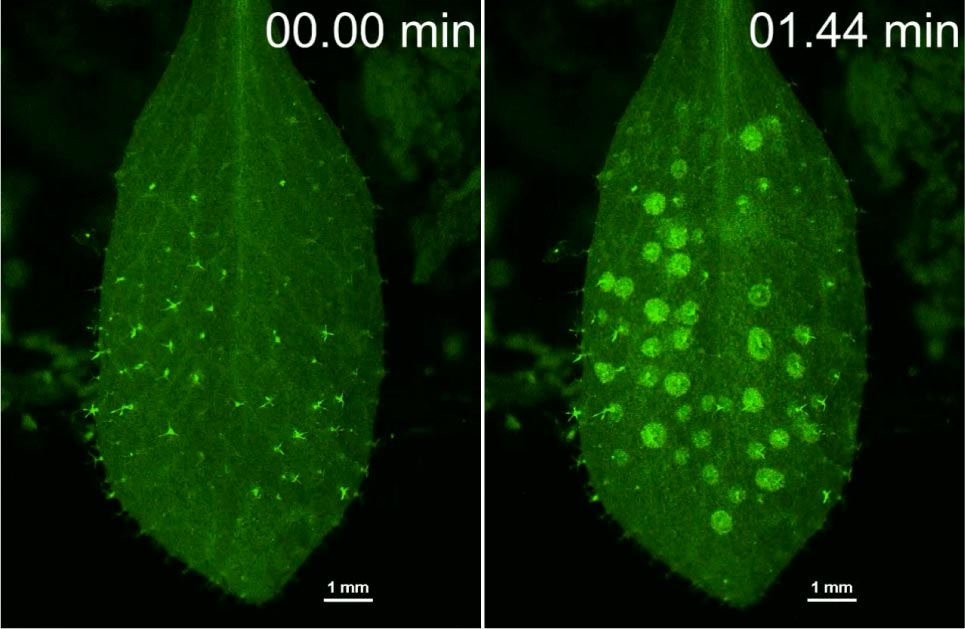
Trichomes on plant leaves sense rain as a pathogen risk, triggering immune responses via calcium waves, offering potential for enhancing crop disease resistance.
While rain is essential for the survival of plants, it also contains bacteria and other pathogens which can cause them harm. So how do plants protect themselves from this threat?
A recent study by Nagoya University researchers and colleagues revealed that when plants are exposed to rain, hair-like structures on the leaf surface called trichomes recognize this rain as a risk factor for causing disease and activate their immune system to prevent infections. These findings, published in the journal Nature Communications, could contribute to the development of methods to protect plants from infectious diseases caused by rain.
Plants have their own immune system, just like humans and other multicellular organisms. When plants detect pathogens, they express immune-related genes to prevent themselves from being infected. Raindrops contain pathogens, such as bacteria, filamentous fungi, and viruses, and thus can cause disease in plants. With this in mind, the researchers hypothesized that plants could recognize rain as a risk factor for disease and react to protect themselves from this risk in some way.
To find out how plants respond to rain, a research team led by Professor Yasuomi Tada and Assistant Professor Mika Nomoto of Nagoya University conducted a study using Arabidopsis thaliana seedlings. The team began by conducting RNA sequencing analyses to examine which genes are expressed in the leaves when they are exposed to rain. They found that several major immune-related genes are expressed in response to rain, and that these genes are regulated by immunosuppressive genes called CAMTAs (calmodulin-binding transcription activators).
Since CAMTAs are controlled by calcium ions (Ca2+), the team hypothesized that rain serves to increase Ca2+ concentrations in cells. Thus, they investigated how Ca2+ levels in Arabidopsis leaves change in response to rain by introducing GCaMP3 — a gene that fluoresces green when bound to Ca2+ — into the leaves. They found that when the leaves were exposed to rain, Ca2+ levels around trichomes on leaf surfaces increased.
Trichomes: Key Players in Plant Defense Mechanisms
The result suggested that trichomes sense rain as a risk factor and induce calcium waves (transmission of localized increases in Ca2+ to the surrounding areas) across the leaf to inactivate the immunosuppressor CAMTA and thereby activate immune-related genes. To confirm this, they next conducted experiments in the same way using mutants of Arabidopsis which lacked trichomes, and the results showed that the propagation of calcium waves was compromised in the mutants.
“From these results, we confirmed that trichomes play a role in sensing rain as a risk factor and activating immune responses,” says Professor Tada. “Our findings suggest that we may be able to artificially improve plants’ defensive capabilities against diseases at any time and for any length of time. Using this technology, we could make it possible to activate crops’ immune responses when environmental conditions are harsh enough to possibly cause disease in plants, which could result in stable crop yields.”
Reference: “Mechanosensory trichome cells evoke a mechanical stimuli–induced immune response in Arabidopsis thaliana” by Mamoru Matsumura, Mika Nomoto, Tomotaka Itaya, Yuri Aratani, Mizuki Iwamoto, Takakazu Matsuura, Yuki Hayashi, Tsuyoshi Mori, Michael J. Skelly, Yoshiharu Y. Yamamoto, Toshinori Kinoshita, Izumi C. Mori, Takamasa Suzuki, Shigeyuki Betsuyaku, Steven H. Spoel, Masatsugu Toyota and Yasuomi Tada, 8 March 2022, Nature Communications.
DOI: 10.1038/s41467-022-28813-8
Never miss a breakthrough: Join the SciTechDaily newsletter.
Follow us on Google and Google News.
1 Comment
Thanks for sharing this amazing and informative information. Thank You..
https://www.rebaid.org/