
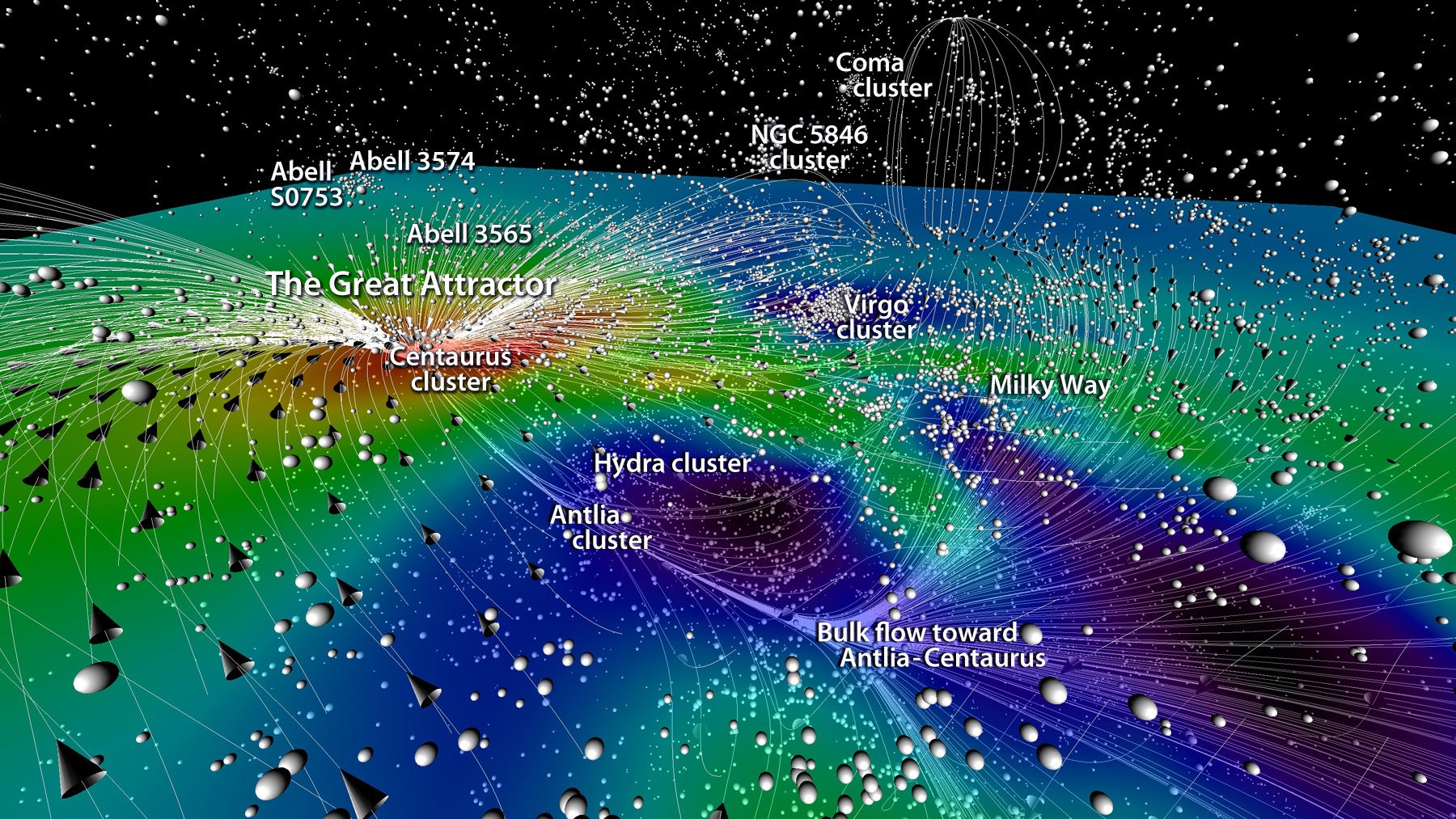
A new seventeen-minute video shows the motions of structures of the nearby universe in greater detail than ever before, revealing a dynamic three-dimensional representation of the universe through the use of rotation, panning, and zooming.
An international team of researchers, including University of Hawaiʻi at Mānoa astronomer Brent Tully, has mapped the motions of structures of the nearby universe in greater detail than ever before. The maps are presented as a video, which provides a dynamic three-dimensional representation of the universe through the use of rotation, panning, and zooming. The video was announced recently at the conference “Cosmic Flows: Observations and Simulations” in Marseille, France, that honored the career and 70th birthday of Tully.
The Cosmic Flows project has mapped visible and dark matter densities around the Milky Way galaxy up to a distance of 300 million light-years.
The team includes Helene Courtois, associate professor at the University of Lyon, France, and associate researcher at the Institute for Astronomy (IfA), University of Hawaiʻi (UH) at Mānoa, USA; Daniel Pomarede, Institute of Research on Fundamental Laws of the Universe, CEA/Saclay, France; Brent Tully, IfA, UH Mānoa; and Yehuda Hoffman, Racah Institute of Physics, University of Jerusalem, Israel.
The large-scale structure of the universe is a complex web of clusters, filaments, and voids. Large voids—relatively empty spaces—are bounded by filaments that form superclusters of galaxies, the largest structures in the universe. Our Milky Way galaxy lies in a supercluster of 100,000 galaxies.
Just as the movement of tectonic plates reveals the properties of Earth’s interior, the movements of the galaxies reveal information about the main constituents of the Universe: dark energy and dark matter. Dark matter is unseen matter whose presence can be deduced only by its effect on the motions of galaxies and stars because it does not give off or reflect light. Dark energy is the mysterious force that is causing the expansion of the universe to accelerate.
The video captures with precision not only the distribution of visible matter concentrated in galaxies, but also the invisible components, the voids and the dark matter. Dark matter constitutes 80 percent of the total matter of our universe and is the main cause of the motions of galaxies with respect to each other. This precision 3-D cartography of all matter (luminous and dark) is a substantial advance.
The correspondence between wells of dark matter and the positions of galaxies (luminous matter) is clearly established, providing a confirmation of the standard cosmological model. Through zooms and displacements of the viewing position, this video follows structures in three dimensions and helps the viewer grasp relations between features on different scales, while retaining a sense of orientation.
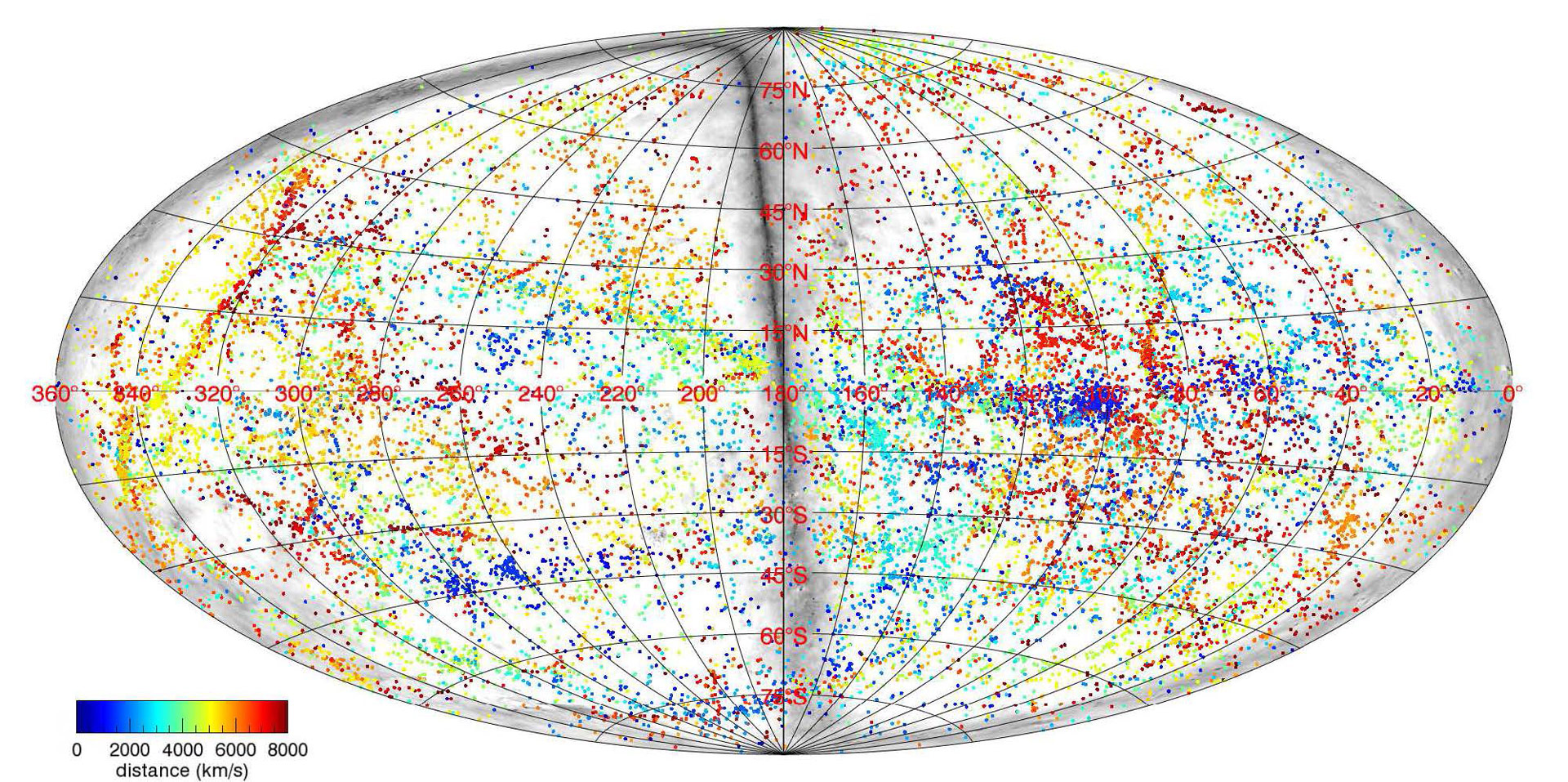
The scientific community now has a better representation of the moving distribution of galaxies around us and a valuable tool for future research.
The scientific article, “Cosmography of the Local Universe,” which explains the research behind the video, will be published in a forthcoming issue of The Astronomical Journal.
Founded in 1967, the Institute for Astronomy at the University of Hawaiʻi at Mānoa conducts research into galaxies, cosmology, stars, planets, and the sun. Its faculty and staff are also involved in astronomy education, deep space missions, and in the development and management of the observatories on Haleakala and Mauna Kea. The Institute operates facilities on the islands of Oʻahu, Maui, and Hawaiʻi.
Reference: “Cosmography of the Local Universe” by Hélène M. Courtois, Daniel Pomarède, R. Brent Tully, Yehuda Hoffman and Denis Courtois, 14 August 2013, The Astronomical Journal.
DOI: 10.1088/0004-6256/146/3/69
arXiv:1306.0091
Never miss a breakthrough: Join the SciTechDaily newsletter.
Follow us on Google and Google News.
10 Comments
This is clearly a marvelous and utterly captivating video representation. Alas, I don’t don’t believe I got more than 80% — probably less — of the narration, and that was enormously frustrating. Is is possible to have a version of this visual document spoken in standard English — either British or Australian or American? Because one misses so many words the effect is quite ruined; I found myself spending far too much the time trying to make sense of the ideas with incomprehensible words embedded in it. If creating a standard English version is impossible, could a narrative text be placed on line? It would be a poor second choice, but I would be glad to oversee the recording of the text with a professional narrator and sync it to the video.
For now, this is the only version we have. The press release does have it in french as well. http://www.ifa.hawaii.edu/info/press-releases/flows/
In a still room fill your mouth with smoke then open your mouth and without exhaling let the smoke escape. The thick cloud separates and forms patterns with flow zones and “avoidance” zones almost exactly like in the video. Is this a common pattern that is to be found regardless of the size of the “cloud”?
Nice video,but I can’t understand what the women is saying,it would have been better to have a Brit or American in the Video.
I can’t understand what she is saying either. I wish they would have gotten someone who speaks better English, no insult to her because I am sure she is very intelligent to understand this stuff.
Excellent job guys. I noted the official Planck results had the ‘confidence’ level for bulk flow ‘surpressed’ to emaciate it, though I gather the more consistent interpretation is being published independently. I assume this is then not exactly equivalent to the official Planck figures, but is with all else? The shortcomings in the Concordance model shown up by Planck seem rather greater than realised and thrown into sharp focus by this excellent work.
For anyone panicking about us being sucked into Centaurus, I should say I have a conceptual model showing that this is not necessarily the case. If we imaging our observation point as some way up an oversize quasar AGN outflow, the helical anisotropy would be explained, and Centaurus would simply be the ‘head’ of the jet. In that case the flow velocity should be slightly reducing towards Centaurus.
Is the data accurate enough to give a velocity gradient along the axis? (I’ve not yet finished reading the paper).
I find this totally amazing, I think the basic idea is that all of the galaxies in the universe are heading towards the Great Attraction which is like a comic plug hole, is this a gigantic black hole, and what happens when galaxies enter the Great Attraction.
This proves that the Local Universe doesn’t contain everything in the Universe. It is only a miniscule fraction of the Total Universe. The Great Attractor is over 45 billion light years away away and beyond our line of sight. However in the far distant future, the Milky Way or its successor will come into view of the Great Attractor. Humanity will by that time be long gone. If inflation is still working then we’ll never have any information because the Great Attractor will be forever out of our sight.
Excellent Video. Only the presentation should be done by a native English Speaker.
I had absolutely no trouble at all understanding the narrator. Her english was perfectly fine. I’m not sure what the problem is.